

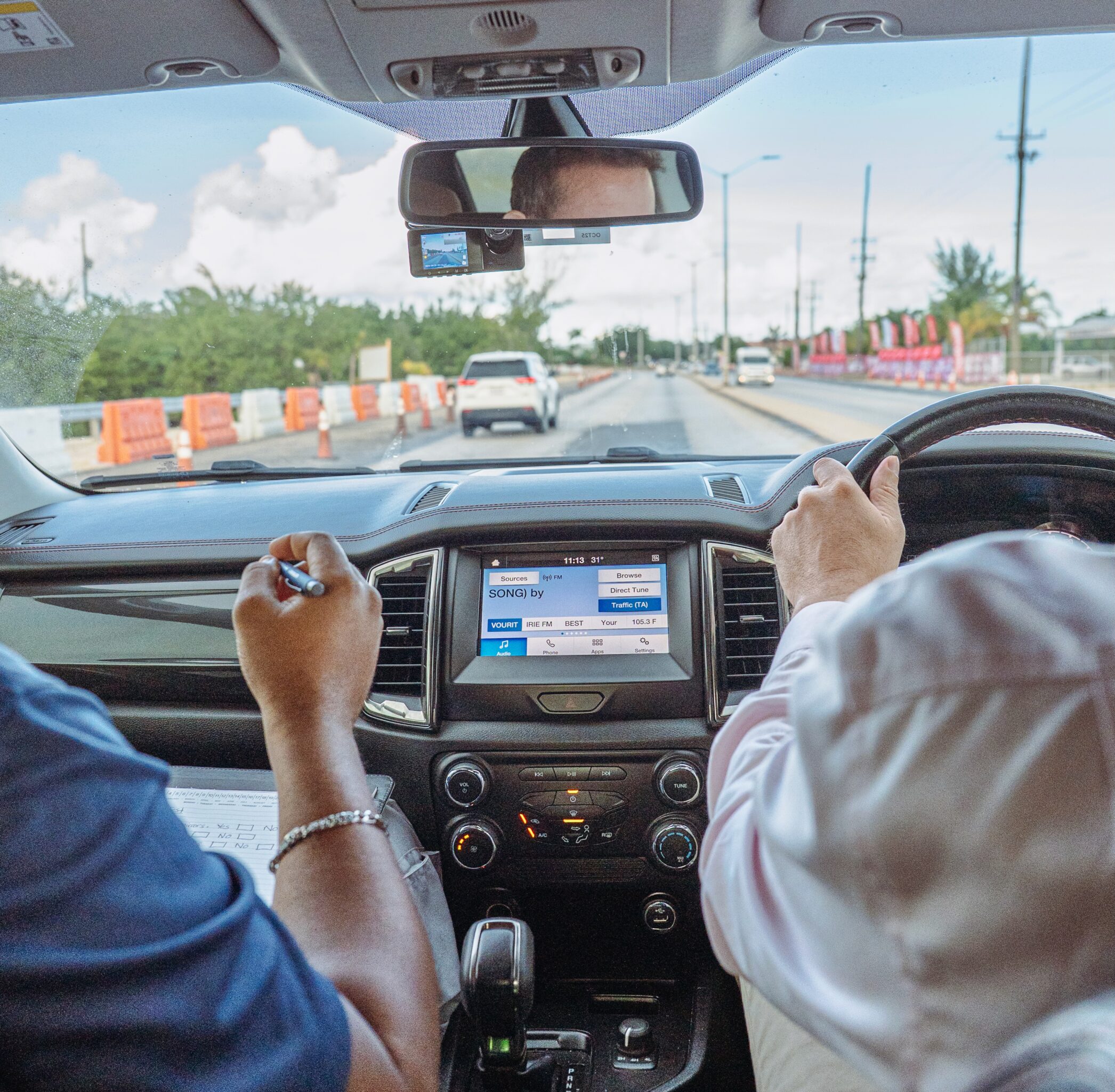
“Which one is the brake and which is the gas?”
It’s a question driving instructor Luke McCoy says he hears surprisingly often – not from teenagers on their first day behind the wheel, but from new residents arriving in Cayman with full foreign driver’s licences and seeking a “familiarisation” lesson before taking to the roads.
What concerns him more are the people who don’t seek a lesson at all.
He and other driving instructors highlight a concern over people arriving on the islands with weak, fake or bought licences that can be swapped for a Cayman licence with limited scrutiny.
Cayman’s population includes residents from more than 130 nationalities. Many come from road systems with different rules and different layouts. Some have never seen a roundabout or a four-way stop.
Under current law, new residents must pass a written theory test, but there is no requirement for a practical driving assessment before they can exchange a foreign licence for a Cayman one.
The policy is based on a longstanding interpretation of the 1949 Geneva Convention on Road Traffic, under which licence-holding visitors must be recognised for the purpose of driving. But many countries, including those also party to the treaty, still require practical testing when a foreign driver becomes a resident.
McCoy, who is a former police officer and the owner of Cayman Driver’s Ed, believes Cayman should do the same.
“I have had people admit to me that they bought their licence before they came here,” he said.
Former police officer, crash investigator and driving-school operator Burmon Scott says he has seen the same issue repeatedly for decades.
During his time with the RCIPS, he said an investigator had been sent to the Philippines to investigate the sale of driver’s licences to people who later used them to swap for Cayman licences. He noted similar cases involving Jamaican, Cuban and Colombian licences.
As an instructor he claims, “We see people all the time with licences they can’t possibly have earned.”
Both Scott and McCoy argue that Cayman should introduce a short practical test or minimum lesson requirement before foreign licences can be exchanged for local ones.
Scott says the theory test alone is insufficient.
“A practical test would be better … you could come back and say, ‘No sir, no ma’am, you cannot drive. You nearly killed me just going down the road.’”
“If we could get something where those people could be tested instead of just exchanging their licence, that would cut down on many accidents.”
Government recently approved increased licence-renewal fees for expatriates, but has not announced any plan to direct additional revenue toward strengthening testing, adding practical assessments or making it harder to get a licence in the first place.
‘Too easy to pass’
Scott believes Cayman’s own licensing standards have deteriorated over time.
He says road tests are often less than 30 minutes, cover only a small loop, and are administered by examiners with minimal formal training. In earlier years, he notes, examiners were trained by certified overseas instructors.
He wants Cayman to build a dedicated testing compound where reversing, manoeuvres and hazard responses can be examined in a controlled environment
“Right now,” he said, “it is too easy to pass.”
Both instructors believe driving standards in Cayman have slipped more broadly.
McCoy said, “I see people driving with one phone in each hand – and trying to eat at the same time.”
He supports the new demerit-points system, which will allow persistent offenders to lose their licences, but argues that it must be backed up with more consistent enforcement.
“A licence is a privilege, not a right.”
Graduated licences for teenage drivers
McCoy says he has been involved in discussions about introducing enhanced drivers-education in high schools, as well as a new system that would allow teens to obtain a learner’s permit at 16, complete 20 hours of approved lessons, and take a practical test at 17.
A broader version of such a system, known as a Graduated Driver’s Licence (GDL), was already passed into law nearly two decades ago.
The 2005 amendment to the Traffic Law would have introduced staged driving privileges, nighttime-driving limits, passenger restrictions and mandatory supervised training.
The bill passed but never came into force.
One of its key advocates was Patricia Ebanks, a former senior civil servant whose son, Matthew, died in a crash at age 17 in 2001. Through the community group MattSafe, she worked to promote safer youth driving and build support for a GDL system.
“The concept was sound, but the conditions needed to support implementation were still taking shape,” Ebanks said.
At that time, she said Cayman lacked the youth-training capacity to make it happen.
“It wasn’t that Cayman lacked capability, or that the idea was flawed,” she said.
Although other reforms did occur during that period, Ebanks remains disappointed that GDL was never implemented.
Evidence from multiple international studies now shows that comprehensive GDL systems can reduce serious crashes among young drivers, especially when paired with restrictions on nighttime driving and teenage passengers. The strategy is also endorsed by the World Health Organisation.
“The principles behind MattSafe – youth engagement, structured training, community involvement – are still relevant. And Cayman now has the institutional capacity to support them,” she said.
“A strengthened graduated licensing programme could be a high-impact part of Cayman’s road-safety strategy today.”
‘The bill passed, but never became law’
McKeeva Bush, who was premier when the amendment passed, confirmed that the legislation was approved by the Legislative Assembly, but did not take effect because it was not promulgated.
“It didn’t get made into law … the Governor didn’t promulgate it,” Bush said.
He acknowledged there had been “some opposition”, but said he did not recall the specific reason it stalled.
He said he still supports the underlying principle and believes it could be revived today.
Scott agreed that the GDL legislation was a ‘beautiful concept”. He said a lack of sufficient driving instructors had been one of the reasons for it not being implemented.
In some respects, Ebanks movement may have been successful even without the law being implemented. McCoy says many parents today insist on comprehensive training for their children, even though it is not mandatory.
And while the statistics, in his view, no longer point to young drivers as the principle issue on Cayman’s roads, he believes that a longer apprenticeship behind the wheel for new drivers would help embed better standards across the community.
He said he believes a modern, simplified version of graduated licensing, starting with schools, is now being developed by government.
Related Videos








Man who sells driving lessons suggests everyone should be forced to get driving lessons.
Next up, man who sells orange juice says everyone should be forced to buy orange juice.
Seriously. I did my driving test here. It is all a joke. Right down to the driving ‘schools’ who teach you only how to drive round the ‘loop’ that the examiners take you down. I did as few lessons as possible as the instructor had some backdoor to the exams meaning i didnt have to wait 5 months to do the test. No other reason to use them.
The leading cause of death among teenagers in the USA is traffic accidents.
There are certain countries where test standards are lower or licenses can be bought. NOT European countries, UK or the USA.
I haven’t taken a UK test for many years. But I can remember one had to parallel park and reverse around a corner and end up with the front and back wheels close to the kerb.
If you couldn’t then you were failed.
I don’t understand the turn signals going around a traffic circle when you never leave the lane you are in. Seems to me it causes more confusion than help
What about the driving instructors who teach people to indicate right when approaching a roundabout in the left-hand lane and going straight on?
We have a highway code in Cayman called the Road Code. It seems for the most part, this has only partial compliance. At the beginning it says, “f you fail to comply with code rules, you are in breach of sections 67 and 68 of the Traffic Law, 2011 (“the Law”). In so doing, you will be committing an offence under sections 93(1)(q) and 98(b) of the Law.” So if we’re ever going to have uniformity of driving standards in Cayman, shouldn’t someone be taking steps to enforce the code? That may be through driving tests but it could also be through remediation courses for those who are caught by the police (or those who lose their licences).