

Fresh comments from key Caymanian and UK political figures this week laid bare the ongoing struggle over access to Cayman’s beneficial ownership register.
On 13 Jan. the UK Minister of State for the Overseas Territories, Stephen Doughty, told Parliament the UK will “continue to pursue” Cayman’s transition to a fully public register.
Reporting on the 13th UK overseas territories joint ministerial council, which was held in London in late November and included a delegation from Cayman, Doughty said: “The UK reiterated its ultimate expectation of fully public registers of beneficial ownership in the overseas territories and we will continue to pursue that objective in future discussions.”
Doughty’s statement has caused consternation in Cayman, where access to the beneficial ownership register is restricted to ‘legitimate interests’. On 15 Jan., Leader of the Opposition Joey Hew, wrote a public letter to Cayman’s Premier, André Ebanks, that cited the potential impact a fully public beneficial ownership register could have on the “financial services industry, which remains a critical pillar of the national economy”.
“Given the potential implications for Cayman’s legislative framework, international obligations, and financial services sector, I would be grateful for clarification on the government’s current engagement,” said Hew in the letter.
Governor Owen calls for patience
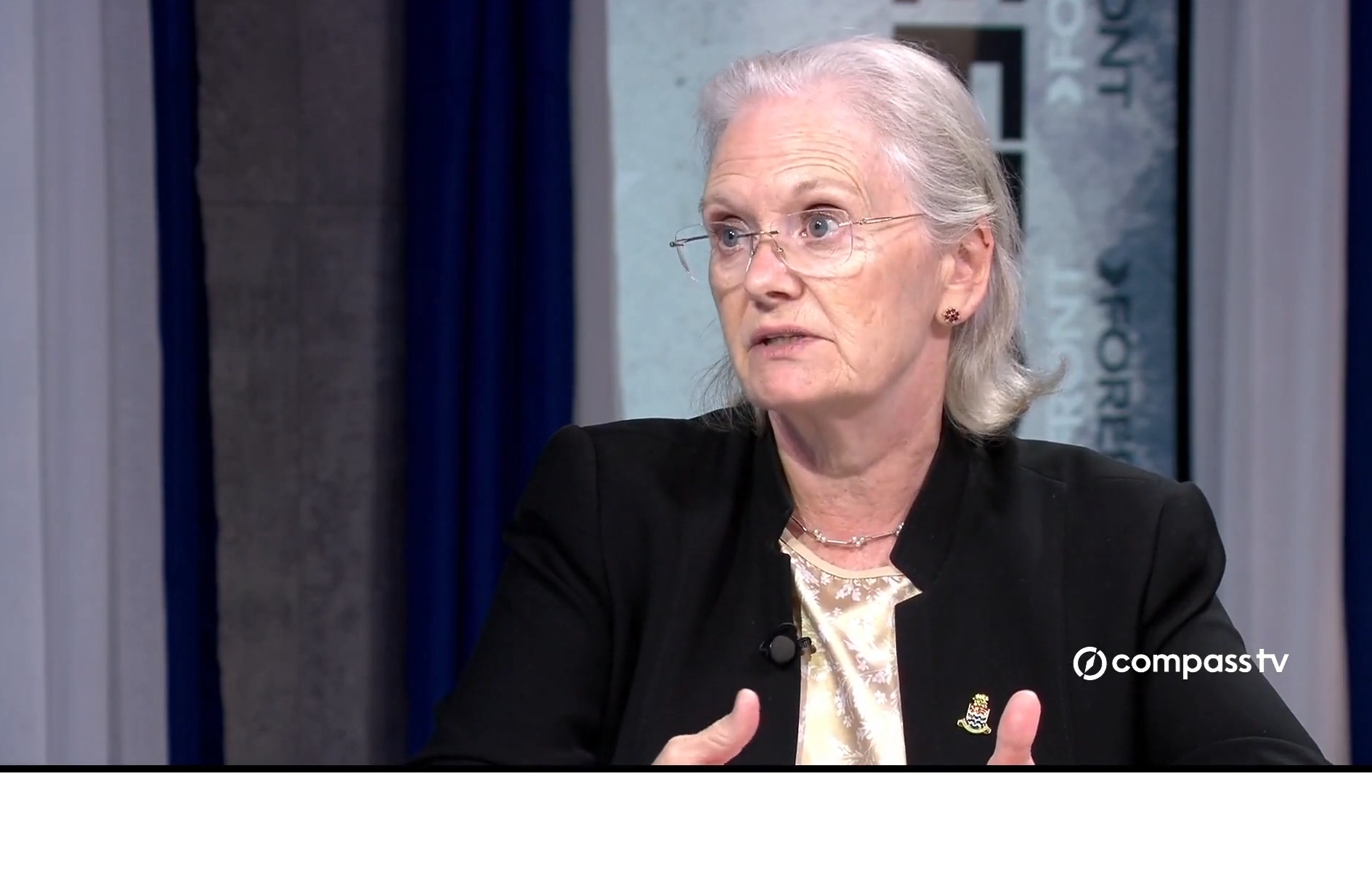
Speaking on Compass TV’s Forefront show on 15 Jan., Governor Jane Owen recognised the UK’s long-standing aim for Cayman to switch to a fully-open register.
“I think the UK has been very clear that in the long-term – because the UK has full public access in Britain – they would like all of our overseas territories to move to that,” said Owen. The governor also noted that this isn’t a new demand from the UK but part of an “ongoing” conversation.
In February 2025, Cayman opened access to its beneficial ownership register for ‘legitimate interests’. These interests are journalists, non-governmental organisations, potential business counterparties and those investigating financial crime.
In her Forefront appearance, the governor also struck a positive tone and requested patience as recent changes to Cayman’s register are evaluated.
“The content of the conversation is quite positive at the moment with Cayman,” said the governor. “We [Cayman] have introduced a comprehensive register based on legitimate interest access and we are constantly in dialogue with the UK about what fee people have to pay for this. If you are a journalist or a non-governmental organisation the idea is that very shortly in the future you can pay a fixed fee – a bit like a season ticket for football – and then make as many enquiries as you would like. That is quite a considerable move forward.”
Would an open register harm Cayman?
The concept of a fully open register of beneficial ownership – which means being able to see the true owner or beneficiaries of businesses – originated in the EU as part of an anti-money laundering drive. Yet in 2022 the Court of Justice of the European Union ruled that Luxembourg’s fully open register interfered with the fundamental rights to privacy, which led EU states to abandon the fully open concept.
Those same rights to privacy are also enshrined in Cayman’s constitution, which could provide a legal stumbling block to implementing a fully open register on the islands.
Yet the UK has persevered and is determined that the British Overseas Territories also adopt the system. Some territories, for example Gibraltar, have followed the UK, but the majority of financial centres around the world still restrict access. As a result, some finance figures fear that if Cayman adopts this it will merely mean business goes elsewhere.

“Cayman has a strong base of institutional clients, who probably wouldn’t be bothered by a fully open register,” explains Lucy Frew, a partner at financial services firm Walkers. “Yet there would be some family offices and sovereign wealth funds that would consider leaving Cayman if this was implemented.
“It’s not about financial crime, because at present financial crime investigators can still access all of this information, as can others with legitimate interest in combatting financial crime,” said Frew.
“But some people will have genuine security fears. The kidnapping threat might be hard to understand from London but if you’re a high-net worth individual from Latin America you might have terrifyingly real reasons for not wanting everyone to see all of your assets. Commercial sensitivity is another valid reason for privacy. Some institutions won’t want their competitors to be able to see where they are investing”, Frew added.
Steve McIntosh, CEO of Cayman Finance, agrees. “It is most unclear who would stand to benefit from allowing access to those without a ‘legitimate interest’; one can easily imagine the problems it would create in an age in which nefarious AI agents could scrape beneficial ownership data as the first step in a malicious and fully automated scheme targeting registered companies or individuals.”
Political push
In December 2024, Cayman’s then premier, Juliana O’Connor-Connolly, said the UK had promised not to seek to bring an ‘Order in Council’ to force Cayman to adopt fully public registers. Yet in the UK politicians continue to push for Cayman to open up.
The Compass reached out to UK-based MPs to get their perspective. “The Cayman Islands’ current system is not sustainable,” said Phil Brickell, the Labour MP for Bolton West, who described restricted access as a “stepping stone”.
“The bar has been set miles too high for the disclosure of information to journalists and investigators. I’m very much hoping that we see some substantial steps to rectify this in 2026,” said Brickell in a 15 Jan. email.
Worryingly for Cayman, there is bipartisan support for an open register. “The absolute requirement of the United Kingdom Parliament is that the Cayman Islands adopt open registers of beneficial ownership – in full; no ifs and buts,” said Andrew Mitchell, the Conservative MP for Sutton Coldfield in a 9 Jan. email. “We are not sure every senior politician and public servant has understood this yet, but I hope 2026 will see agreement and enactment.”
Westminster’s keen interest in Cayman’s register may be due to domestic factors. “It’s probably politically driven,” said Frew. “It’s quite a good argument to make that you are doing something about ‘fat cats’, while not really solving problems at home.”
Related Videos












The UK’s register of companies, Companies House, is littered with fraudulent businesses set up at random addresses without the home owners permission due to a lack of proper “know your customer” checks by Government. If the UK is worried about ownership, money laundering and fraud, perhaps fix this first?
Other financial centres do not allow disclosure of ownership information.
Nor do most other countries, including the USA. It’s even illegal in the EU.
These left-wing British MPs seem determined to destroy Cayman’s Financial Industry.
The position of the Starmer government is the open register should be adopted as there is a rebuttable presumption of activity which is contrary public interest.
Not one shred of evidence has been tabled in the House to support that position.
Across Europe, countries switched off public access to beneficial ownership registers, in response to a ruling from the continent’s top court, the European Court of Justice.
In Nov. 22, the ECJ ruled that a provision of the EU’s anti-money laundering directive, which requires EU member states to maintain such registers was invalid.
The court concluded that, on balance, these public registers were inconsistent with the right to privacy and were “interfering with the fundamental rights to respect for private life and to the protection of personal data” enshrined in the Charter of Fundamental Rights of the European Union.
There are important practical reasons not to promote unlimited systems of transparency.
Disclosing data of businesses and other legal entities creates risk, which is partly why it is strictly regulated. For instance, Canada’s privacy law framework is one of the most stringent in the world. The same risks that apply to personal data often also apply to business data.
The more information available in the public domain, the higher the risk that interested parties can produce a complete profile using information available from multiple sources. With this composite profile, bad actors perpetrate identity fraud and phishing attacks.
Open registries have the net effect of driving the tiny minority of miscreants deeper underground as quickly became clear with the inadvertent release of the Panama Papers.
Included in the closed registry system determined by the EJC is Ireland. Exactly why the British Government would what to promote Ireland’s business interests ahead of its own protectorate’s is not immediately clear.