Discovery Day is celebrated in the Cayman Islands each May, but behind the long weekend lies a remarkable moment in Caribbean history: A fleeting sighting in 1503 by a weathered Genoese navigator and his 13-year-old son that placed the Cayman Islands into the written history of the world.
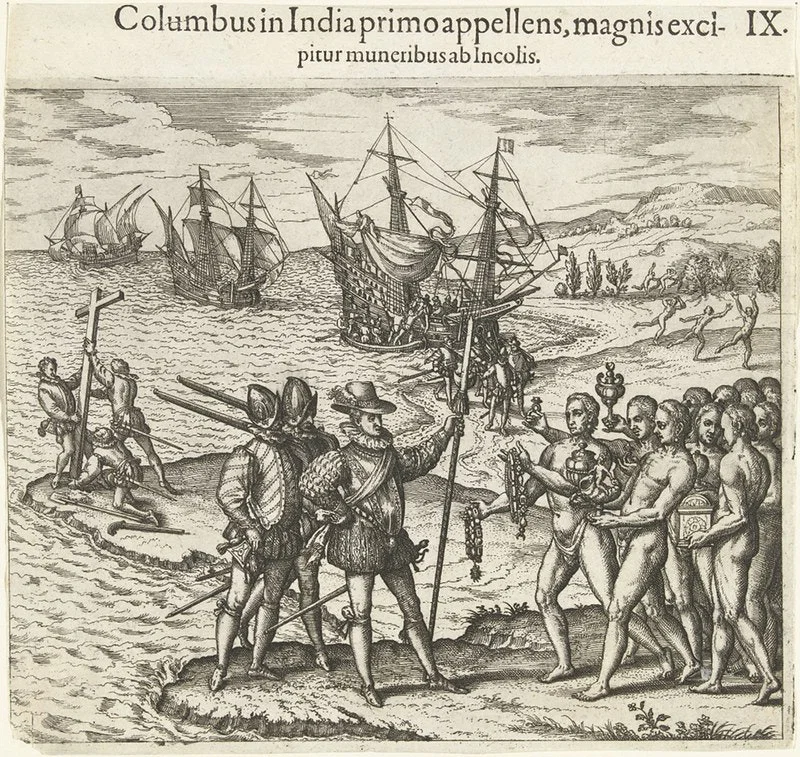
This year, Discovery Day falls on Monday, 18 May. The actual sighting traditionally associated with the Cayman Islands took place on 10 May 1503, during Christopher Columbus’ fourth and final voyage to the New World.
Yet it was not Columbus himself who left the most enduring account. Much of what survives from that journey comes through the writings of his son, Ferdinand Columbus, also known as Hernando Colón, a brilliant and often overlooked figure who would later attempt to build what some historians describe as the closest thing the 16th century had to an internet: a universal library containing every book in the world.
On 10 May 1503, Columbus’ small fleet drifted northwest of Jamaica after storms and shipworm damage had crippled the expedition. Ferdinand, just 13 years old at the time, recorded the sighting of “two very small and low islands, full of tortoises (turtles), as was all the sea all about”. Those islands are believed to have been Cayman Brac and Little Cayman.
Columbus named them “Las Tortugas” because of the immense numbers of sea turtles in the surrounding waters. Grand Cayman may not yet have been clearly seen from the ships.
The moment itself was brief. Columbus never landed in Cayman, never established a settlement and never formally claimed the islands. But Ferdinand’s written account marked the beginning of Cayman’s recorded history.
The life of Ferdinand Columbus
Ferdinand Columbus remains one of the most fascinating figures connected to the age of exploration. Born in 1488 to Christopher Columbus and Beatriz Enríquez de Arana, he was the explorer’s illegitimate son, something that carried social stigma in Spain’s rigid hierarchy. Unlike his older half-brother Diego, who inherited titles and political authority tied to the Indies, Ferdinand largely had to make his own name through scholarship and intellect.
He travelled with his father on the fourth voyage as a teenager and later became his father’s biographer, writing “The Life of the Admiral”, one of the principal surviving accounts of Columbus’ voyages. Historians note that much of what the modern world knows about Columbus comes through Ferdinand’s writings.
After the voyages, Ferdinand devoted himself to an extraordinary ambition: creating a universal library. During the dawn of Europe’s printing revolution, he employed readers across the continent to purchase books, catalogue them and produce summaries known as the “Books of Epitomes”. His collection eventually grew to thousands of volumes and survives today in part through archives connected to the Cathedral of Seville and later European collections.
The wider world Ferdinand encountered in the Caribbean stunned Europeans. Indigenous peoples cultivated cassava, tobacco, sweet potatoes, papaya and sea island cotton. Ferdinand described enormous dugout canoes capable of carrying dozens of people across open water between Cuba, Jamaica and Central America. The Caribbean Sea was already a sophisticated maritime world long before Europeans arrived.
Islands covered in turtles
There also remains debate among historians over whether Columbus was truly the first European to see Cayman. Some researchers point to the famous Cantino map of 1502, which appears to show islands in the western Caribbean before the documented sighting of 1503. Others suggest that undocumented voyages may have crossed the region before Columbus’ final expedition.
Still, Discovery Day in Cayman remains tied to that moment in May 1503, when a tired fleet, limping through the western Caribbean Sea, passed islands teeming with turtles. And watching from the deck was a 13-year-old boy who would go on to document not only his father’s journeys, but also the beginning of Cayman’s written story.
Related Videos