

A report from Boston Consulting Group predicts the Cayman Islands will benefit from a boom in global financial wealth.
According to the BCG’s Global Wealth Report 2026 – The Great Reordering – global financial wealth is at a record high. The report found it reached US$333 trillion in 2025, up from US$301 trillion in 2024.
Most of that wealth is held by owners within their own countries. However, some is held abroad in international financial centres such as Cayman. That type of cross-border wealth rose 8.4% to US$15.7 trillion in 2025.
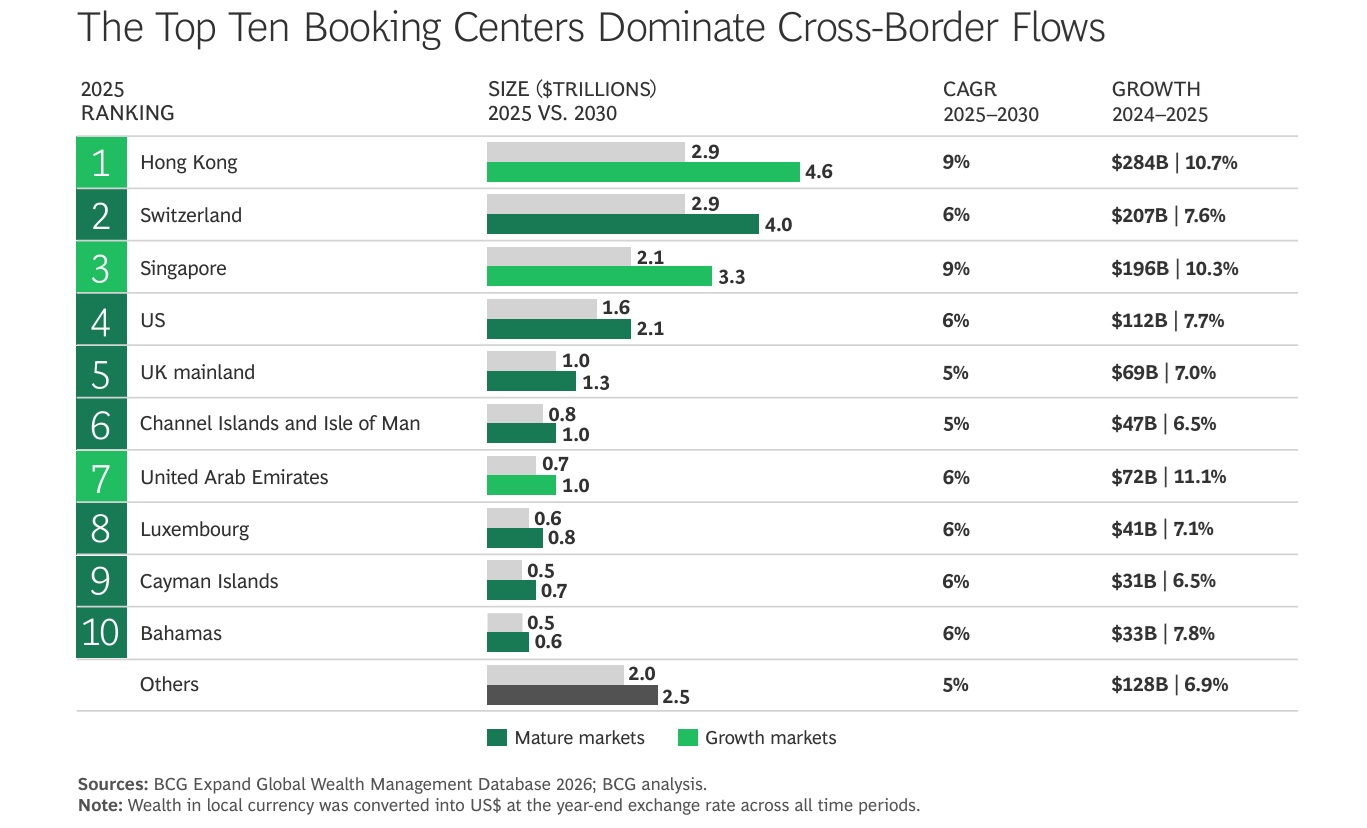
The report, which was published on 27 May, ranked Cayman as the ninth-most important ‘booking centre’ in the world. It estimates that the jurisdiction will hold US$700 billion of cross-border private wealth in 2030, up from around $500 billion.
That growth would take Cayman ahead of the Bahamas, which BCG estimates currently also has around US$500 billion of international wealth assets but will only grow to US$600 billion by 2030. Cayman is the top-performing Caribbean financial centre for attracting cross-border private wealth. But the top of the table is dominated by Asia and Europe, with Hong Kong, Switzerland and Singapore occupying places one, two and three respectively.
Hong Kong’s top ranking is big news in wealth management circles as it’s the first time that Switzerland was not the largest booking centre in the 26 years the report has been published.
The report notes that one reason for the shift is the massive wealth creation in Asia. “Asia-Pacific remained a key engine of growth, supported by its central role in the AI supply chain, from semiconductor exports in South Korea to accelerating data center investment across Southeast Asia, and strong equity market performance in Hong Kong and Japan,” read the report.
That trend helps explain why Premier and Minister for Financial Services and Commerce André Ebanks led a finance delegation to Hong Kong, mainland China and Japan in mid-May.
Geopolitics and diversification
Another key trend to emerge from the report is the impact of geopolitics. “Geopolitical fragmentation is reinforcing the emergence of two hub networks, one anchored by Hong Kong and Singapore that serves mainland Chinese, Indian, and Southeast Asian capital, and one anchored by Switzerland, the US, and the UK, serving European, Middle Eastern, and Latin American wealth.”
It remains to be seen how geopolitics will impact the United Arab Emirates’ status as a global wealth hub. The report ranks the UAE as the world’s seventh-largest booking centre in the ranking, with its holding of cross-border wealth assets expected to reach approximately US$1 trillion in 2030, up from US$700 billion in 2025. Yet the authors warn, “any projections for the Middle East carry an unusually high degree of uncertainty, and the following estimates should be read in that light”.
Ultimately geopolitical disruption encourages more cross-border wealth, as high-net-worth individuals and family offices look to diversify. “The broader trend is not fleeing from place to place, but diversification,” said Richard Grasby, a Hong Kong-based partner for Appleby, in an April interview to the Compass.
“This is not just financial hedging, but jurisdictional hedging – spreading risk across locations in case of geopolitical shocks, tax changes, law changes etc.,” said Grasby.
Related Videos







Yet no CI Government is, or will be, bold enough to tax that transient wealth at even 0.01%.
Why not?