

The Cayman Islands port is handling more than 10 times the amount of cargo it was originally built for in a facility that has not been meaningfully expanded since it opened in 1976.
As the population and demand for imports has grown, the port and the islands’ supply chain face increasing strain.
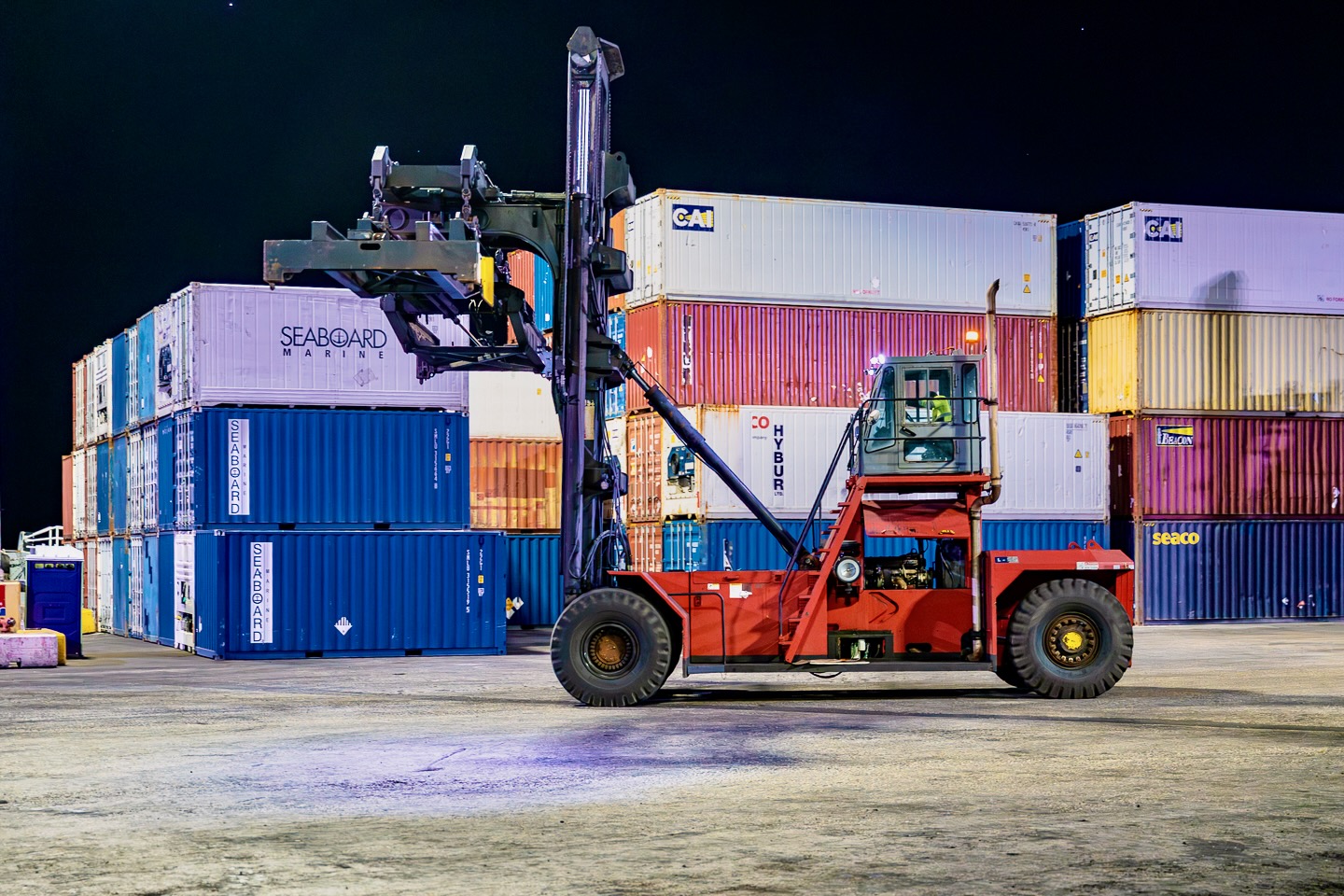
The Cayman Compass joined the night shift on a busy Saturday to chart one of the key choke points in Cayman’s under-funded national infrastructure.
The night shift
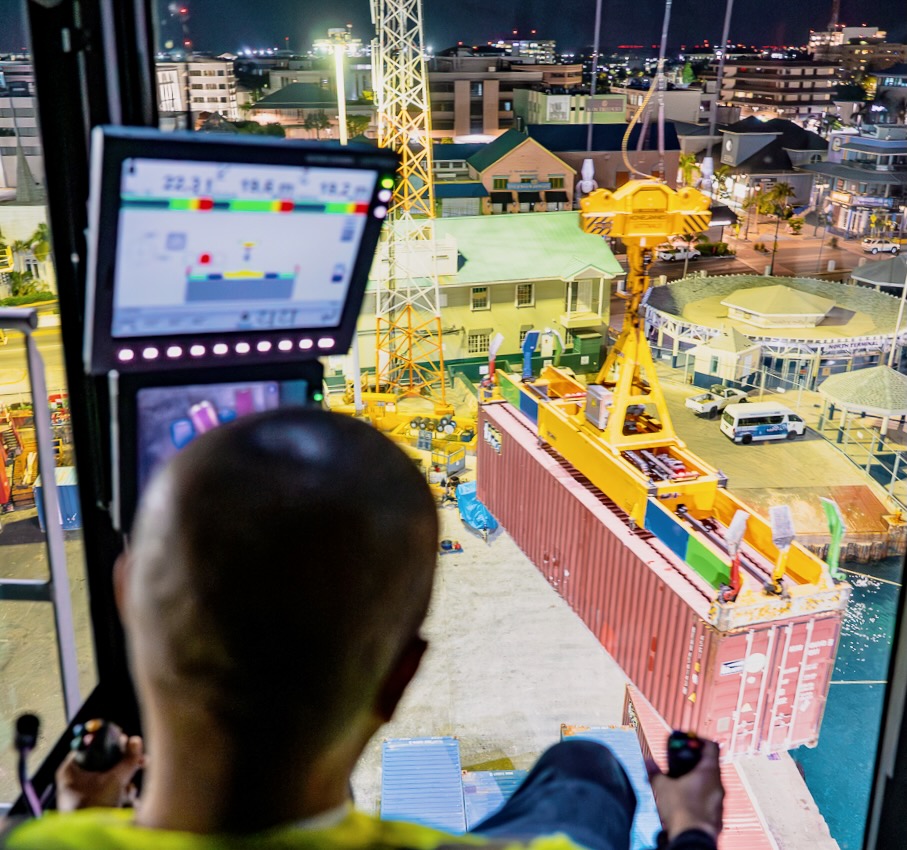
From the cockpit of the harbour crane, Vince Smith can see right across George Town.
The lights of ONE | GT, the latest addition to the city skyline, are visible through the windshield.
“Every piece of that building came through the port,” he says.
Everything from the concrete for the walls, the struts for the roof, the aggregate for the foundations and the beds in the rooms, right through to the paint on the walls, was lifted off the dock.
Smith flicks a switch on a panel, like a Nintendo controller in the arm of his chair and sends the cab swinging around to get a better view across Grand Cayman.
Almost everything we see, including the crane itself, a new $5 million investment, was unloaded here.
And Smith, who has spent two decades at the Port Authority, has had a hand in most of it.
“I have the best job in Cayman,” he says as he manoeuvres the controls to grab and lift another container off the Caribe Voyager.
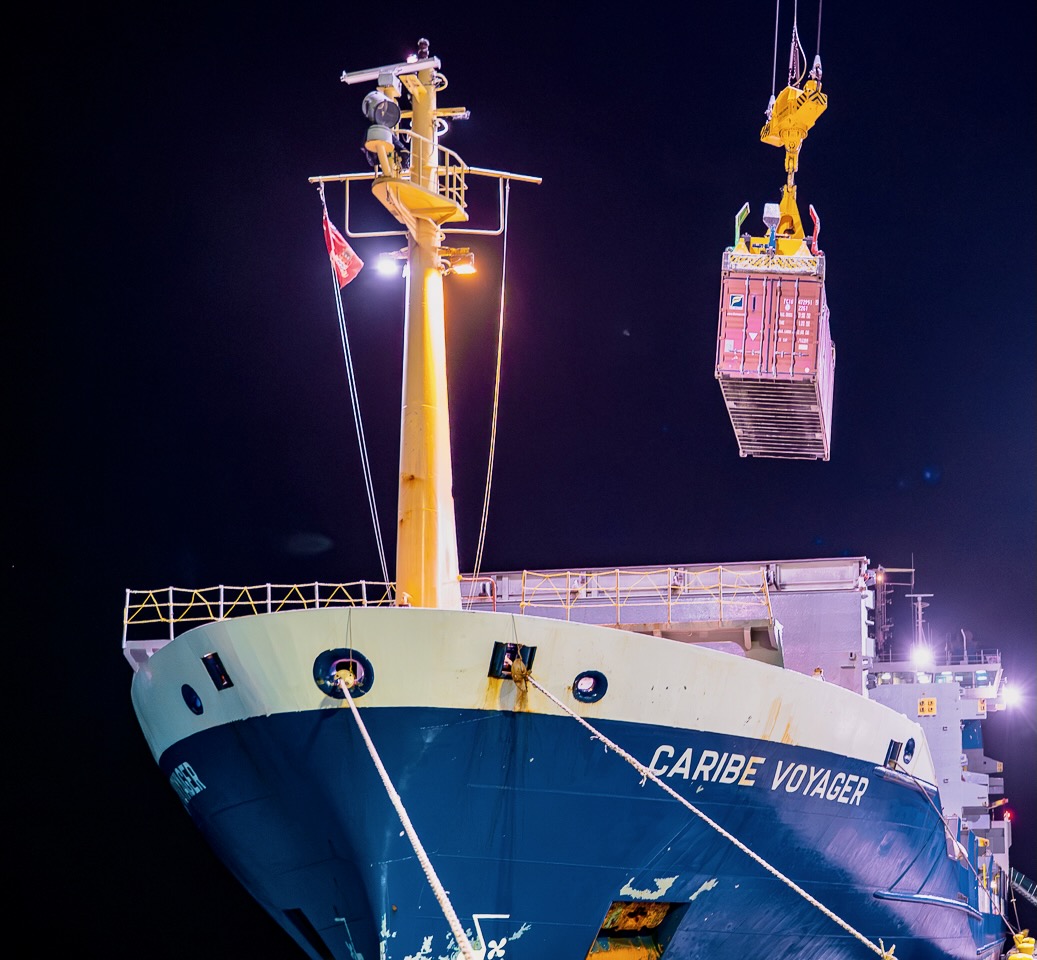
This one is a white 40-foot ‘reefer’ – a refrigerated container carrying produce for the supermarkets. As it gently touches down on the concrete dock, it is met by a forklift and taken to a waiting truck.
There is not enough space on the port side and a fleet of trucks – seven of them are in action tonight – collect the containers and run them to the Cargo Distribution Centre on the other side of town.
Driver Dwight Connor estimates he makes dozens of journeys in a single night.
For fresh produce, Foster’s Supermarket has its own vehicles already waiting at the yard. They ferry them to a warehouse close to the airport, and customs officers clear them on site. The meats, fruits and vegetables in the container Smith is moving from the deck will be on sale in stores around the island the next day.
It is close to midnight and there are just 11 containers left to unload, but for Smith and his colleagues, the shift is not yet half done.
In the parlance of Cayman stevedores incoming cargo is ‘southbound’, the outgoing ‘northbound’ cargo remains to be loaded.
There’s not much of it. Mostly empty containers and shipping pallets.
Little room for error
When there is just one ship in port, the equipment is functioning smoothly and the weather is co-operating, everything runs as it should. But the pressure builds when any of those factors go wrong.
Anthony Ellis, the night operations manager, who started on the port as a teenager sweeping the dock, oversees the whole operation.
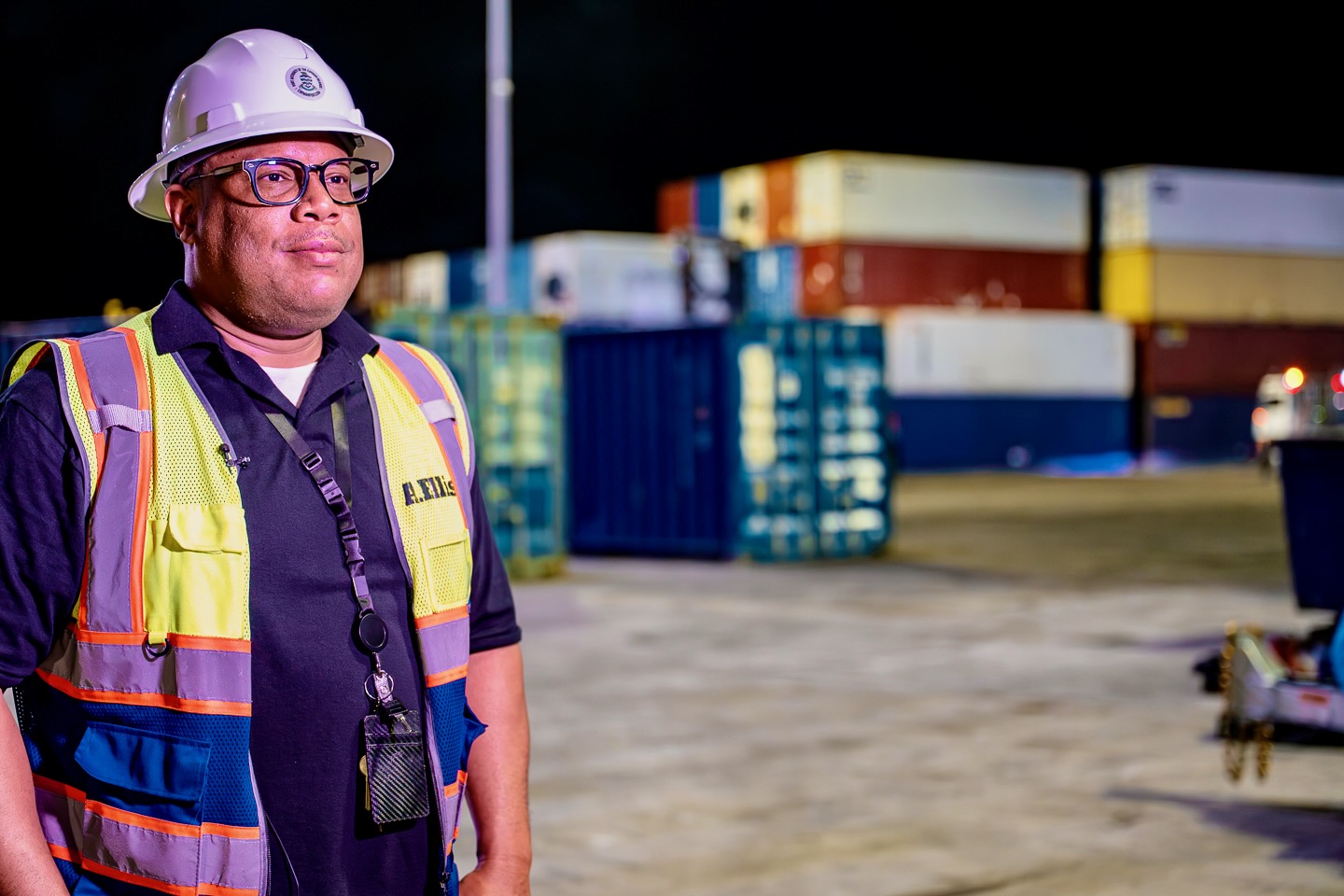
He has come through the ranks and seen the operation grow.
“The biggest challenge is making sure the vessel gets out of here on time,” he says. Cruise passengers and tour buses will fill the space the next morning and the dirty work of the night shift needs to be out of sight and out of mind.
Without the all-night trucking operation, it would be “impossible”, says Brevan Elliott, deputy port director. It is already a challenge when weather causes delays and the pier can’t accommodate two full-size ships at one time.
“There’s no storage out here,” Elliott says. “So, if the ship comes late, all of our ships are backed up. We have to process each ship one by one – offload, transport, reload, and get a ship out before we can move in the next one.”
Scraping the bottom
Hyde Shipping’s Caribe Voyager, which came in from Port Everglades in Florida, is among the biggest vessels that can be handled in Cayman.
It brought in 128 containers on this particular night and has a capacity of 389 TEUs – twenty-foot equivalent units, the standard measure of container volume. The Port of Kingston – a transshipping hub for Cayman and many other countries in the region, handles ships that are 40 times larger.
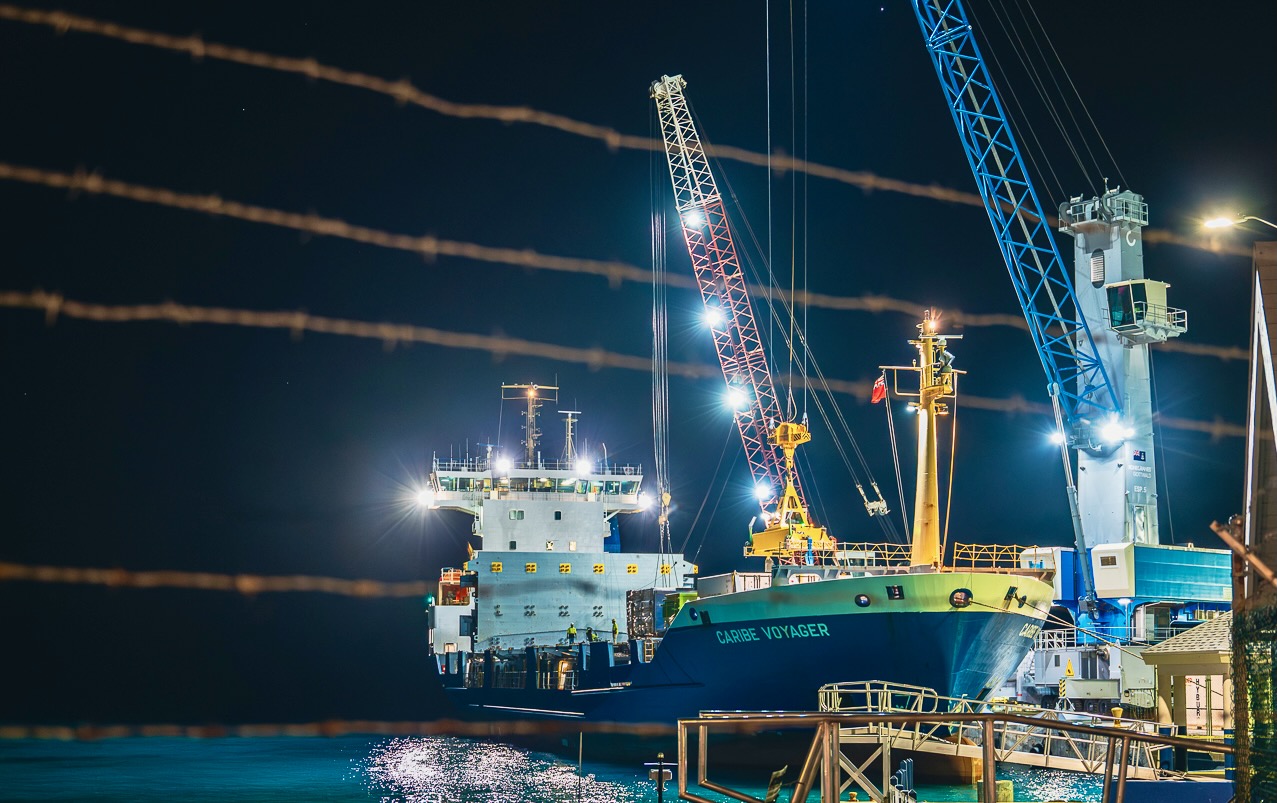
Even these relatively small ships are difficult for Cayman to handle in its shallow water harbour.
Already, on heavily loaded voyages, crews must unload the bow first to lighten the ship before it can slide fully alongside the pier. Some vessels have been photographed sitting on the harbour bottom at certain tides.
The day shift
The Cargo Distribution Centre yard was designed as an overspill facility because there is no room to store containers on the port.
But that facility is now also approaching capacity.
On a busy Friday, two rubber-tyre gantry cranes shuffled containers around like different-coloured blocks in a Rubik’s Cube, finding the right one in the stack for waiting trucks.
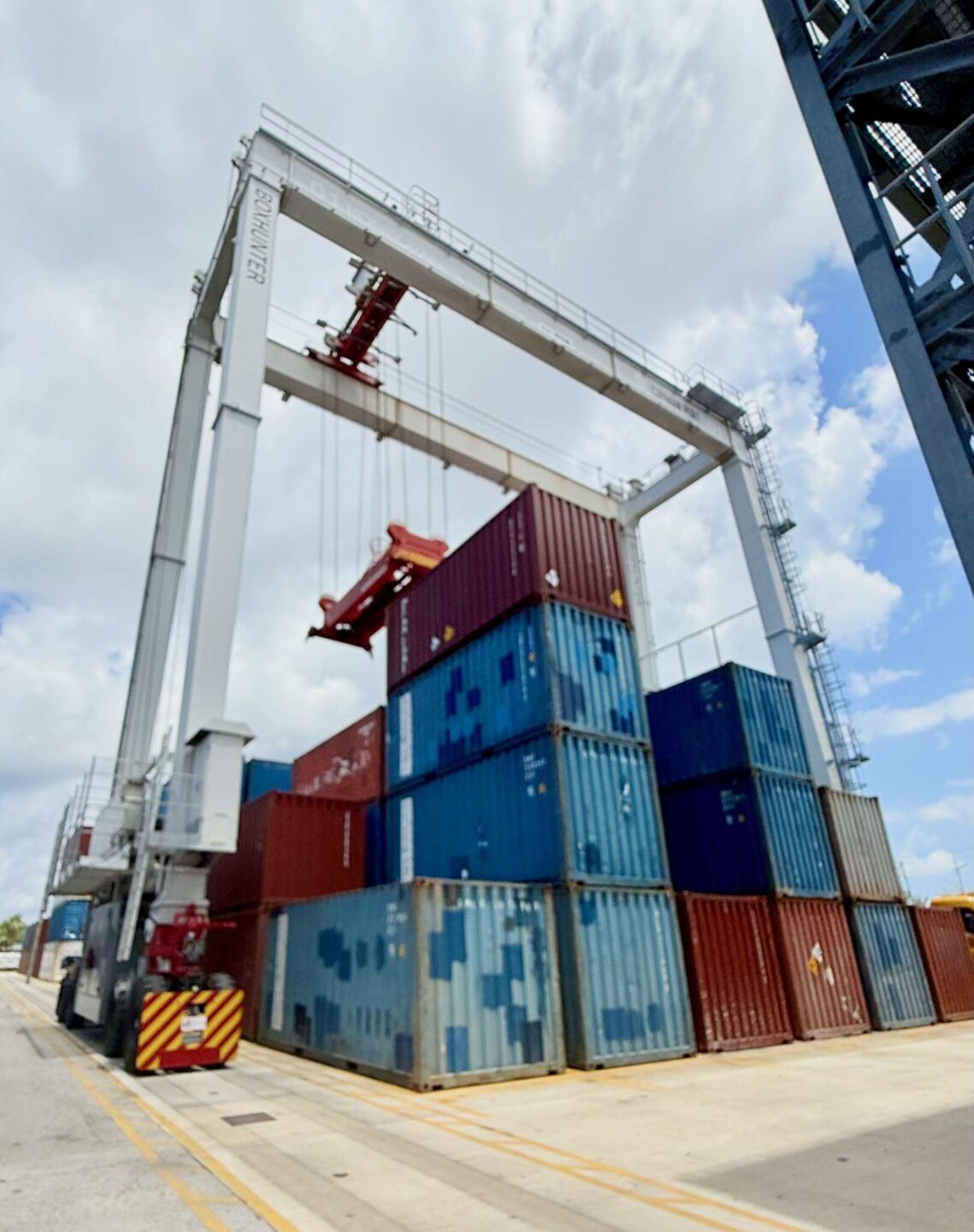
Port workers move between the rows, directing traffic. In a small front office, clerks process payments and organise customs inspections. There’s a five-day grace period before storage charges kick in for anyone that doesn’t collect and remove their belongings.
If there are cars on board, Frank Russell takes care of them. He is the port’s vehicle delivery coordinator and has been behind the wheel of almost every car imported into Cayman.
He’s driven a Porsche, a Ferrari and plenty of Honda Fits from containers to the customer collection point. Higher-end Lamborghinis and Rolls-Royces arrive in dedicated sealed containers, driven out by their owners.
On another side of the yard, a small and deteriorating warehouse handles all the loose cargo.
Staff sort and stack medical equipment, flat-pack furniture and ubiquitous Amazon Prime packages in shrink-wrapped bundles. Metal shelving running three tiers high under the exposed steel roof.
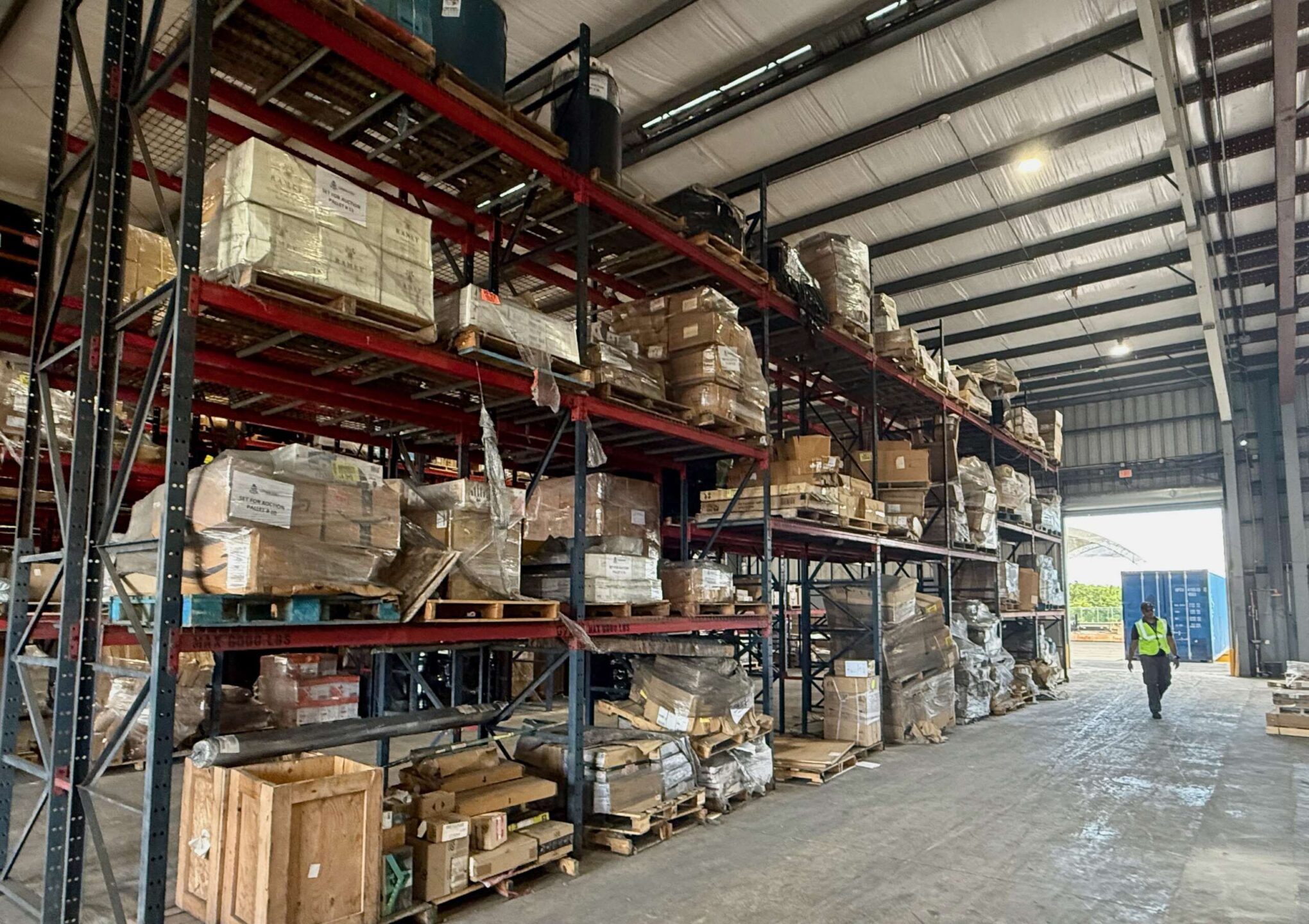
Every employee repeats a version of the same problem.
“Volume”, says CDC manager Bruce Reynolds, citing the massive increase in imports. “We have outgrown the space tremendously. We need at least three times the size to function properly. In the yard is the same thing.”
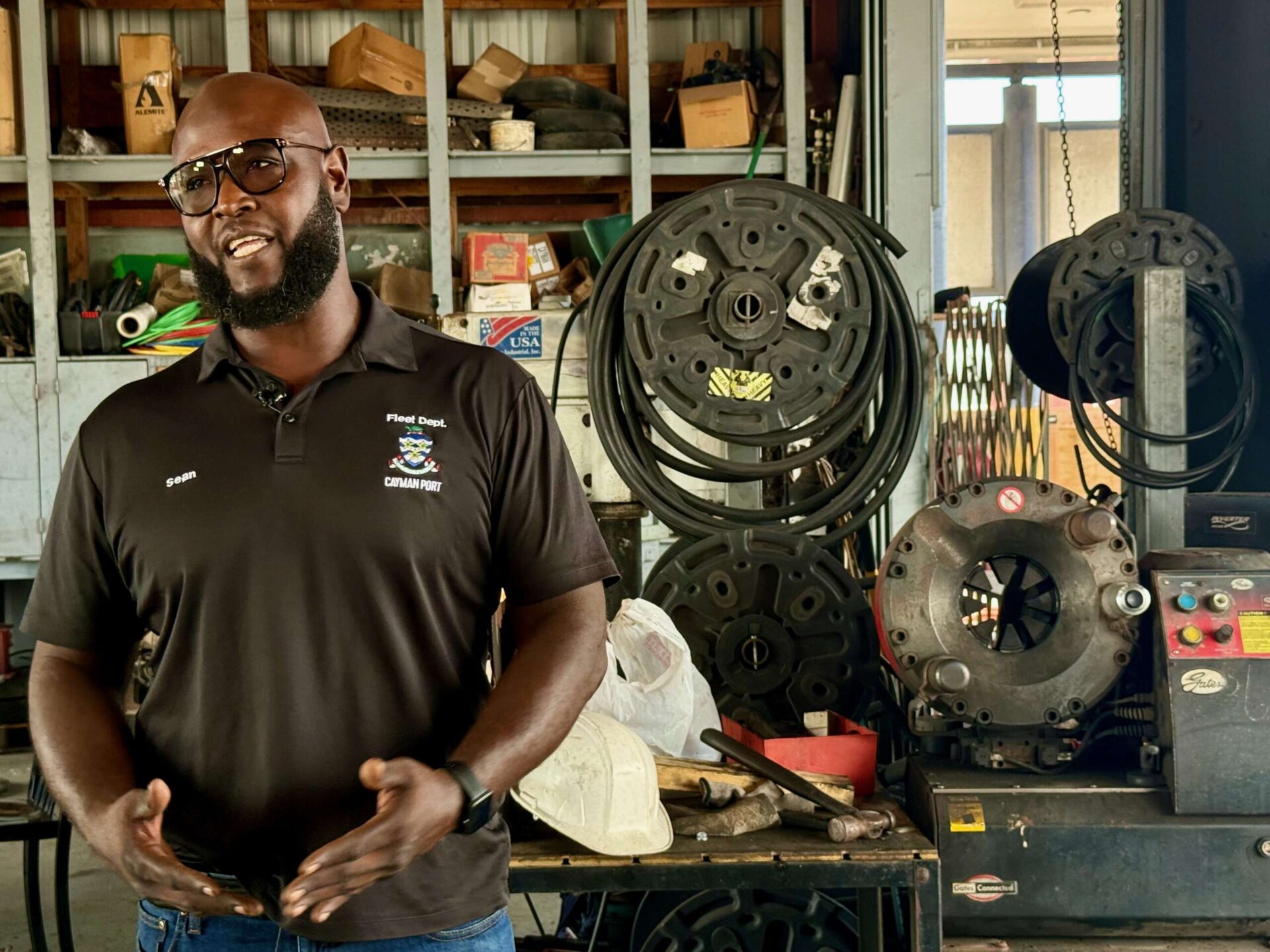
There is little scope for things to go wrong. Chief mechanic Sean Watson oversees a versatile team who are effectively on call round the clock.
In a corrugated shed filled with machine parts and tools, he leafs through a weathered manual for 1980s-era equipment, looking to solve a problem. Later on, he may have to call on the specialist training he received in Germany from the manufacturers of the port’s new crane.
“If something breaks down here, we don’t go home until it’s up and going,” he says.
Under strain
If the cranes stop working, the port stops working, and if the port stops working, the country’s supply line grinds to a halt.
As director of the port, Paul Hurlston is the one who will hear about it when that happens.
The way he tells it, people don’t always see the value of the port until something goes wrong.
“The port has always operated good. It meets its mission day after day. No one sees that [space challenge] because we’re just getting things done.”
He recalls the panic after Hurricane Ivan when the port was down for four or five days. As the island’s population grows, he warns that could become the norm, even without a storm.
The port, he says, is already handling 10 to 15 times the amount of imports for which it was built.
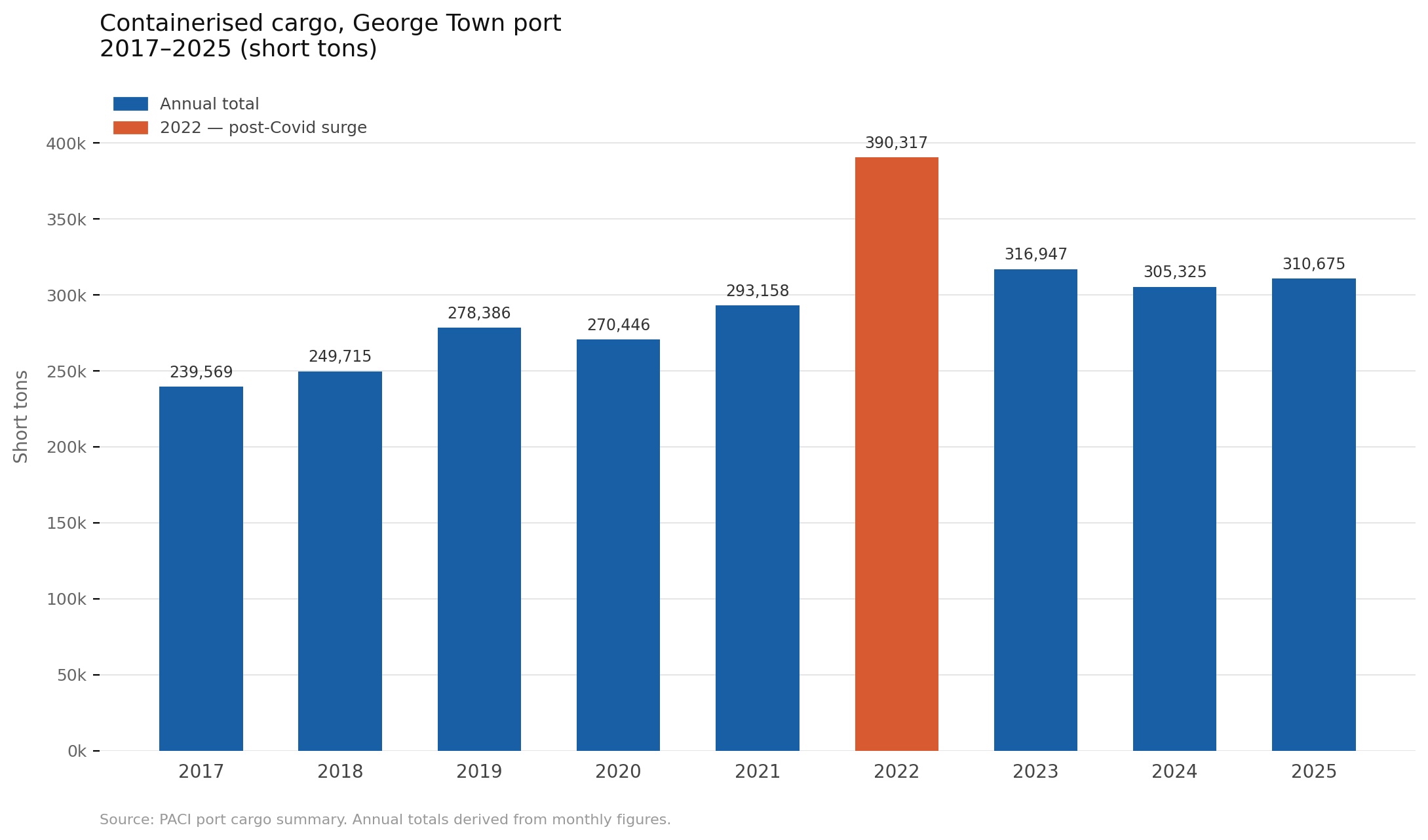
In 2025, 310,675 short tons of containerised cargo were imported through the facility – up from 180,882 short tons in 2011.
Total cargo last year, including aggregates and cement, exceeded 676,000 short tons. The port’s own analysis projects it will reach capacity within a decade.
‘We need to expand’
A new port is needed for the long term if Cayman continues to grow, Hurlston says. Before that is possible, expansions of the existing facility are planned.
“We could expand here to last another 10 to 15 years and that would give us time to start,” he says, but the depth of the harbour and the environmental challenges of creating a significant port on site mean a long-term solution lies elsewhere.
“Beyond 15 years, you will experience a lot of delays here,” he added.
A Strategic Outline Case for a new port identified a project at Breakers in Bodden Town district as the best long-term solution. Whether at that location or elsewhere, Hurlston believes it has to be built.
“I think it will happen at some stage. I don’t see everything continuing here,” he says.
There are no immediate plans to move forward with a new port, although Infrastructure Minister Jay Ebanks supports the project.
He points out the East-West Arterial Highway project must come first for a shipping port in the eastern districts to have the transport links needed to supply the island.
Some of the cost projections for a fully equipped new port in Breakers – which would include cutting a channel through the coastal road and excavating the existing quarries – exceed $400 million. Even if government was committed to the plan, it would likely take several years of planning before any work could begin.
Ebanks acknowledges there would likely be resistance, but suggests the country’s long-term future depends on ultimately moving forward with some form of new cargo port.
He said, “A country can’t grow without a proper port facility.”
In the interim, a temporary expansion at the current site, including some reclamation of land from the sea and an extension to the finger pier is proposed. It is a stop-gap measure that no one expects to be more than a Band-Aid solution, and even that will require a full business case and planning process.
The port was built in the early 1970s and had been used informally before that. Black and white photographs on the walls of the Port Authority Cayman Islands offices show baskets of rope being lifted off schooners on to hand carts. In 1977, the first full year that records were kept, the port handled 34,444 short tons of cargo.
The 2022 post-pandemic surge set a new record, with total cargo exceeding 780,000 short tons as construction demand and consumer imports flushed through simultaneously.
‘One step closer to the precipice’
Joey Woods, the former port director, believes delays are only making the solution more expensive.
“I don’t see government now, or 50 years from now, ever having the money to do it on their own, so what they need to do is a public-private partnership. Get investors in and get it going,” he says.
“Every delay takes us one day closer to the precipice,” he adds.
Woods argues that a bigger dock would mean bigger ships, bulk supply, more direct trade routes, and cheaper groceries and consumer goods. But he warns the ‘do-nothing scenario’ is not a viable option and insists the process of expanding should have already started.
“You, the customer, will not know about it until you reach the point when you can’t collect your cargo, but it’s too late then,” he says. “A port doesn’t take one year to build, and it doesn’t take two years or even five years. It takes a lot longer.”
Woody Foster, who runs the Foster’s Supermarket chain, is more restrained. As a major customer of the port, he believes the current process is efficient enough, given the limitations of a small island that produces little of its own food. But he acknowledges that could change as the population grows.
Foster’s has grown with the community over the years, adding new stores and new distribution arms. He can only see that growth continuing.
“We’re going to hit 100,000 [in population] pretty soon, and there is no light switch that’s going to turn it off after that,” he says.
Related Videos







It seems our politicians should spend more time touring our problem areas rather than touring the world at taxpayer expense.