


The government’s two-tier vehicle and driver’s licensing fee regime will take effect on 1 Sept., with expatriate residents paying up to eight times more than Caymanians for driving licences.
Cabinet approved the implementing regulations on 1 July and they were published in this week’s gazette.
The Traffic (Amendment) Regulations introduce separate Department of Vehicle and Drivers’ Licensing fees for Caymanians and non-Caymanians, with expats facing substantially higher charges for driver’s licences, learner’s permits, driving tests and some vehicle licensing transactions.
Under the new regulations, the cost of a three-year driver’s licence for a non-Caymanian will increase from $75 to $600, an eight-fold difference, while the cost of taking a driving test will be $200 for expats and $50 for Caymanians. Five-year licences will cost non-Caymanians $1,000, while the Caymanian fee will be $125, and a 10-year licence will jump to $2,000, compared with $250 for Caymanians.
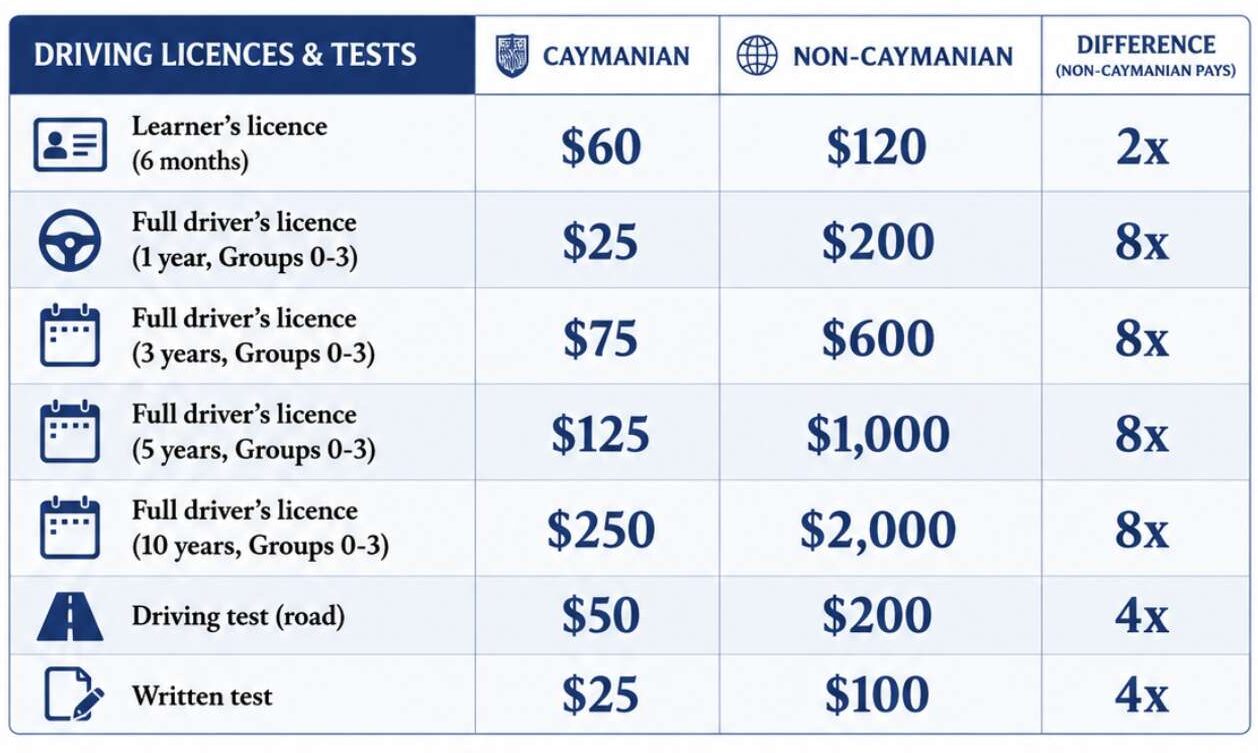
The regulations also provide that non-Caymanian spouses and civil partners of Caymanians will qualify for the Caymanian fee structure.
The publication ends months of uncertainty after Premier André Ebanks revealed earlier this year that government had paused implementation because of technical difficulties identifying who qualified for the lower Caymanian rates.
Speaking to the Compass in February, Ebanks said the main challenge was that there was no straightforward mechanism for all Caymanians to verify their status, making it difficult for the DVDL to identify those eligible for the preferential rates.
At the time, Ebanks said the new ‘My eID‘ national identity card could provide the solution. Rolled out in Grand Cayman in February and the Sister Islands in May, the card gives Caymanians a secure way to verify their identity and status, addressing the longstanding challenge of proving Caymanian status.
The delay raised questions over one of the National Coalition for Caymanians government’s key revenue measures. The 2026-27 budget relies on about $209 million in new and increased fees over two years, with the DVDL changes expected to contribute to that total.
The regulations published this week indicate those implementation issues have been resolved, although government has not publicly explained how Caymanian status will be verified when the new fees take effect.
According to the Ministry of Social Development, 1,229 My eID cards had been issued as of June. As the programme was open only to Caymanians up to 1 July, that equates to about 3% of the eligible population based on the latest available figures, indicating a substantial increase in uptake would be needed if My eID is to become the primary means of verifying eligibility for the lower fees.
Increased fees to bring in $9.6M in government revenue
The measures were introduced as part of the 2026-2027 budget, with Finance Minister Rolston Anglin arguing the fee increases would minimise the burden on Caymanians while generating an additional $9.6 million in revenue in both 2026 and 2027.
A Compass report published in November 2025 found Cayman’s proposed non-Caymanian driver’s licence fees would likely be the highest in the world.
The analysis compared licence renewal costs across jurisdictions including the UK, Canada, Bermuda, the British Virgin Islands, Jamaica and the United States, finding none imposed separate fee structures for citizens and non-citizens.
The analysis also highlighted the potential impact on overseas workers, many of whom already live close to the poverty line. Even at the new minimum wage of $8.75 an hour, a three-year driver’s licence for a non-Caymanian will cost the equivalent of nearly two weeks’ gross pay for the island’s lowest-paid workers.
During Finance Committee proceedings last year, Attorney General Samuel Bulgin said there was a “presumption of legality” surrounding the two-tier fee structure unless a court ruled otherwise, adding that government had broad authority to provide preferential treatment for Caymanians without breaching constitutional anti-discrimination provisions.
International law does not generally prohibit governments from charging different fees to citizens and non-citizens. Under the International Covenant on Civil and Political Rights, the UN Human Rights Committee has said such distinctions are not discriminatory if they are based on “reasonable and objective” criteria and pursue a legitimate purpose.
Related Videos











Well it seems our Govt have no conscience as they are willing to milk some of our poorest, many of whom are already struggling to send money home to their families. Now they have the highest fees in the world by some margin , yet none of our neighbours have discriminated against their foreign workers in this fashion,in fact it may be unique.
Why not increase import duties accoss the board , rasing $10million from this source would have liitle effect on individuals, but I suppose this would hit the pockets of our politicians albeit by a hardly noticeable amount.
This Sept enactment will go down in the annals of Cayman’s history as a day of shame to all Caymanians.
Nothing like some two tier racism, expiation, whatever you want to call it. Supress the expats. If this is the new norm, it will never get better. Only worse with yearly fee hikes.
Our MLAs are a bunch of corrupt thugs who are engaging in performative expat abuse for no significant financial benefit.
All the while, they are haemorrhaging cash to buy votes through cash-for-non-jobs in the hideously bloated World-Class Clown Service and SAGCs, and taking massive kickbacks from developers – who actually pull their strings.
Cayman gone.
A shameful move by our ministers. As a Caymanian, this does not feel right to me.
CUC prices through the roof, water authority increasing rates and now this. Creating a 2-tier system is discriminatory, racist and blatantly cruel. The Government all assumes that every expat is a wealthy professional at a law firm or making bank in financial services. But majority are working class individuals often on minimum wages, working as domestic helpers, in hospitality, cleaners, labourers, etc only moving here to save money and support their families abord.
This is already the most expensive country on earth in a cost-of-living crisis, and then they want kick us when we are already struggling. Is there no one that reviews these policies with common sense and integrity?
Terrible idea
If the government needs to raise revenue it should do so by changing the current system of a one-off payment for permanent residence to an annual payment.
For example: currently a 25 year residence permit requires a one-off payment of $25,000 plus the one-off purchase of an expensive home.
Instead, reduce stamp duty for everyone and charge people, say, $15,000 a year to live here, continuously renewable with good behavior. No requirement to buy a home.
This would be far less offensive and divisive than this plan. BTW, it doesn’t affect my family at all.
Just wondering how many people will drive unlicensed – using other people’s license plates and not buying insurance. Could be a mess.
I understand the government’s desire to increase revenue, but are we becoming comfortable with creating different prices for Caymanians and non-Caymanians for essential public services?
Today it’s DVDL fees. Tomorrow, what comes next?
* Utilities?
* Water?
* Government services?
* Schools?
* Other essential services Grocery stores too going to have a separate pricing very soon.
Where do we draw the line? A society works best when it brings people together, not when it creates more divisions between those who live and contribute here. Charging different prices for basic government services based solely on status may solve a short-term budget issue, but it risks creating long-term resentment and a greater sense of separation within our community.
Is this really the direction we want to take?
These increases are ridiculous. Even if you accept that you are going to charge more to expats (which I don’t) then the difference in price is sending a message that we don’t want expats. How can construction workers, childminders, gardeners etc afford this? If you want to keep your helper here for example then the Caymanian employer is likely to have to pay this increase, so it comes back to bite Caymanians. Let’s have intelligent initiatives (duty off basic foods anybody?!)
I am shocked and ashamed of my government that they would add to the problems of the thousands of workers who through Government’s unbridled development plan have come to the island to make the rich richer and obviously the poor poorer. This is despicable and should be retracted. Every member of Government should be ashamed.