
CFA, MBA
Chief Investment Officer
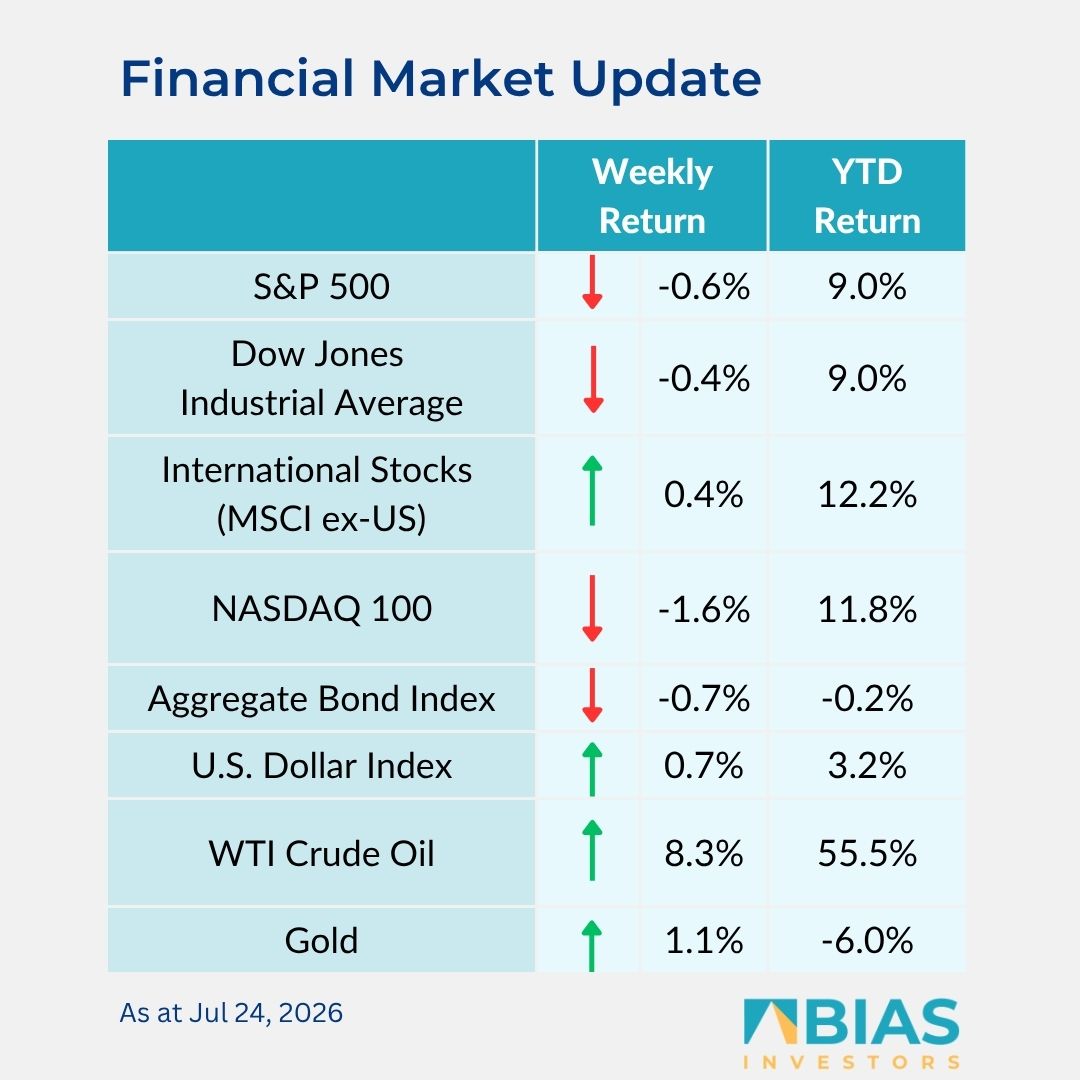
Escalation in the conflict between the US and Iran pushed energy prices higher and created a risk-off mood in the equity markets last week.
For the week, the S&P 500 Index was -0.6%, the Dow Jones Industrials -0.4%, and the NASDAQ -1.6%. The energy, utilities, and industrial sectors led the S&P 500 Index for the week, while the communication services, consumer discretionary, and consumer staples sectors lagged.
The 10-year US Treasury note yield was 4.683% at Friday’s close versus 4.593% the previous week.
There was little economic data last week, but that changes this week with reports on consumer confidence, second-quarter Gross Domestic Product (GDP), personal consumption expenditures (PCE) Prices, and the July Federal Open Market Committee (FOMC) meeting.
The FOMC is not expected to increase the Fed funds at the meeting, but CME Fed funds futures are currently forecasting two 0.25% increases between now and year-end.
The meat of the second-quarter earnings reporting season arrives this week with 177 companies in the S&P 500 Index scheduled to report earnings.
Second quarter earnings are expected to grow by 37.9% and quarterly revenue growth is expected at 13.2%. This is already a significant increase versus the 23.3% earnings growth expected at the start of the reporting cycle earlier this month. Full-year 2026 earnings are expected to grow by 27.3% with revenue growth of 11%.
In our ‘Dissecting headlines’ section, we look at the back-to-school shopping season.
Dissecting headlines: Back-to-school shopping
Even though it is prime time barbecue and swimming season, consumers are hitting the stores for back-to-school shopping.
The National Retail Federation is forecasting 2026 spending to increase 14.5% to $146.8 billion. Most of the spending is for college students at $103.5 billion, a 16.6% annual increase. K through 12 spending is forecast at $43.3 billion, a 9.9% increase.
While 62% of shoppers have already taken advantage of June promotions at Amazon Prime Day, Walmart Deals, and Target Circle Deal Days, others are still waiting for better deals, some are spreading spending across pay periods, and others report still trying to figure out what they need.
Given that the forecasted spending per family is $1,437.79 per college family and $863.86 per K through 12 family, it makes sense that consumers are deal seeking, only buying what they need, and looking to spread costs.
The main categories for college shopping are electronics, representing nearly a quarter of all spending, followed by dorm furnishings, clothing, food, and personal care items. K through 12 spending is also focused on electronics, followed by clothing, shoes, and school supplies.
Only half of the survey respondents indicated they would be shopping online this year, versus 55% last year. Other destinations include department stores, discount stores and clothing stores.

BIAS Investors (Cayman) Ltd.
Grand Pavilion (Hibiscus Way)
802 West Bay Road
Grand Cayman, Cayman Islands
W: biasinvestors.com
E: [email protected]
T: 345-943-0003
Subscribe to the BIAS Investors newsletter here.
Related Videos