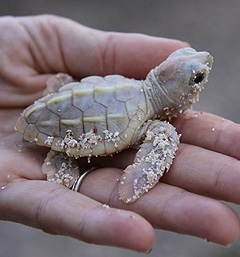
So far this year, volunteers who patrol Grand Cayman’s beaches looking for turtle nests have found 230 nests, putting 2012 on track for being one of the highest years on record for turtle nesting.
Janice Blumenthal, research officer at the Cayman Islands Department of Environment, said nesting would continue through September, so more nests will likely be added to that number.
Among the hatchlings found this year were two live albino baby turtles – a loggerhead in Grand Cayman and a green sea turtle on Cayman Brac.
“After the nests hatch, we count the number of egg shells, or hatched eggs, left behind and examine all unhatched eggs to determine hatch success and fertility. We also carefully track observations of albino and deformed hatchlings, as this could indicate an increase in genetic mutations due to small population size,” Ms Blumenthal said.
“Decreased fertility would be another key indicator that population size had dropped too low, but results from the past 15 seasons of DoE turtle monitoring are encouraging: while our turtle populations are still critically small, more than 80 per cent of eggs are fertile. This indicates that with sufficient protection our wild turtle nesting populations can recover, and indeed an overall upward trend has been observed in recent years,” she added.
As more turtles return to Cayman’s shores to nest on local beaches, interest from visitors to the Islands is also increasing.
“Many have said that they will plan their next vacation to the Cayman Islands during the nesting season, or that they plan to come back to see nests hatch,” Ms Blumenthal said.
Each morning at dawn, volunteers scour the beaches looking for telltale signs of turtle tracks that can lead them to nests. Once they locate a nest, they mark it and contact the Department of Environment to let staff known where the nest is. Then Ms Blumenthal and other volunteers or staff come to the nest and check if there are eggs in it. The coordinates of the nests are logged and then, once the eggs are ready to hatch, the DoE staff and volunteers keep an eye on it to try to ensure the babies make it safely into the water.
The Department of Environment has been carrying out a survey of beaches in the Cayman Islands and between May to November, its staff and volunteers patrol the beaches.
The collected data is used to assess the quantity, frequency and distribution of nesting and to aid conservation efforts.
By the end of each nesting season, the patrollers have covered more than 800 miles of beach.
Last month, Miller Lite and Sunset House hosted a party in appreciation of the dedicated volunteers who give up their time week after week to patrol the beaches.
“Without their hard work, the programme could not function,” Ms Blumenthal said. “With limited a budget at the DOE, it’s fantastic that companies such as Miller Lite can help us thank all the volunteers who give up their time to protect turtle nesting populations.”
During the party, which was attended by more than 25 volunteers, Miller Lite presented the DOE with a cheque for $4,500, which was raised through fundraising events, including island-wide beach clean-ups and donations from Miller Lite purchases, has already been used to purchase supplies, such as PVC pipe for marking nests and shades for lights.
Lights along the beaches can have an impact on the survival of baby turtles, who instinctively go toward the light. When there are no artificial lights, the turtles move toward the sea, but if there are lights nearby, they go toward those lights, moving inland where they are often attacked by crabs or birds.
Ms Blumenthal thanked the hotel and condo managers, beach front property owners and Caribbean Utilities Company for turning off lights on the beaches to protect these nests.
“Together, we have already protected over 5,500 hatchlings, and the work of protecting the years’ hatchlings is just beginning,” she said.
However, she said that while there had been an encouraging increase in nesting numbers, turtles are facing increasing threats, the worst of which are poaching and light pollution.
“We are excited about using some of the funds from Miller Lite to implement turtle ‘friendly lighting’ solutions in key areas. The DoE is committed to finding lighting solutions that work for turtles and people and there is great potential to improve nesting habitat in this way,” she said.
Turtles can lay between 100 and 130 eggs three to six times each season.
The public is encouraged to call the DOE Turtle Hotline 938-NEST (938-6378) if they see turtle nests, nesting turtles, or hatchlings or e-mail [email protected] for more information.


Related Videos