

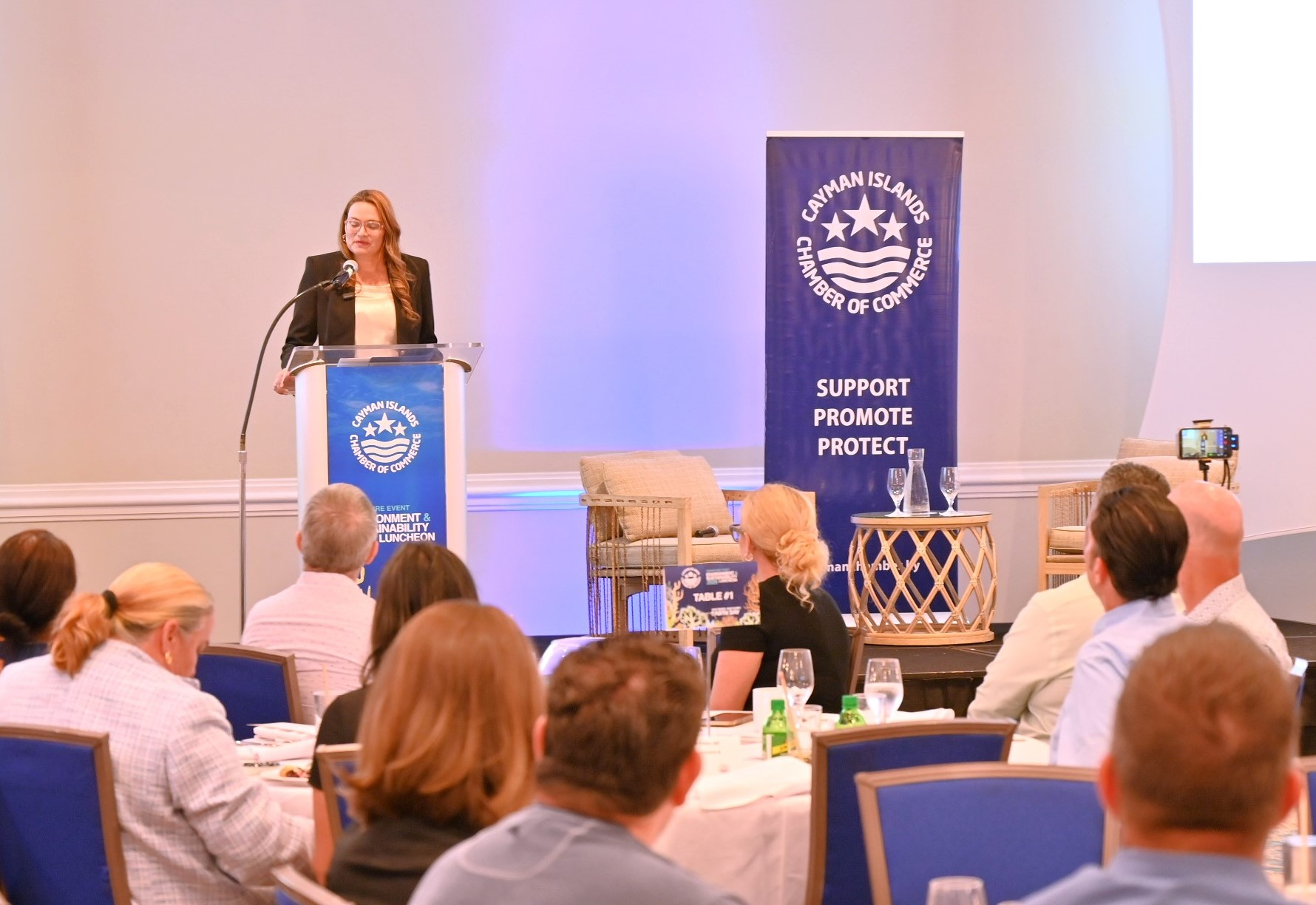
Cayman must stop waiting for crises to emerge before taking action and instead begin designing policy around prevention, resilience and long-term risk reduction.
That was the central message delivered by Minister of Health, Environment and Sustainability Katherine Ebanks-Wilks at the Cayman Islands Chamber of Commerce’s inaugural Environmental and Sustainability Luncheon and Showcase, which brought together 138 attendees representing more than 55 public and private sector entities at the Grand Cayman Marriott Resort on 7 May.
The session opened with remarks from Chamber President Cristina Spratt, followed by a keynote address from Ebanks-Wilks and a fireside chat between them both.
“Sustainability and resilience are no longer peripheral issues,” Minister Ebanks-Wilks said. “They are central to how we think about economic sustainability, investment and the long-term future of the Cayman Islands.”
She framed resilience as a practical issue affecting households, businesses and government systems alike, linking rising electricity costs, infrastructure strain, climate pressures and waste management challenges to Cayman’s long-term economic future.
“When we talk about resilience, we’re not speaking in abstract terms,” she said. “We’re talking about whether families can afford to cool their homes, whether businesses can operate with certainty, whether infrastructure can withstand pressure, whether our natural systems continue protecting us, and whether future generations inherit a Cayman that remains stable, livable and economically strong.”
Resilience index
A major focus of her remarks was the planned Cayman Islands Resilience Index, or CIRI, which government is developing under the Climate Change Policy 2024–2050. The proposed platform is intended to help guide future policy and investment decisions by measuring whether projects strengthen or weaken national resilience across areas including infrastructure, the economy, environmental systems and community well-being.
Ebanks-Wilks said the government was attempting to move from crisis management toward more proactive, long-term environmental and resilience planning.
“This government is shifting from reactive management to long-term resilience planning,” she said.
Among the initiatives discussed was Cayman Forward, an evidence-led policy review initiative intended to better align development and environmental legislation while balancing business and conservation interests.
The minister also addressed the ongoing landfill issue, describing the recent George Town landfill fire as evidence of mounting long-term system pressures.
She said government was advancing commercial recycling mandates, improving landfill operations and developing a national recycling policy as part of a broader shift toward long-term waste management reform.
Energy affordability and climate resilience were also central themes.
Ebanks-Wilks highlighted government’s recently announced energy relief plan, including temporary fuel duty waivers, residential electricity fuel cost caps and the expansion of the Cayman Home Energy Efficiency Retrofit programme, known as CHEER.
She said the longer-term strategy involved increasing solar generation and reducing Cayman’s dependence on imported diesel fuel in order to lower vulnerability to global oil price shocks.
The minister also referenced recent environmental and conservation announcements made in Little Cayman.
During the fireside discussion and audience question-and-answer session, topics ranged from marine conservation and coastal setbacks to renewable energy, recycling, noise pollution, and environmental enforcement capacity.
Ebanks-Wilks repeatedly stressed that government alone could not achieve the resilience goals being outlined.
She called for stronger partnership between government and the private sector, urging businesses to integrate sustainability and resilience into operational and investment decisions.
“Resilience is ultimately cumulative,” she said. “It is built decision by decision, investment by investment, project by project.”
Created as a new platform for collaboration and dialogue, the Environmental and Sustainability Luncheon brought together organisations working across environmental protection, conservation, restoration, enforcement and sustainability initiatives in the Cayman Islands. The event also aimed to strengthen connections between the business community and those engaged in frontline environmental stewardship efforts.
The luncheon forms part of the Chamber’s broader and long-standing commitment to environmental action, building on the momentum of its annual Earth Day cleanup held this year on 18 April. The initiative mobilised more than 3,500 volunteers from Chamber member businesses, schools, service clubs, nonprofit organizations and community groups.
Related Videos










for many years, Govt has been reactive rather then proactive and this is the nub of our many problems. It seems the Minister is now recognising the problem and hopefully we will see some meaningful changes in Govt. policies.