At a glance
- Little Cayman’s Edward Bodden Airfield will remain in its current location, with government opting to upgrade rather than relocate it.
- Planned works will focus on meeting safety and certification standards, ending long reliance on regulatory exemptions.
- The decision, announced on Earth Day, forms part of a wider policy package including new protected areas and steps toward a single-use plastics ban.
The Cayman Islands Government has confirmed that Little Cayman’s Edward Bodden Airfield will remain in its current location, bringing a decisive end to years of uncertainty over the future of the island’s only airport.
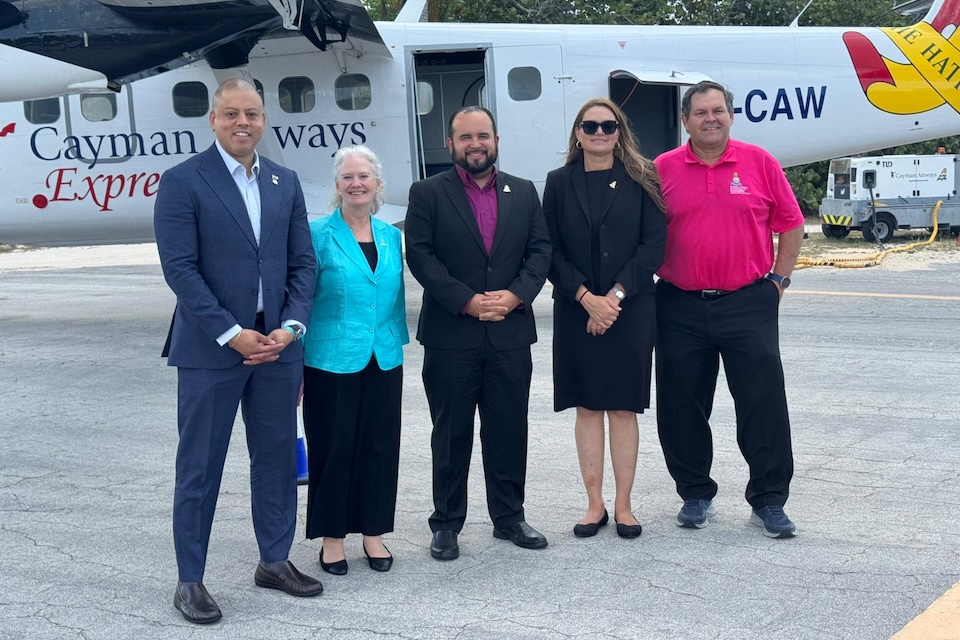
The announcement, made by Premier André Ebanks following a Cabinet decision, was delivered to residents at a community meeting on Little Cayman on Earth Day, 22 April – a choice he described as symbolic, given Little Cayman’s ecological importance. It was presented alongside a broader package of policy measures focused on environmental protection and long-term planning.
“Today in Cabinet we have made a firm decision that the Little Cayman airfield will remain right where it is,” Ebanks said in an interview with the Compass, describing the island as “a treasure”.
The decision signals a clear shift away from earlier plans to relocate the airfield and instead commits government to upgrading the existing site to meet safety and regulatory requirements.
Long-running debate
The decision follows years of debate over whether the airfield should be upgraded in its current location or replaced entirely with a new facility elsewhere on the island.
First built in 1962 as a small grass strip to support early tourism, the airport has since evolved into a vital but unconventional transport hub. It was paved in 1998 and remains the primary access point for residents and visitors, including many divers drawn to Little Cayman’s marine environment.
Despite its role, the airfield has operated for more than two decades under an “exemption of airworthiness” issued by the Civil Aviation Authority, as it does not meet modern international aviation standards.
That regulatory gap has been central to policy discussions, with authorities warning that exemptions could not continue indefinitely without a plan to bring the facility into compliance – a question that has shaped both government deliberations and community concern.
Reaction from the community
Against that backdrop, the announcement was met with a sense of relief among many residents.
“There was a lot of trepidation as to what they were going to say,” said Gregory McTaggart, Little Cayman District Committee chair for the Cayman National Trust. “Were they going to change positions on moving the airport? Fortunately, they didn’t do that.”
McTaggart said the decision reflects the will of the community, which has consistently opposed relocation of the airfield.
Sabine Hubaux, assistant manager at Paradise Villas, said the timing of the announcement added to its significance.
“It was wonderful to hear such good news on Earth Day, and quite pleasing to see them all come together,” she said, referring to the rare joint presence of the premier, governor and MPs.
Fiona Williams, a long-time visitor who recently became a resident, said the decision brings clarity after years of uncertainty.
“It is really good news that they’re not going to move the airport,” she said. “I hope that they can meet the timeline and the budget that they’ve outlined.”
Balancing safety and identity
The central challenge for policymakers has been balancing aviation safety requirements with the social, environmental and economic realities of Little Cayman.
Technical assessments have highlighted multiple issues at the existing site, including its short and narrow runway, proximity to roads and power lines, and lack of standard aviation infrastructure such as lighting and taxiways.
At the same time, the airfield has maintained an operational safety record over decades of use.
District Administration Minister Nickolas DaCosta said government has established a timeline and implementation plan to bring the airfield up to certification standards while retaining it in its current location.
“We have approved a timeline and implementation plan on works that need to be done to ensure that it can be certified and secure, but the most important thing is it’s going to remain exactly where it is,” he said.
DaCosta said there had been significant public concern ahead of the meeting, with some residents expecting a different outcome.
“The truth was that many people came to the meeting thinking that the opposite news was going to be provided,” he said, adding that the decision had been difficult to keep confidential. “Each time I’ve been coming to Little Cayman, someone pulled me in the corner – ‘What are you doing about the airport?’”
A working group approved by Cabinet late last year had been tasked with assessing whether retaining the airport was feasible before a final decision was made.
Initial works are expected to focus on safety upgrades.
“One of the main things that we need to do to make the airport certifiable … is to restrict access to the airfield. So right now, there’s no fence. That’s one of the small things that we can do immediately,” DaCosta said.
He said plans also include widening the runway to improve safety margins but confirmed there are no proposals to extend it to accommodate larger aircraft.
Safety remains a central concern
Governor Jane Owen said certification remains a priority as the project moves forward.
“It’s so important for Little Cayman to have an airfield so that people are able to come and go,” she said. “But my additional concern as governor is to make sure it’s safe and certified.”
Ebanks said progress will be managed through a milestone-based framework, replacing the practice of rolling annual exemptions.
“What we’ve come to an agreement on is that there’s a set of milestones to achieve,” he said. “As we achieve each milestone, there will be an expectation from the Civil Aviation Authority that they will grant another extension … This will keep the project on track.”
He framed the approach as part of a broader shift in governance.
“This term is about not kicking cans down the road. They’ve been kicked around for decades.”
For many, the decision represents a compromise between safety requirements and the preservation of Little Cayman’s identity.
A balanced approach
MP Wayne Panton, who is also a former premier and environment minister, said the decision reflects both the views of residents and wider national considerations.
“It reflects exactly what the people of Little Cayman want,” he said. “People love the charm of the airport the way it is. And hopefully, while there will be changes, we can maintain a lot of that charm.”
He added that the approach also makes financial sense.
“It reflects a lower investment for the country as well. So I think it’s a win-win across the board.”
Ebanks said the move also reflects a broader policy direction centred on balanced development.
“We are committed to ensuring that every community has access to the infrastructure and services it needs to thrive,” he said. “Confirming the future of the Little Cayman airfield provides certainty for residents and businesses, while preserving the unique character that makes the Sister Islands so special.”
DaCosta said the decision aligns with longstanding community sentiment.
“The Edward Bodden Airfield is both a critical piece of infrastructure and an important part of Little Cayman’s history,” he said. “The community has been clear about wanting it to remain in its current location, and the government has listened.”
A series of policy decisions
Alongside the airport decision, government outlined a wider set of policy measures aimed at environmental protection and long-term planning.
Cabinet confirmed the designation of six new protected areas under the National Conservation (Protected Areas) Order 2026, with a further 125-acre site at the Cayman Brac Lighthouse under consideration. A national forum, ‘Cayman Forward: Aligning the Natural and Built Environment’, is scheduled for June to bring together public and private stakeholders to shape future development policy.
In addition, drafting instructions have been issued to begin phasing out selected single-use plastics, including plastic bags, straws and polystyrene containers, with consultation to take place ahead of implementation.
The Compass will report more about these other policy decisions in the coming days.
Related Videos