At a glance
- Divers on Little Cayman report four sightings of multiple hammerheads this year
- Sightings of schools of hammerheads at these depths have not been seen since the 1970s locally
- Increase in reports of hammerheads in local water may indicate success of conservation laws
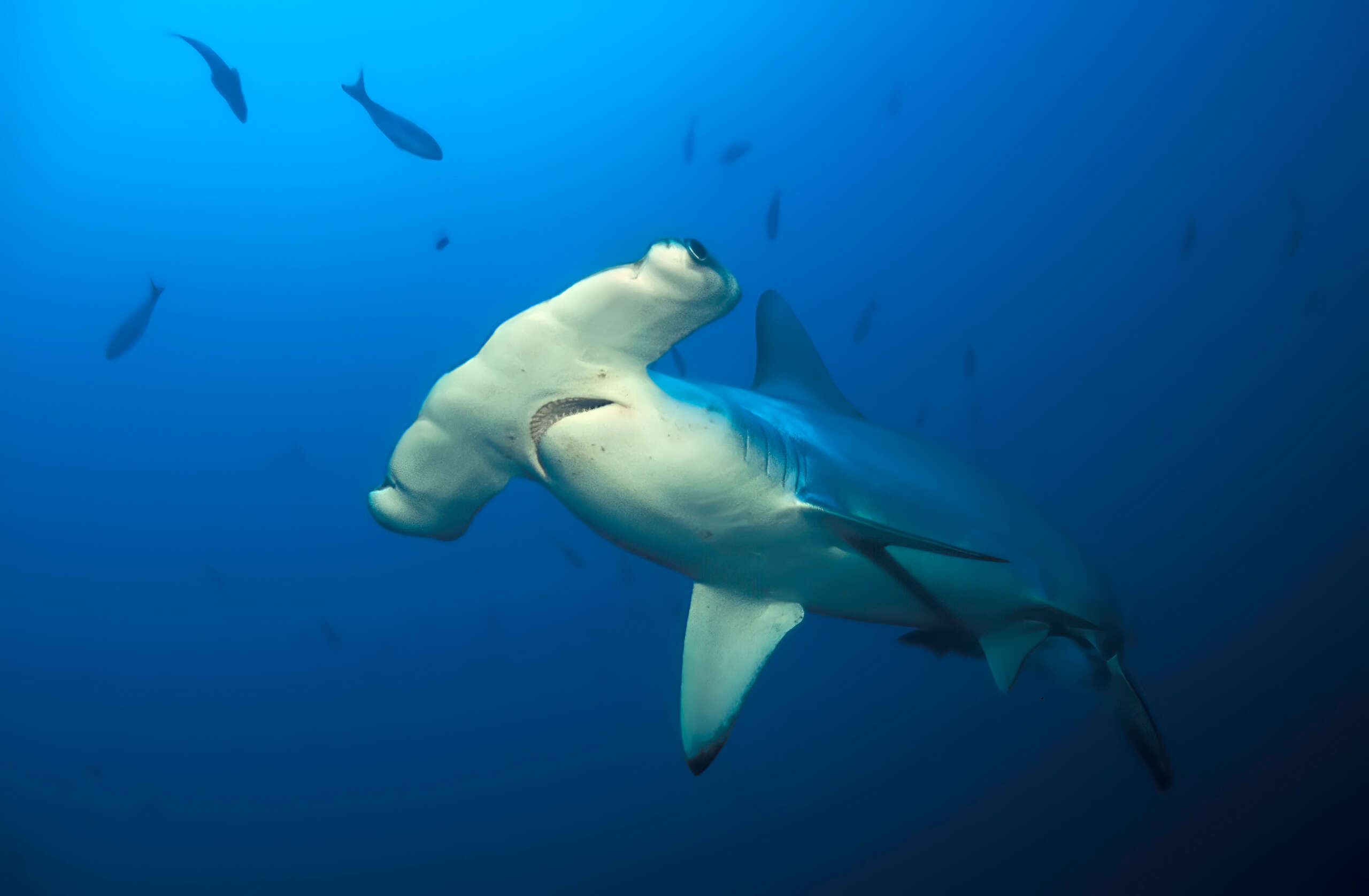
Divers in Little Cayman have reported unusual sightings of schools of hammerhead sharks.
While there have been several recent sightings of solitary hammerheads throughout the Cayman Islands, the last time schools of hammerheads were reported here by divers was in the 1970s. Other than then, the only other recorded sighting of a school of hammerheads was by underwater cameras during a scientific study of deep waters, to a depth of 650 feet, in 2022.
Johanna Kohler, a marine biologist at the Department of Environment, who runs the local Sharklogger Network, says it’s likely the individual hammerheads that been sighted are great hammerhead sharks, which are a solitary species, while the ones spotted schooling off Little Cayman are scalloped hammerheads.
Sighting of both species are exciting, Kohler says, but reports of the schools of the scalloped hammerheads on Little Cayman are a welcome sequel to the 2022 recording of that species at much deeper depths.
In March 2022, a team from Marine Conservation International and the Cayman Islands Department of Environment, using a baited remote underwater video system to survey marine creatures at depths of between 150-650 feet (50 and 200 metres), captured footage of a school of critically endangered scalloped hammerheads off the North Wall in Grand Cayman.
A scientific paper on that sighting was published in Frontiers of Marine Science publication.
When Kohler got the report from divers at Southern Cross Club on Little Cayman about a school of about a dozen hammerheads, “it actually gives me goosebumps, because I personally have been waiting since that event in 2022 when we saw them down deep”, she said.
The diving team at Southern Cross Club are members of the volunteer citizen scientist Sharklogger Network and logged the sighting.

Increase in hammerhead sightings
Mike Schouten, the dive manager at Southern Cross Club, said there have been four sightings of multiple hammerheads by crew and divers on his boats since January this year.
The first sighting was on 3 Jan. when two hammerheads were spotted together at The Cascades dive site in Jackson Bay, on the north side of Little Cayman. Then, on 17 Feb., came the largest sighting, this time of 10 to 12 sharks, at Lea Lea’s Lookout, also on the north side, during a dusk dive.
There were two more sightings in late May, Schouten said, with three to five of the sharks being spotted on 26 May, again at Lea Lea’s Lookout during a dusk dive, and then on 28 May, at Randy’s Gazebo, when six hammerheads were seen.
“The past years, we have had sightings of hammerheads, but they have been of individual sightings,” Schouten said.
He added, “I dive every day, I dive a lot. I’ve been diving these waters for 20 years. One thing I can tell you is that I personally have the feeling, and there’s no statistical data for this, but over the last couple of years we have been seeing more sharks, and we’ve also been seeing more hammerhead sightings than in previous years.”
Kohler says members of the dive community in Cayman, like Schouten, have been invaluable in monitoring the prevalence of sharks in local waters.
She says there is a theory that hammerheads prefer cooler sea temperatures, so they have been staying deeper, and that usually sightings were made in the winter months, but now, sightings are lasting longer into the summer months.
Protecting sharks
She added that “the second part of the equation might be just shark protection”, citing legislation that protects shark species in Cayman waters.
“We crossed the 10-year anniversary of our shark protection law last year. Now, we are seeing the very first signs of hope and evidence that the protection measures are working, but it’s also because … people have changed their behaviour,” Kohler said.
She said fishermen are now following DoE guidelines, releasing sharks they catch accidentally, and removing hooks and cutting fishing line.
“All these things are helping sharks to survive into adulthood,” she said.
She noted that schools of scalloped hammerheads are considered locally extinct in the Atlantic, so spotting the school at below 200 metres in 2022 had been “such a sign of hope”.
Kohler says Cayman should be proud of the conservation work that has been done here, and that results are being seen.
“What we are seeing right now is just a really special event, because in 2022 we saw them at depth, and now we are seeing these beautiful animals, that are critically endangered worldwide, on the top of the coastal shelf,” she said.
“It’s really a compliment to Cayman that we can actually reverse a projection of decline and loss of biodiversity. Because in other places around the world, you just see the trend of decline being continued, and seeing these positive changes here is really big.”
For more information on the Sharklogging Network, visit doe.ky/marine/sharks/sharklogger-network.
Related Videos