The educators of the Cayman Islands simply aren’t getting the backing they need, according to respondents to the latest Caymanian Compass online poll.
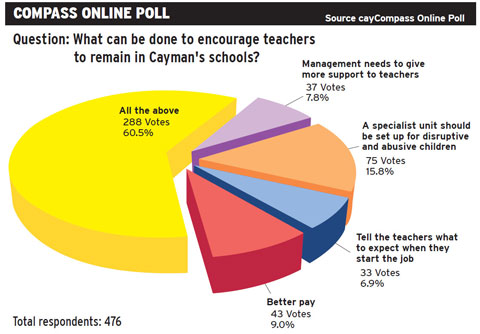
Of 472 respondents, 75 said that a specialist unit should be set up for disruptive and abusive children, making 15.8 percent of the 476 that took part. Better pay was called for by 43 people (9 percent), 37 people (7.8 percent) called for management to give teachers more support and 33 people said it was important to tell teachers what to expect when they start their jobs, which equates to 6.9 percent.
Significantly, however, well over half of respondents checked “All of the above,” an option that drew 288 people, equaling 60.5 percent of all votes.
Of those who checked an individual option, a range of comments were shared.
“Separate [the] pay scale from the rest of [the] civil service,” requested one person, who’d selected “Better pay.”
One participant called for “better training,” whilst another felt that “Parents need to teach their children discipline and respect.” Another person who selected that option thought that, “When government become passionate [about] education, so will the teachers.”
Telling teachers what to expect also brought a number of comments.
“Get the parents to bring up their children properly,” declared one person. “Children are routinely dropped off at public schools in Mercedes SUVs but with no breakfast. These unruly children are this way because they have no upbringing. Where are the traditional Caymanian values going?”
Another respondent felt that teachers were “already paid very well,” while another felt that instead of a [disciplinary] unit, increasing “the number of behavior specialists [was needed] so that more children can be supported in their own schools.”
Two succinct comments stood out from those who’d selected the option of setting up a specialist unit for disruptive and abusive kids.
“Deal with the disruptive students and tie pay to student achievements,” said one, whilst another was straight to the point, saying “Some parents need more of a whipping than their brats!”
The largest category – all of the above – also brought a range of comments.
“Most of time, most teachers will try and do the best they can,” said one contributor.
“Teachers cannot do this big and important job alone; parents, get up from the TV. Cayman parents many years ago did not have TV and did a much better job looking after their kids,” one said.
“Teachers need to go … who do not pull their weight. The pupils who misbehave or do not complete their exams should be held back at a lower level until they pass,” began another poll participant. “Specialist teachers should have the time and resources to help those who wish to learn and are having difficulties with school work.”
Another person wrote, “Unfortunately, some children have behavioral problems due to Autism and ADHD. The children here are not getting the therapy that they need which is setting them up for failure. With the right therapy when they are young, they can change.
“I think that we need to get less Caribbean teachers and more Caymanians or other countries who have experience and know more about special needs children. They don’t need to be locked up in a special school. They need to be productive members in society which happens in other countries. You missed out on a major problem: parents need to be more supportive.”
Finally, tongue firmly in cheek – we think – another person called for a return to a familiar but painful piece of teaching equipment from the past. “Bring back the cow cod!,” wrote the commenter.
Next week’s poll question:
What do you think of the kinds of questions being posed to applicants of permanent residence?
- They seem pretty obscure. Who knows this stuff?
- Anyone who researches the history of Cayman should know the answers.
- People should be provided with a list of questions and answers relevant to living in Cayman to study and then be posed a selection of those questions.
- They’re too easy. They should be harder.
- Other (explain)
To participate, visit caycompass.com.

Related Videos