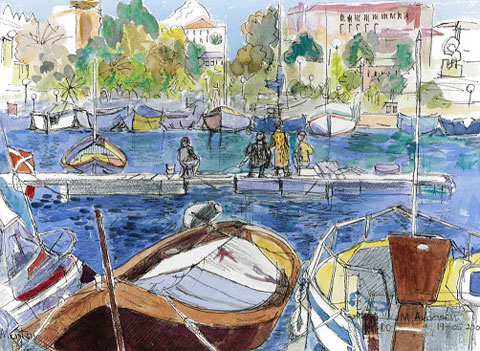
Two pieces of local artwork recently donated to the National Gallery of the Cayman Islands significantly amplify the gallery’s small but growing permanent collection.
According to the gallery’s director, Natalie Urquhart, creating a national collection of artwork is important because it tells the story of a people.
“They provide the record of a growing nation – from the mythic to the commonplace, the harmonious and the dissonant – as it defines itself in a rapidly changing world,” she says.
The artworks in the National Collection are held in trust for the people of the Cayman Islands by the National Gallery, the National Museum and the Cayman National Cultural Foundation via their respective collections. The National Gallery collection, Urquhart advises, is currently the smallest, with approximately 150 works of art, given that it is the youngest of the three cultural entities.
“Owing to the space restrictions – both for exhibiting and storing work – of the old National Gallery facility, and budget limitations, we did not actively collect artwork until 2012. Instead, we focused on developing and promoting local art via temporary exhibitions and education programs, which remains a central part of our mandate,” Urquhart said.
Since the move in 2012 to the new National Gallery building on the Esterly Tibbetts highway, with its purpose-built Permanent Collection Gallery, collecting has become a strategic priority, she says.
“We hope to grow the collection via donations and by creating an Art Fund sponsorship program.”
The donations
The recent donations by Maureen Andersen Berry and Miguel Powery have been greatly welcomed by gallery staff.
The family of the late C. Charles Adams donated a significant work by Miguel Powery in Adams’s memory. “Paradise Found, Paradise Lost,” which was painted in 1998, draws attention to the islands’ rapid development and reflects Adams’s long-term commitment to protecting the islands’ environmental and cultural assets.
Adams’s wife Susan and son Charles Adams presented the artwork to the gallery.
“This artwork was important to Mr. Adams, and it was his wish that it would eventually become part of the National Gallery collection,” said Urquhart. “Mr. Adams was a long-term supporter of the National Gallery, the National Museum and the National Trust … This poignant piece speaks to both of these important areas [environmental and cultural assets].”
Artist Maureen Andersen Berry donated “French Harbour with Boats” in memory of her daughter Juanita Marianne Berry. Ms. Berry, who completed the painting during an artistic sojourn in France in 2001, felt that it would provide a useful teaching tool for students of perspective, given that it includes three viewpoints.
The artists
Miguel Powery knew he wanted to be an artist after visiting Mr. Arthur’s General Store as a young boy and discovering a set of paints and brushes. He couldn’t afford to buy them, but he would visit often in the following months. One day weeks later, his sister presented him with the set and Powery never looked back.
In the years since, Powery has established himself as one of Cayman’s premier artists. He is a founding member of the Native Sons and has exhibited widely both locally and abroad, with the group and in solo exhibitions. His proudest accomplishments to date include a solo exhibit at The National Gallery of the Cayman Islands in 1999; a lifetime achievement award from the Cayman National Cultural Foundation in 2003; representing the Cayman Islands at Carifesta in Trinidad; and recently having work commissioned for the premier’s office.
Powery is also a master jewelry maker who works in precious metals, gemstones, coral and amber. His unique creations can be found in stores across the Cayman Islands.
Followers of Powery’s work are familiar with his paintings of Cayman’s maritime heritage, which has been his dominant theme for the past decade. However, the painting donated to the National Gallery stands out from the norm. Originally from a series of works created in the late 1990s and focusing on the rapid development of the island, “Paradise Found, Paradise Lost” explores the islands’ changing landscape. Powery’s intention is to raise awareness of this evolution.
Maureen Andersen Berry, who was born in Derby, England, is an artist and teacher who arrived in the Cayman Islands more than 30 years ago. She was instantly struck by the beautiful flora of the islands, which she has been busily painting, in oils and watercolors, ever since. An active member of the art community in Grand Cayman, Berry taught art at the original John Gray High School and was head of the art department at the middle school. Since her retirement in 1991, Berry has traveled extensively, pursuing her passion for painting and drawing dolls.
Berry’s work is from her trip to the Mediterranean, a region known for its magnificent light.
The subject – a French harbor with boats – differs from her Cayman-themed paintings which often depict landscapes and traditional cottages, as well as still lifes. The National Gallery possesses a couple of excellent examples of these works in the collection, Urquhart says.
“This particular [donated] painting is a study in perspective. It shows three different viewpoints (foreground, middle, distance) and was donated specifically for this purpose, as a teaching tool,” Urquhart says. “Education remains a great passion of Maureen’s.”
Important reference point
The National Gallery’s collection incorporates a wide variety of media and subject matter, Urquhart says. It illustrates the ways in which artists have captured both the ordinary and extraordinary aspects of life in the Cayman Islands over a period of 40 years.
“Seen collectively in the Permanent Collection Gallery, the artworks trace an historical and stylistic journey – starting with the visionary markings of self-taught artists like Gladwyn ‘Miss Lassie’ Bush and moving forward to the early work of realist painters who sought to capture the idyllic, nostalgic aspects of ‘the islands time forgot,’” she explains.
“By the early ‘90s, with the birth of groups like the Native Sons, the art begins to express a new vision influenced by the changing realities of the time: economic prosperity, population growth, environmental distress and hurricanes. These artists are looking at color, canvas and material differently and are refusing to be defined by traditional themes, using their art to explore social issues and techniques that are designed to encourage dialogue.”
Importantly, she adds, these works are being protected for future generations.
The National Gallery’s Permanent Collection features work by more than 60 local artists. Selected works can be viewed daily in the Upper Gallery. Admission is free.

Related Videos