

‘Part of Cayman fabric’ back on George Town waterfront

Just prior to the 10-year anniversary of its destruction in 2004’s Hurricane Ivan, the Cayman Islands Catboat Club clubhouse was in ship shape for its grand re-opening Saturday on Whitehall Bay, George Town.
“It’s a big day for me,” said Catboat Club Vice President Kem Jackson. “I didn’t think I’d live to see it.”
“Before the advent of pick-up trucks, the catboat was the pick-up truck of Cayman,” said club member Loxley Banks. “It transported dead bodies, it transported sick people, it transported foodstuffs, it transported material.
“There were some romances born in catboats, especially between Grape Tree Point in North Side and West Bay Morgan’s Harbour area.”
The building just north of the downtown port on North Church Street that had been a local seaman’s home before it was purchased by the Catboat Club was devastated in Ivan and has been vacant ever since.
Catboat Club President Jerris Miller said his group had a lot of interest from local merchants who donated construction materials for what was eventually $650,000 in repairs needed on the old house, but the labor costs proved daunting.
“I need to get across how appreciative we are for the property sponsorship,” Mr. Miller said. “In the beginning, I had all the materials to build this thing back with no money to pay for the labor. That’s where Dart stepped in … that’s what got us to the finish line.”
In September 2012, the Dart group of companies came forward with a support package worth $175,000, including a $100,000 cash grant and a three-year events sponsorship deal worth $25,000 annually. The grant money was used for several initiatives, including allowing the club to put $75,000 toward its clubhouse project.
“We were able to double that with corporate donations from businesses on the Island, so we were able to get $150,000 of work done,” Mr. Miller said. Donations of materials were received from Flowers Block, A.L. Thompson’s Home Depot and Watler’s Metal Products, Cox Lumber and Kirk Home Center.
“This project has come together because a lot of people gave,” said Ken Hydes, representing the Dart group at Saturday’s event. “I don’t think that commitment to the Catboat Club ends today.”
“Rather than [children] going to school and reading about it, they can come here and be a part of history,” Deputy Governor Franz Manderson said at Saturday’s opening ceremony.
Catboats have left an indelible mark on Caymanian society and history, but Mr. Miller said the club did not intend for the small, light-blue boats merely to remain a museum piece.
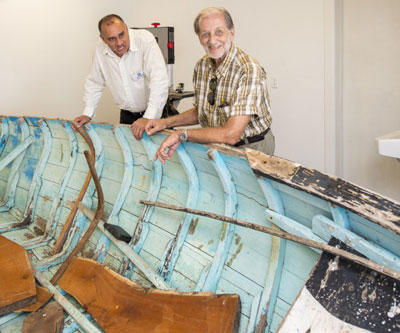
Part of the new clubhouse contains a museum detailing the history of the boats, as well as space for meeting rooms and, potentially, a restaurant. However, on the side of the building is a garage where catboat repairs, and possibly even new construction, will get under way in the near future.
Mr. Miller said there is already one such repair project getting started on a vessel built in 1926 which his son is working on refurbishing.
“Blue Nose is the name of the boat. It was built by one of the premier schooner-builders on the islands, Elroy Arch,” Mr. Miller said. “It actually sat in a garage for 30-35 years and nobody knew it was there.”
“This boat is in the best condition of any of the boats we had [to refurbish after Hurricane Ivan],” he said.
Ivan not only destroyed the catboat clubhouse, but most of the remaining seaworthy catboats in the islands. Of the dozen that existed before September 2004, only three survived. Today, there are about seven seaworthy catboats remaining in Cayman.
“And the youngest boat out there is about 60 years old,” Mr. Miller said. “We have to start building new catboats. It’s our mission. Catboats haven’t been built on the island for a quarter century. We want to teach people how to build catboats, because there’s only two or three of the original catboats left. We want to maintain these as working crafts.”
The Catboat Club clubhouse also serves as an interesting example of old time Cayman architecture, Mr. Banks said.
“They can see some of what went into building a house back 100, 110 years ago,” Mr. Banks said. “There’s a display of the wattle and daub tradition, there’s an ironwood post in the middle of the building which is probably 110 years old.”


Related Videos









How about getting some of the prisoners at Northward involved in building some new Catboats?
Traditional carpentry and shipwright skills are labour intensive and require patience and attention to detail. Woodworkers and Carpenters are in demand by the construction industry.
Paying a shipwright to build a catboat would be prohibitive but giving the prisoners a chance to give back to the community would have benefits all round.
With a few new club boats available teaching sailing skills to youngsters would become a much easier and practical proposition.