

Recent statements from Caribbean Utilities Company, OfReg and rooftop solar installers have shown that electricity is a contentious topic in the Cayman Islands. Perhaps the only thing that all parties agree on is that something must change.
Cayman’s electricity prices are about 20% more expensive than the Caribbean average. It also has less renewable energy production than its neighbours. With just 3% of Cayman’s electricity produced from renewable sources, the jurisdiction will have to move fast to meet the ambitious National Energy Policy target of 30% renewable power by 2030.
The other factor forcing change is demand. Economic expansion – including hotel developments – coupled with rapid population growth, is predicted to push Cayman’s peak electricity demand to 143 MW in 2030 from 129.5 MW in 2025.
But while all the key stakeholders agree that Cayman’s electricity generation needs to change, there is intense disagreement about the best route forward. The debate is nothing new, but with economic and political pressure building, it looks likely to be settled in the next few years.
The outcome is of vital importance to everybody who lives in Grand Cayman. Not just because of the bill they receive every month from CUC or Island Energy, but also because an abundant, reliable supply of low-cost energy would increase Cayman’s economic growth potential.
Will renewable reduce electricity bills?
At present, around 97% of Cayman’s electricity is generated from diesel-fuelled power plants. That means that when the cost of oil goes up, electricity bills move higher. Historically, diesel-fired generation was seen as the best option for small Caribbean islands that lacked the scale to justify large coal or nuclear power plants. But over the last 20 years, steep decreases in the cost of solar energy technology have given Cayman a new option.
Finance firm Lazard’s influential ‘Levelized Cost of Energy Report’ found the unsubsidised levelised cost of utility-scale solar in the United States fell to an average of 5.8 cents per kilowatt hour (c/kWh) in 2025, down from 35.9 c/kWh in 2009. The precise numbers would be different in Cayman, yet the powerful trend of falling solar costs would still apply.

Indeed, one of the few things that all sides in Grand Cayman’s energy debate agree upon is that solar costs have dropped. “Solar systems are much cheaper [on a cost per kWh basis] now than they were 15 years ago,” said James Whittaker, founder of the Cayman Renewable Energy Association and CEO of GreenTech Group – a rooftop solar installer.
Richard Hew, CEO of CUC, agrees, “Ten years ago, the cost of solar was expensive, even for utility-scale solar. Now, utility-scale solar is the cheapest form of renewable energy that is available and would allow for cost savings for our customers.”
But for Jonathan Tibbetts, general manager of Island Energy, the electricity generation and distribution company for the Sister Islands, the main advantage of solar is price stability. “Diesel prices are very volatile. Right now, they’re high – they could go higher. We simply don’t know.”
Island Energy aims for utility-scale renewable energy to fuel up to 55% of electricity in Cayman Brac and up to 75% in Little Cayman. “For long-term stability in electricity prices, you need some sort of stability in your fuel source,” said Tibbetts.
Utility-scale solar versus distributed solar
All the key stakeholders agree that solar energy has the potential to reduce electricity costs and make power bills more predictable. The dispute is about what type of solar project is best for Cayman.
One option is large-scale solar operations, known as utility-scale solar. At present, the only utility-scale solar in Cayman is the 5-megawatt (MW) Bodden Town solar plant, which is operated by InterEnergy and sells electricity via a power purchase agreement at 14.28 c/kWh to CUC.
The other option is smaller distributed solar systems – often known as ‘rooftop solar’ – placed on homes and businesses. According to CUC figures, Grand Cayman has 0.4MW of rooftop PV per 1,000 utility customers. That’s below Barbados at 0.7MW, but ahead of the Bahamas and Jamaica.
One key advantage of utility-scale solar is cost. The Lazard report estimates the unsubsidised levelised cost of smaller solar projects in the US was 14.9 c/kWh in 2025, compared to 5.8 c/kWh for utility-scale solar.
But Cayman is not the US. Here, land is at a premium and rooftop solar can be placed on unused space, such as the roofs of warehouses and supermarkets, whereas new utility-scale solar projects would have to buy additional land at Cayman price levels. For example, the Bodden Town solar farm is on a 20-acre site.
Tibbetts acknowledges that land was an issue in the past, but says improved solar technology means large projects need less space. “Before the newer solar panels came out … around 1MW would equal about 10 acres of land, at least,” said Tibbetts. “Now it’s almost four acres to 1MW.”
CUC estimates that utility-scale solar plants in Cayman can deliver electricity for less than 10 c/kWh.
Will Cayman meet the 2030 target?
In 2025, the combination of the Bodden Town plant, plus the rooftop systems, produced around 3% of the Islands’ electricity. That 3% is far short of Cayman’s target of 30% by 2030. To that end, the Utility Regulation and Competition Office (URCO), which is also known as OfReg, has received proposals for a planned 22.5 MW solar dispatchable photovoltaic project, defined as a solar park with a battery. URCO told the Compass that it has already narrowed down the proposals to a group of shortlisted bidders and will be ready to make a decision in the next few months.
But given that Grand Cayman has an existing total installed capacity of around 171 MW – if you include the Bodden Town solar farm – then the 22.5 MW solar plant won’t be enough to reach the 2030 renewable target. CUC has sent URCO a ‘certificate of need’, which indicates that Grand Cayman will need an extra 94 MW of additional generating capacity by 2029. If a significant portion of that capacity is met by renewable energy, then Cayman could meet its 2030 target.
CUC believes those projects will ensure Cayman meets the 2030 target. But it estimates that if CUC were to win the bids, it would need to spend an additional US$400 million to US$500 million over the next five to 10 years.
Neil de Vere, the founder of ProSol Engineering, says there is “no chance” that the 2030 target will be met. “The 22.5 MW utility-scale solar procurement process alone has already taken about six years and URCO hasn’t even chosen a contractor to build the farm, which means we are another three years away from seeing it come online.”
The rooftop solar installers’ argument is that distributed solar could help Cayman meet the targets more quickly.
“If you have widespread distributed generation – solar on rooftops, parking lots and businesses – then you also need less large-scale utility infrastructure,” said Whittaker. “Instead of needing 400 MW of utility-scale solar farms, maybe you only need 200 MW.”
In a written statement to Compass, CUC denied that it opposes distributed solar. “Rooftop solar has a significant role to play in the country’s energy transition and could contribute between 20% and 40% of the 2045 NEP target.”
Is rooftop solar being obstructed?
In May, the ongoing dispute between the rooftop installers and CUC flared up in public. Some of the rooftop solar installers issued a petition calling for action against CUC, sparking public responses from URCO and CUC.
The rooftop installers say CUC is hindering the development of distributed solar. “The frustrating thing is that rooftop solar isn’t really being allowed to scale,” said de Vere. “CUC’s preferred model is utility-scale solar that they control directly. They want a monopoly on renewables the same way they historically had a monopoly on fossil-fuel generation.”
Whittaker agrees. “CUC’s profit incentive is based on investing in infrastructure and selling kilowatt hours of electricity. If consumers have solar panels and batteries producing 50% of their own electricity, that’s 50% fewer kilowatt hours being bought from the grid.”
The rooftop solar installers argue that the existing regulatory frameworks that allow distributed solar in the Cayman Islands are designed in a way that hinders the development of the technology.
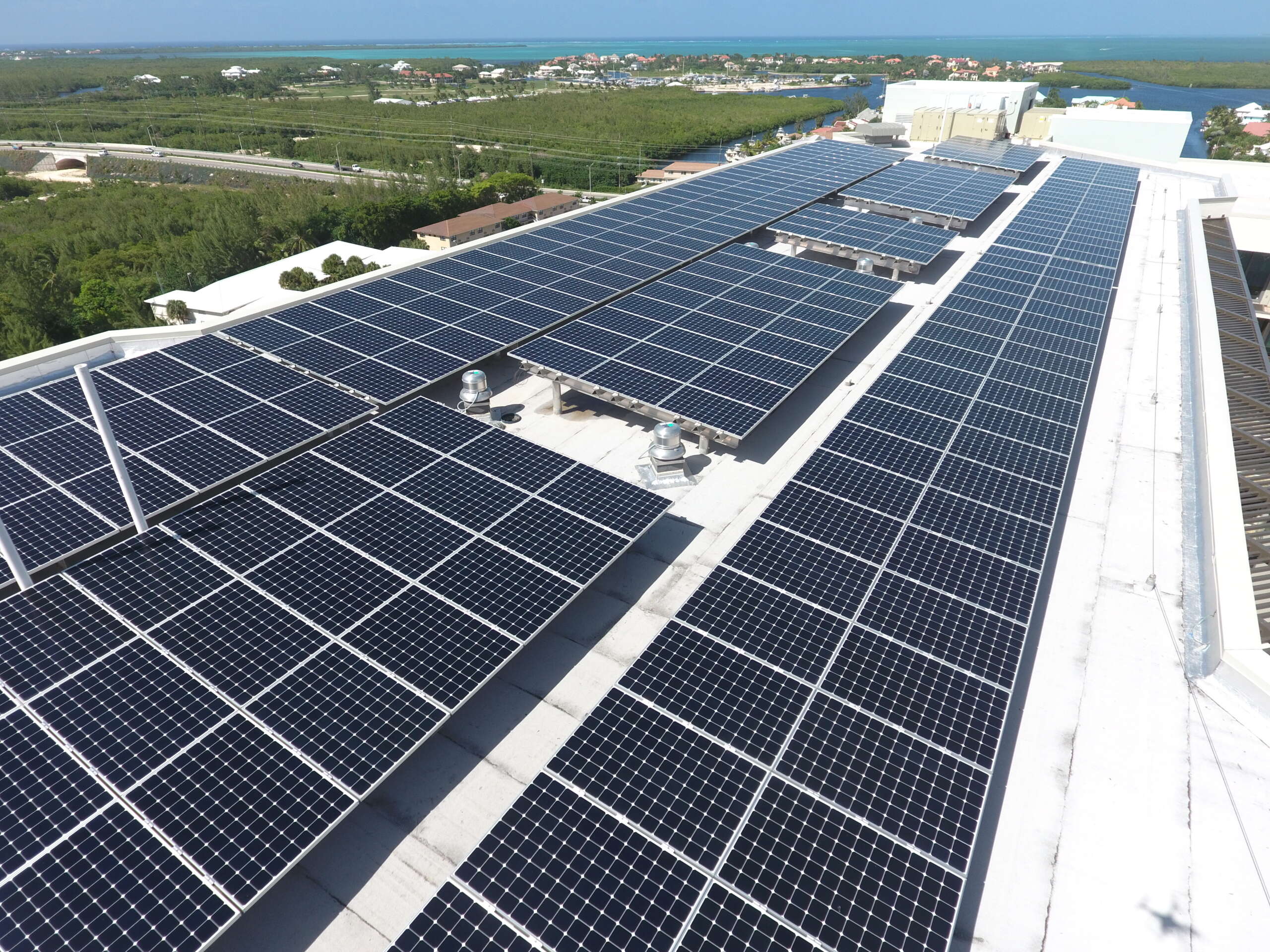
The most common way for households in Cayman to have solar energy is via the Consumer Owned Renewable Energy programme. CORE is a net-billing programme that sees users provide power to the grid in exchange for a rebate off their bill. The maximum size of a solar unit eligible for this programme is 15 kW.
“The utility argues that the rates are too expensive and subsidised, but our response has always been: If you allowed larger commercial systems, the average cost would actually come down significantly because of economies of scale,” said Whittaker.
For larger solar systems up to 250 kW in size, there is the Distributed Energy Resources programme. DER allows large residential properties and businesses to directly consume the energy they produce, with the option to sell any excess production back to the grid, while they can also take power from the grid when needed.
“The concept itself isn’t bad,” concedes Whittaker. “The issue is how the rates and tariffs are structured. Under DER, large users often get moved into higher electricity-rate classes once they install solar and the programme itself is complex and uncertain. So, you may save money through solar generation, but your tariff classification may change and your base electricity bill increased, often times dramatically.”
The final way to use your own solar power in Cayman is self-consumption, a right that is specified in the National Energy Policy. This applies to systems up to 20 kW plus battery. Some self-consumption users are completely off-grid, relying on their own panels and battery systems, while others take energy from the grid but don’t have the right to re-export energy.
Over the last month, self-consumption has proved one of the most controversial parts of Cayman’s renewable energy sector. “When it came time for inspections, CUC objected and argued that the systems were not compliant with the solar programmes they control, despite the fact that government policy allowed them and the Planning Department had approved them,” said Whittaker.
Following the controversy, URCO said it will update its self-consumption policies. “The Board is set to meet next week to discuss the necessary guidance the Office will issue, which will be aimed at making the rights and obligations clear for all stakeholders,” said URCO in a written statement to the Compass.
The grid operator view
For CUC, the matter is clear. “The grid exists because you can use the scale of the grid to make electricity available to everyone at a lower cost, more safely, and more reliable than if customers were to produce it on their own, on the premise that everybody pays their fair share,” said Hew.
It’s not just about economics, it’s also about safety and reliability, said Tibbetts. “Utilities companies are focused first and foremost on safety and, because of that, any third party that connects to the grid, whether a standby generator or renewable source of energy, must do it in an approved manner,” said Tibbetts.
Crucially for CUC and Island Energy, the regulator agrees with that point. “If someone wants to connect to the CUC grid, then certain requirements apply,” said McCleary Frederick, URCO’s executive director of energy. “We believe that all homeowners have a right to participate in renewable energy generation for self-consumption; however, we need to make sure the lights stay on and that bringing renewables online does not disrupt reliability of the supply, result in unsafe operations of the grid, or result in unreasonable rates for the consumer.”
Smaller grids often find it harder to incorporate solar energy because they have less capacity to absorb intermittent power production. In 2023, Barbados, which has a larger grid than Grand Cayman, paused distributed solar installations while it builds the battery capacity to smooth out the fluctuating solar input.
Solar energy is by its nature intermittent – so utility-scale solar can also cause instability – but utilities find it easier to incorporate large solar plants that they control into their grid, rather than thousands of tiny ones that they don’t.
And while Grand Cayman’s current power supply is costly and diesel-powered, it is also very reliable. Regional utilities association, CARILEC, recently awarded CUC for providing the most reliable electricity service in the Caribbean.
URCO’s role as referee
It is not surprising that competing business interests are vying for different regulations. That’s why energy sectors around the world have regulators to set balanced rules.
“The rates for the CORE programme are determined by the URCO Board,” said Frederick, adding that URCO is now adapting to the National Energy Policy. “URCO had already established a couple of programmes to allow integration of solar, but the National Energy Policy goes broader than the established programmes. So now we have to work with key stakeholders to ensure that the goals of the policy can be met.”
But the rooftop solar companies believe URCO is failing as a regulator.
“The reality is that nobody in government or regulation seems willing to fundamentally challenge the system,” said de Vere.
Whittaker does believe there has been some improvement. “I think the previous management of URCO was far too weak on CUC, but the current regime is better and more balanced. I don’t think they simply rubber-stamp requests CUC anymore.”
But he thinks URCO doesn’t have the energy specialists it needs to properly regulate the sector.
“OfReg lacks the technical expertise required to properly regulate a modern renewable energy market,” said Whittaker. “They need world-class technical consultants on retainer to provide ongoing expertise.”

“URCO was really set up as an economic regulator,” said Frederick. ““The legislation was designed to encourage competition, protect utility national infrastructure, encourage renewables and protect the consumers’ interest. It wasn’t really set up to regulate the technical engineering side of the industry in detail.”
“CUC obviously has far more technical capability than we do, but that’s not necessarily the area we were created to regulate,” said Frederick. “The technical requirements come from the electrical code, which has existed since the 1970s.”
Ultimately, it’s not URCO’s job to implement Cayman’s National Energy Policy. That task falls to the Ministry of Health, Environment and Sustainability, which declined to provide comment for this article.
Readers could be forgiven for losing track of the long-running debate between CUC, URCO and the rooftop installers. Yet the vital issue looks set to be resolved soon. There are only three rooftop solar companies left in Cayman, and de Vere says that his rooftop solar company will be forced out of business “within a few months” unless there is a change to the solar programmes. Meanwhile, CUC’s certificate of need says the 94 MW project must be commissioned by January 2029 to meet growing demand. And the government’s own ambitious renewable energy targets have also set the clock ticking.
If the large utility-scale projects are delivered on time, at a lower-cost than rooftop solar and help Cayman meet its targets, then the CUC approach will have been vindicated. If those projects are delayed and Cayman misses its renewable targets, then many in the jurisdiction will rue the missed opportunity with rooftop solar.
Related Videos










The largest consumer of power is a
AC
A cold loop to the ocean that draws water from a dept of 300 ft is 50 deg.
It is returned to a depth of 75 ft so return water is same temp as existing no heat polution
A couple of 24 inch loops at low pressure could be retro fitted to existing ac. 5 to 7 year pay out and 75 percent savings.
Runs 24 hrs a day. Complete sovereign energy. Tiny enviromental impact. Just a trench.
Honolulu is the ref
Build smarter
Steven with the best comment I’ve ever read on Cayman Compass.
It’s a monopoly in Cayman and all a scam due to people holding CUC shares which would be worthless if there is market competition. Not letting people have their own solar is so anti green. Never seen anything like this in my life. Closest thing is communist China which is far more open to capitalism then the Cayman electricity seen.
This who solar thing has been talked about so much but nothing will ever be done due to exclusive contracts and this current government flush with CUC shares.
Every significant monopoly in the world acts the same way. They seek, at all costs, to stifle innovation, restrict competition and continue the monopolistic power that they have. CUC is no different.
Only 3% of our electricity is generated by Solar – Shame on us for allowing this to happen and to continue. CUC will do everything they can to restrict solar unless they control it. The 3% figure shows this to be the case. This isn’t just bad for consumers but bad for our country – Cayman.
There is a simple and effective solution to this. CUC needs to be split up into 2 parts. The first is the grid which can remain a monopoly provided CUC agrees to a reasonable return on investment, lower than it currently receives. The second is generation and here, competition needs to be actively encouraged by this and every following government. This will spur innovation and jump start the use of solar and battery storage both in residential and commercial spaces.