

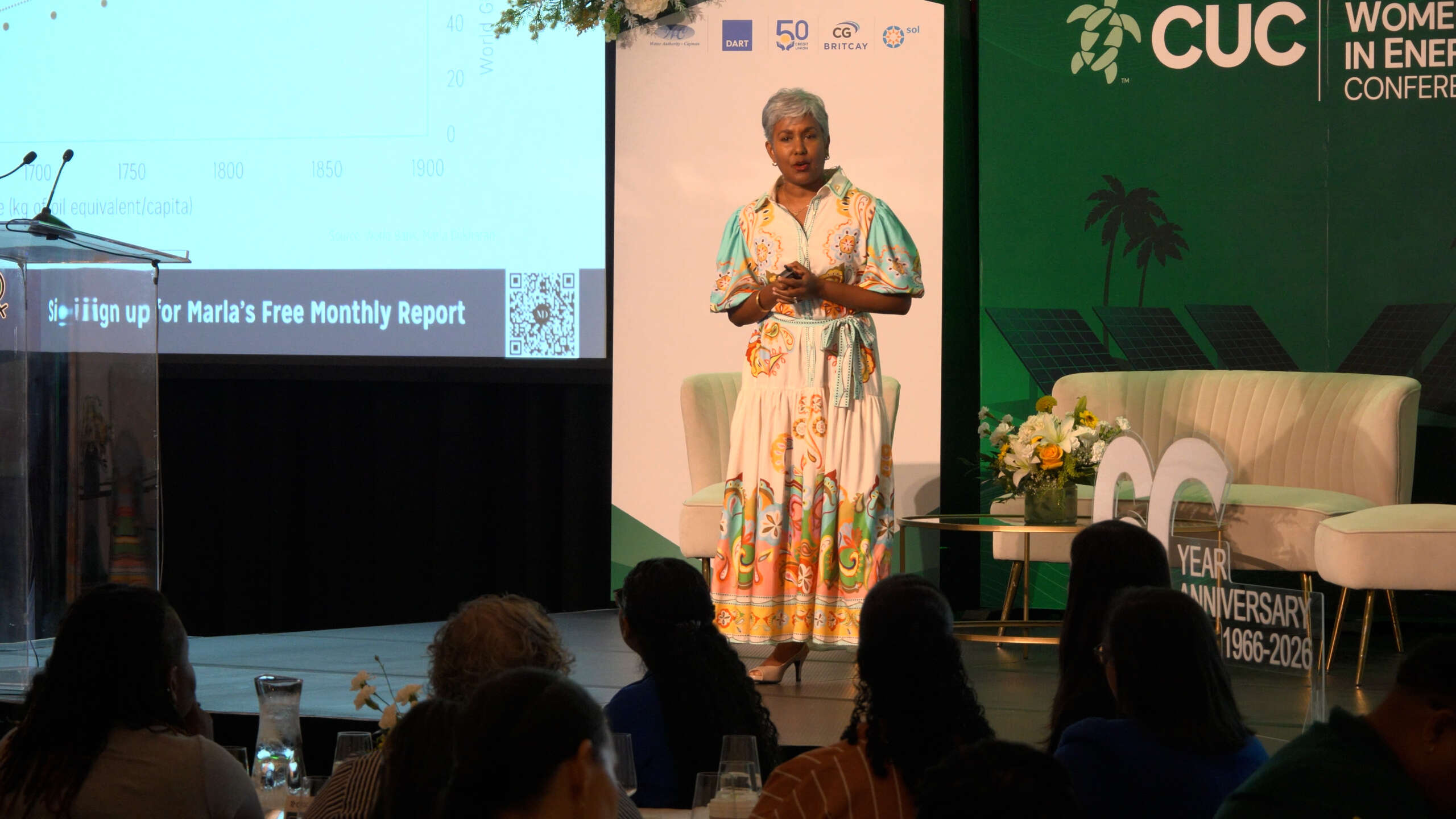
Marla Dukharan, a leading Caribbean economist, made a strident appeal for renewable energy during her keynote address at Caribbean Utilities Company’s Women in Energy Conference, held at Hotel Indigo, Grand Cayman on 22 May.
Dukharan began her presentation, with a robust defence of energy consumption. “Poverty can’t be solved without the consumption of energy – there is a very strong relationship between getting people out of poverty and the energy they use.”
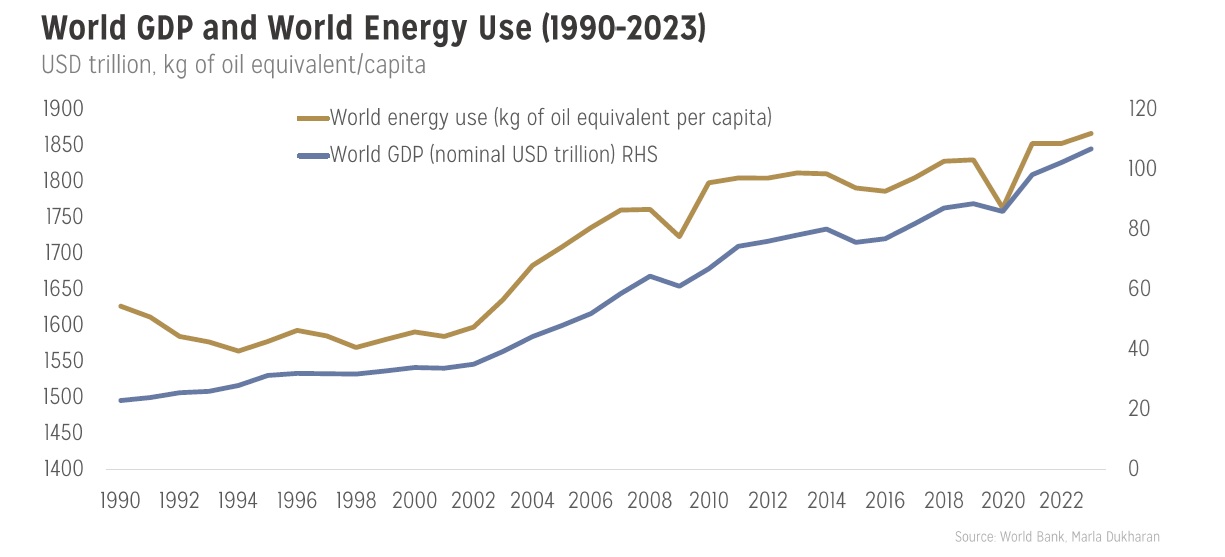
Dukharan, then countered recent economic claims that energy consumption is not linked to economic growth. That argument had become popular among some economists in developed economies that saw their energy use flatline as they outsourced manufacturing to China. Yet she showed global statistics that demonstrated the positive correlation between GDP expansion and energy consumption.
“Energy intensity of GDP is not declining,” said Dukharan. “Especially with AI, which is a big consumer of energy, we will not see this relationship diverge or decouple; [instead] we will see a strengthening of the relationship between economic activity and the amount of energy we use.”
It’s a key message for the Cayman Islands, where rapid population and economic growth have driven energy demand close to the limits of current installed capacity.
Dukharan didn’t pull any punches when it came to her analysis of Cayman’s current energy mix, noting that the jurisdiction’s existing energy production is more expensive and less renewable than the regional average.
“Cayman’s electricity prices were 20% above the regional average in 2025,” said Dukharan.
With around 3% of its power generated from renewable sources, Cayman’s electricity is also less clean than most of its peers in the Caribbean, where the average share of renewable energy is approximately 15%. Cayman’s National Energy Policy calls for 30% renewable energy by 2030.
Yet it wasn’t all bad news. Dukharan noted that Cayman has far fewer electricity outages than other countries in the Caribbean. The regional annual average for electricity disruption is 17 hours, while in 2023 Cayman only had 1.7 hours of disruption. That has a wider economic impact, said Dukharan, because across the Caribbean businesses lose an average of 6.4% of annual sales because of power cuts.
Energy imports fuel inflation
Cayman’s Economics and Statistics Office recently upgraded the jurisdiction’s 2026 inflation estimate to 5.3% from its previous projection of 2.6%. Dukharan believes that expensive energy imports are a direct driver of Cayman’s ever-increasing cost of living.
“Imported inflation via fuel is one of the most important drivers of the cost of living in the Caribbean and Cayman,” said Dukharan. “Imported fuel accounted for 4% of Cayman’s GDP in 2024.” Indeed, the US$221 million that Cayman spent on importing fuel in 2024 was double the 2014 level.
Cayman’s government recently announced a $9 million temporary “relief package” to protect Cayman families from rising gas prices at the pumps, and on electricity bills during the summer months when rising temperatures increase electricity bills. Yet Dukharan warned against energy subsidies.
“We need to target the relief very closely [because] rich people are the ones who disproportionately benefit from fuel subsidies globally. Rich people have more air conditioning units, more refrigeration and more [electricity-consuming] devices than poor people, so energy subsidies are not very targeted.”
Dukharan expressed optimism that “Cayman is small enough for government to accomplish [targeted relief].”
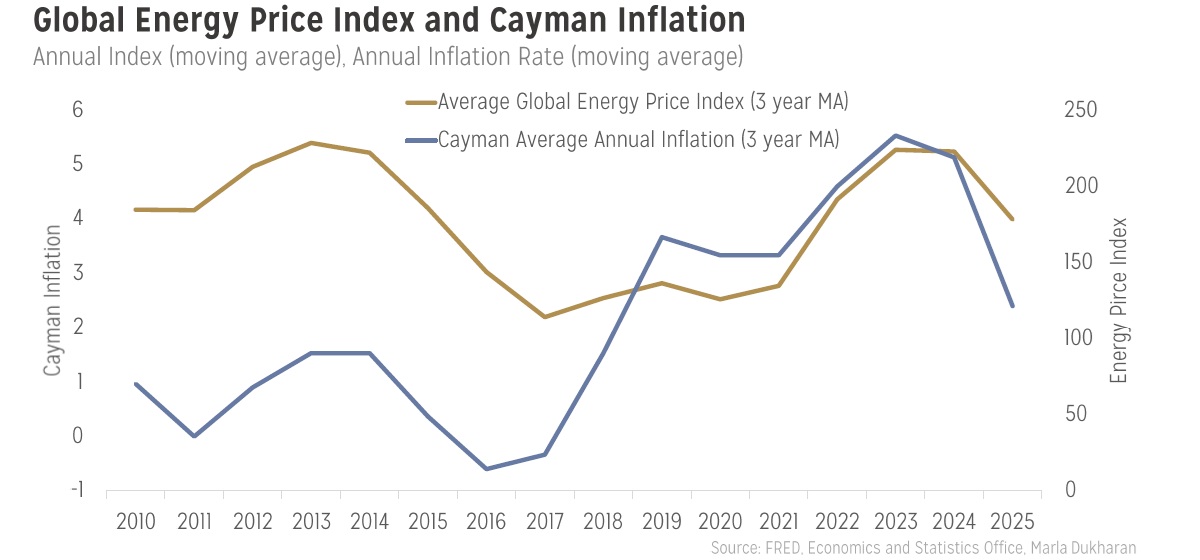
Switching to renewable energy would cut Cayman’s fuel import bill and help to dampen inflation, said Dukharan, who displayed a graph that showed the direct link between the global energy price index and inflation in Cayman.
Dukharan was keen to emphasise that renewable energy also brings strategic benefits for Cayman. Citing regional examples, she noted that solar energy can be quicker to restart in the wake of a hurricane. She also referenced the energy crisis being experienced by “our brothers and sisters in Cuba” and noted that renewable power would give Cayman greater energy independence and security.
Globally renewable energy investment attracted US$870 billion of capital in 2024 compared to the US$543 billion invested in oil and gas projects that year, said Dukharan.
Related Videos













Why Cayman governments have been so slow to properly utilise solar energy is a real concern. We have year-round sunshine and solar farms are relatively straightforward to set up. Yet the government lets the public pay ridiculous charges each month to import fuel just to keep their homes cool. I think this should be scrutinised far more than it currently is.