

Bodden Towners say speeders a menace

Despite highly publicized problems with burglaries and thefts on Grand Cayman over the past 18 months, Bodden Town residents indicated Tuesday night that they are far more concerned about dangerous speeders in their district.
“It is criminal what is happening in the main part of Bodden Town,” said Tom Zerhusen, one of about 25 residents who attended a community meeting with local police Tuesday at the James M. Bodden Civic Centre. “The big trucks … come through Bodden Town at speeds you would not believe – 50, 60 miles per hour. It just reverberates through the whole town.
“I can’t believe you guys [referring to the police] can’t hear it,” he said.
Royal Cayman Islands Police Service Chief Inspector Brad Ebanks said his officers were aware of the speeding issues through the narrow streets of historic Bodden Town, but at the moment he had only three patrol officers assigned to a shift. One officer to police the Savannah area, one to monitor Bodden Town and the third to keep an eye on North Side and East End.
It’s a huge area to cover and Mr. Ebanks said he hoped, with some new police officers being brought on board, that staffing could be increased to six officers per shift.
“Why not use speed cameras to catch these people?” Mr. Zerhusen said. “At $200 a ticket, it would be a hell of a deterrent.”
Bodden Towners may be glad to know the government is looking into that option at the moment.
Speed cameras’ cost and technology are two of the issues under review by the government-appointed committee that oversees Cayman’s public closed-circuit television camera surveillance operations as it considers adding these cameras to the system.
Speed cameras, which are used in a number of jurisdictions – including the U.K. – automatically issue tickets for speeding and other traffic offenses after photographing drivers and vehicles “in the act.” Depending on the system, those citations can then be issued through the mail, electronic mail or other forms of electronic media.
The addition of speed cameras to the current CCTV system would cost at least hundreds of thousands of dollars. Brent Finster, director of the Cayman Islands 911 Emergency Centre, said Monday that price is one of the issues being reviewed by the national committee.
“The current CCTV core infrastructure does not have speed recording capability,” said Wesley Howell, deputy chief officer of the government Ministry of Home Affairs. “However, infrastructure created in phase 1 of the [CCTV] project could be used to transmit data from speed cameras.”
The CCTV system already has what are known as automatic number plate readers or ANPR cameras. These devices capture images of the license plates of vehicles on public rights of way.
The ANPRs are useful for tracking down individuals who may have been in the area at a time a crime was committed. However, using them to catch speeders or stoplight scofflaws is unlikely.
“It would be impracticable to use ANPR for speed detection,” Mr. Finster said.
Mr. Howell said that while speed cameras are now legal under the Cayman Islands Traffic Law, issuing traffic tickets electronically would require legislative changes. “But it is possible with the technology that is on the market now,” he said.
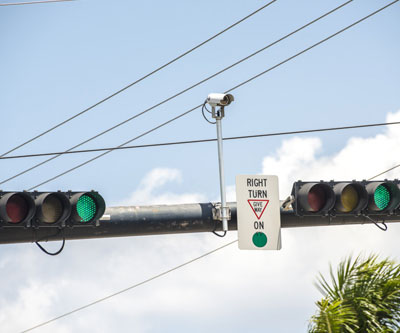
Speed cameras and red-light cameras – which take photos of cars that ignore stoplights – were never part of the original CCTV plan, Mr. Howell said, but the potential for using both technologies has been discussed in recent years. There is no funding set aside in the current government budget to pay for speed or red-light cameras, or the computerized “brain” needed to operate them. Nearly two years ago, Home Affairs Ministry chief officer Eric Bush said that government wanted to add both to the CCTV system.
The speed cameras, which can either be fixed or mobile, depending on how the system is designed, would be used to automatically issue speeding citations working with the existing licence database maintained by the Department of Vehicle and Drivers’ Licensing.
“The same system could also be used for fines for not paying your licence tag on time, if your insurance has lapsed,” Mr. Howell said.
The proposed red-light cameras would do the same, but they would only be mounted at stoplight intersections, Mr. Howell said.
Both types of cameras would likely have to operate from “pods” separate from where the CCTV system’s fixed, pan-tilt-zoom and automated number plate readers are located.
The RCIPS has mobile trailers in place that show the speed of passing drivers. Speed cameras might also be affixed to those trailers.

Related Videos













When you read this story bear in mind that there are a number of options available here.
Before joining Cayman Net News in June 2006 I spent several years studying the impact of fixed speed cameras on road casualties in the UK. It was a very disappointing exercise that showed they were vastly over-rated.
During this work it emerged that while fixed speed cameras may be very good at reducing speeds at one particular spot their overall effect was minimal. In fact you could see cars slowing down for the cameras then immediately speeding up again, which in itself created a new traffic hazard. Some cameras are triggered by sensors buried in the road and vehicles could simply be driven round them on the wrong side of the road generating more problems.
Since then a new generation of speed cameras has been developed, commonly known as SPECS they measure average speed over a fixed distance. These are very effective and would seem ideal for Bodden Town because they force drivers to stick to the speed limit through the whole area rather than at just one spot.
Of course if the problems is mainly with trucks there is another solution – make the installation and use of tachographs mandatory.
Red light cameras installed in a town near me lasted 18 months before the citizenry revolted and they were removed. I don’t have personal experience with speed cameras, but Mr. Evans’ comments seem logical.