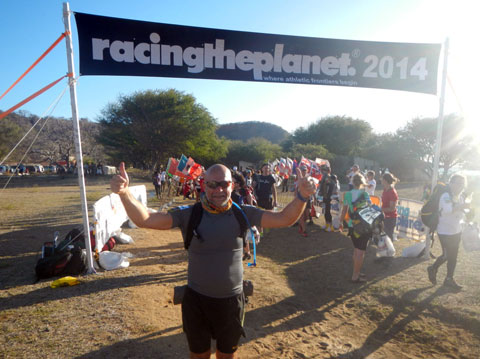
Intrepid ultra-distance runner Kenneth Krys has just conquered another grueling race.
This time it was Racing The Planet’s Madagascar Ultra-marathon, a week-long trek across some of the most beautiful but inhospitable terrain possible. It finished on Sept. 7 and Krys has just returned to Cayman to tell his story.
Madagascar is a huge island off the coast of east Africa in the Indian Ocean. Its landscape includes lush rain forest, sheer rock cliffs, desert and savanna and Krys experienced all that as he bravely took on the elements.
This was the seventh Roving Race. Last year it was in Iceland and next year it will be in Ecuador.
The format is similar to some of the other ultras Krys has done. It is self-supporting, which means entrants carry all their own food, water and gear and have to complete six stages covering 260 kilometers.
Krys has completed many ultra-marathons and the Roving Race was always on his list, especially when he spotted this year’s race was in Madagascar.
“I had read about the flora and fauna unique to this part of the world – over 90 percent exists nowhere else in the world – and I thought that the best way to see it was to do a run,” he said.
A few things caught Krys by surprise, particularly Madagascar’s size; it is the fourth largest island in the world.
He was also surprised that it is mostly dry and there are many savannas, the rainforest is only a small part of it. He will also remember how incredibly poor it is and corruption is rife. The Gross Domestic Product per person is less than $500 a year, and many people live in small wooden structures with no electricity and no running water.
“It really puts things in perspective when you are running through the villages and the gear you are wearing probably cost half of what they earn in a year,” he said.
Now a seasoned competitor in these events, the 51-year-old businessman felt that “in some regards, it was not as hard as some of the others.”
He was glad it was relatively flat but the fact that there was a lot of sand made it extremely difficult.
“We spent a lot of time on tracks and back roads where the sand was 2-3 inches deep and difficult to traverse,” he said. “It was also very hot and humid. Temperatures were around 37 degrees Celsius and 70-80 percent humidity.
“With the reflection off the sand, the running sucked a lot of energy out of you.”
He added that there was a lot of river crossing and running through rice paddies. Mud came up to everyone’s waist and their shoes were sucked in. Between the occasional water submergence and blistering hot sand, the feet really took a pounding.
Of the 239 runners registered for the race, around 189 finished, which is a dropout rate of around 20 percent. For Krys, being able to survive and finish was critical, given the heat and humidity. “I took my time and successfully completed the race.”
He was able to enjoy it despite the hardships, particularly the longest stage. “We went through Tsingy National Park and got to see a couple of lemurs along with a host of other wildlife. It was breathtaking scenery.”
Krys is the founder of Cayman’s annual Off The Beaten Track event which he competes in himself.
The Canadian has raised thousands for charity in many races. Having done the Gobi March earlier this year for charity, he decided not to seek donations this time.
As usual, the race gave Krys perspective “of how fortunate we are in Cayman and how blessed I am.”
He added, “In Cayman we are limited only by our imagination. It’s difficult to see a way out for someone in Madagascar. There are so little opportunities for them.”
Krys’s next tortuous ultra will be in late November, this time in Cambodia with an organization called Global Limits, his first race with these organizers.
Before that, the Volcano Marathon is on Nov. 11, in the Atacama Desert in South America.
“I might try to sneak that in as a training run,” he said.

Related Videos