The hardest part is actually parking the thing. At 48 feet long – 54 with the anchor and rear platform – backing the Cayman Protector into its berth is no small feat.
A powerful CR Dauntless boat with two massive outboard engines, the patrol boat, operated by the Drugs Task Force, a joint project of Cayman’s police and customs departments, spends much of its time in drug interdictions, but is responsible for myriad search-and-rescue operations and interception of the numerous Cayman-bound boats carrying fleeing Cubans.

From left, Customs Officer Trevor Tummings and Marine Commander Bruce Smith aboard the Cayman Protector. Photo: Iris Stoner |
‘Smugglers usually operate long, narrow wooden boats, sometime fibreglass, that are about 28-feet long with a 4.5-foot to 5-foot beam,’ said Marine Commander Bruce Smith, a native Caymanian who has been operating the Protector for five years.
Known as Jamaican canoes, the boats are generally powered by two outboard engines and capable of exceeding 15 to 20 knots.
Mr. Smith is careful about describing the capacities of the Protector, not wishing to announce sensitive details, but says it will make more than 20 knots, a speed sufficient to overtake any smuggler’s craft.
‘They are not just Jamaican, but also come from Central and South America,’ he says, ‘and we don’t do just close-to-shore operations.
‘We deal with them (smugglers) quite often. What we try to do is function as an intelligence unit with the police, customs and immigration.’
The Cayman Protector is fully equipped with radar, a depth sounder, VHF and police radios, GPS facilities and the usual automatic pilot, magnetic compass. flow-screen engine management and windspeed indicators.
The cabin seats four; the usual crew complement is six; bunks in the bow compartment can accommodate overnight guests; patrols are constant.
The Cayman Islands have 110 miles of coastline, Mr. Smith says, and 80 miles separates Grand Cayman from the Sister Islands. A seagoing criminal has thousands of places to hide, to load and unload a boat.
‘It’s tasking,’ says the Marine Commandant, describing the problems of keeping watch over such a vast theatre, pointing out that criminals do their own counter-surveillance of the Protector.
‘This is a very open place,’ he says, sweeping his eyes across the moorings and buildings surrounding the Protector‘s Cayman Islands Yacht Club berth.
‘We are here because it’s central, has electricity and security guards. We are grateful for the assistance the club gives us. There are not too many areas in Grand Cayman like this.’
Remarkably, however, the Protector does not have its own secure, official mooring in a private location, creating a host of complications.
‘The confidential nature of our work can be jeopardised by being in a public place. It’s a real disadvantage,’ say Mr. Smith.
Specifically, he says, in a public place, anyone – particularly someone doing surveillance – can see if the boat is docked; how long it is absent; and knowing the police and their vehicles, whether officers are present. It does not take long to establish the Protector‘s location if it is not berthed.
Sabotage potential
Not least among his concerns is the potential for sabotage.
‘It’s a very serious concern. We spend a lot of time making sure we are safe before firing the boat up. We have suspected attempts in the past, but there has been no real damage.
‘It’s just that the bad guys are brazen enough to do it,’ he says.
On the subject of safety for legitimate, leisure boaters, Mr. Smith points out the startling lack of laws prohibiting alcohol consumption by boat pilots.
‘Vessel operators, especially those who are going to drive these boats, please … refrain from consuming alcohol.’
The commander describes his vision for the future, calling for establishment of a fully fledged coast guard service for the Cayman Islands.
‘The political will is there to upgrade. We are looking at additions to the fleet, to support vessels and manpower. We need a base that is purpose-built.
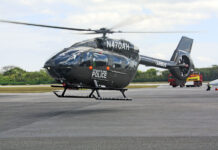
‘Maybe we should have an air wing. Sea, air and surface support have to work hand in hand; we need more manpower, specialised training, rigid maintenance and repair schedules.’
He acknowledges that the program would be expensive, but says: ‘The need exceeds the expense. It’s time.’
Related Videos