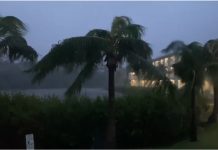
Authorities urged people in the northwest Caribbean to be on alert Tuesday as Tropical Storm Wilma neared the Cayman Islands, gathering strength as it cut a path that threatened western Cuba, Mexico’s Yucatan Peninsula and Florida.

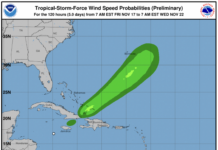
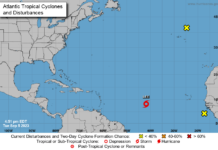
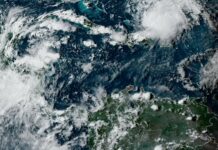
As of 8 a.m. E.D.T. (7 a.m. Cayman Time) Tuesday, Tropical Storm Wilma was located 245 miles SSE of Grand Cayman: 15.9 N, 80.2 W; with winds of 70 mph and gusts up to 85 mph; and is moving NW at 1 mph. |
Wilma is the Atlantic hurricane season’s 21st named storm, tying the record set in 1933 and exhausting the list of storm names.
The storm was expected to pass southeast of the Cayman Islands, which were badly damaged in Hurricane Ivan last year.
“We’re waiting with bated breath to see what will happen,” said Brent Santha a vice president at the water company. “We’re hoping and praying it will change direction.”
In Jamaica, heavy rainfall from Wilma’s outer bands flooded several low-lying communities, blocked roads with mud and forced 100 people into shelters, said Barbara Carby, head of Jamaica’s emergency office.
A 35-year-old farmer drowned Sunday in central Jamaica after he was swept away by a rain-swollen river while trying to retrieve some goats that were too close to the banks, police Constable Keisha Scott said.
At 8 a.m. EDT (1200 GMT), Wilma’s top sustained winds increased to about 70 mph (112 kph). When the winds reach 74 mph (119 kph), the storm will be upgraded to a Category 1 hurricane.
Forecasters said Wilma remained nearly stationary overnight in the northwest Caribbean Sea and was centered about 245 miles (400 kilometers) south-southeast of Grand Cayman, but it was eventually expected to gradually turn to the west and northwest.
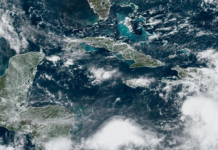
New forecast models placed the storm closer to western Cuba than Mexico’s Yucatan Peninsula by Friday. The storm was forecast to then turn sharply in the Gulf of Mexico toward Florida over the weekend.
“I think the message is that the season is certainly not over. People in the Gulf Coast are going to have to watch Wilma,” said Max Mayfield, director of the National Hurricane Center in Miami.
“There’s no scenario now that takes it toward Louisiana or Mississippi, but that could change,” Mayfield said.
The Gulf Coast was already battered this year by Hurricanes Katrina, Rita and Dennis, while Emily hit Mexico.
Wilma would be the Atlantic season’s 12th hurricane. There haven’t been this many hurricanes since 1969 – and that was the most since record keeping began in 1851.
Conditions such as warm water and favorable atmospheric winds are in place for Wilma to strengthen, possibly into a major hurricane with winds above 110 mph (177 kph). “If it goes through the Yucatan Channel, there won’t be much to weaken it,” Mayfield said.
A hurricane watch was posted for the Caymans while Honduras posted a tropical storm warning.
The storm was expected to dump heavy rain over the Cayman Islands, Jamaica, Haiti and southeastern Cuba, with as much as 12 inches (30 centimeters) possible in some areas, forecasters said.
Tootie Eldemire, owner of the Eldemire Guest House on Grand Cayman, said she stocked up on water, candles, flashlights and canned goods for her guests but said she wasn’t worried about the storm.
“We’re on alert but we’re not panicking,” Eldemire said, adding that tourists were moving around town as usual.
Many islanders still had storm shutters up from last year’s Hurricane Ivan, which destroyed 70 percent of buildings on Grand Cayman, the largest island in the three-island British territory of 45,000 people.
The six-month hurricane season ends Nov. 30. Wilma is the last on the list of storm names for 2005; there are 21 names on the yearly list because the letters q, u, x, y and z are skipped. If any other storms form, letters from the Greek alphabet would be used, starting with Alpha. That has never happened in roughly 60 years of regularly named Atlantic storms.
Related Videos