

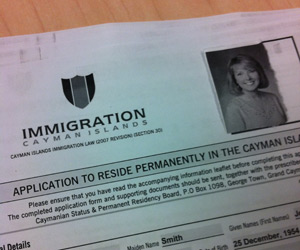
Between December 2008 and October of this year, the number of work permits held in the Cayman Islands has dropped from 26,517 to 19,378 (as of 6 October, 2011), according to figures provided by the Immigration Department.
Looking at those figures, the casual observer might conclude that – in less than three years – Cayman has lost more than 7,000 work permit holders from its population; a decrease of about 27 per cent.
However, those figures don’t tell the entire story.
For the first time, under Cayman’s Freedom of Information Law, the full number of permanent residence grants given to non-Caymanians during the past three years has been released. The figures detail grants in every category of residence presented and correspond to the time during which the sharp decline in work permit numbers was seen. They do not represent the full number of permanent residence-holders who live here, only those grants made during the past three years.
Here’s some of what the figures revealed:
The majority of the residence grants between September 2008 and thus far in November 2011 went to spouses of Caymanians (1,558). Those applications are rarely declined, having been approved more than 80 per cent of the time since September 2008.
Applications for permanent residence from foreign individuals who worked in Cayman for eight years and applied in their own right to stay here were declined 60 per cent of the time between September 2008 and November 2011. According to Immigration Department figures, 1,414 people were granted permanent residence as a result of those applications, and 2,099 were refused during the period.
The overall number of applications for permanent residence declined sharply between July 2009 and November 2011, when compared to applications made between September 2008 and June 2009.
Comparatively few people of independent means, including wealthy retirees, have applied for grants of residence. According to immigration figures, a total of 68 people of independent means have been granted residence within the past three years and another seven wealthy retirees have been granted leave to remain.
Fewer than 50 people in the past three years have been approved to legally reside here as the dependant of a Caymanian; it is not clear whether that figure includes children. A total of 333 people were granted the right to remain and work as a dependant of a permanent resident-holder.
Cayman’s Immigration Law operates a tiered system of progression. A foreign-born worker is only allowed to stay here up to seven years consecutively, unless they obtain what’s known as key employee status – which allows them to remain for an additional two years. The extra two years allows individuals to apply for permanent residence; the right to remain in Cayman for the rest of their lives. The 7,000-plus person drop in work permit numbers included a decline in those individuals who were “working as an operation of law”; in other words, awaiting decisions on permanent residence applications and appeals of work permit denials.
It is likely the majority of the 1,414 people granted permanent residence between September 2008 and November 2011 were included at some point on that list. In that instance, those individuals would have been taken off the work permit-holder lists and added as permanent residents; still part of Cayman’s population, just no longer showing up as work permit holders. It is also likely this is what occurred with the majority of the 333 people who became dependants of work permit holders with the right to work during that period.
It is impossible to determine from the figures presented by the Immigration Department how many of the 1,558 people granted residence by way of marriage to Caymanians previously held work permits. Any change in their immigration status because of that would have, again, taken them off the work permit list and made them part of Cayman’s permanent population.
However, even if all of those people were added together as previous work permit-holders – 1,414 permanent residence grantees, their 333 working dependants, and 1,558 spouses of Caymanians – it would equal far less than half of the work permit decline since in Cayman since December 2008.
If only half the spouses of Caymanians were work permit holders prior to getting married and being granted residency rights; that would leave a 4,600 work permit drop unaccounted for by the permanent residence grant figures. The rate of permanent resident grant approvals taken during the three year period shows a roughly 40 per cent approval rate for those foreign workers who have lived in Cayman for eight years and who applied for permanent residence in their own right.
However, the approval numbers may have been skewed by a massive backlog of permanent residence grants for a number of years. That backlog has been largely cleared by the Caymanian Status and Permanent Residency Board. In early 2009, then Chief Immigration Officer Franz Manderson said the immigration boards were struggling to process thousands of residency applications – many of which were made in the years after Cayman’s seven-year term limit policy on foreign workers’ residence first came into effect; roughly between 2005 and 2007.
At the time the term limit on residence began, the government allowed anyone who had been living in Cayman for five years or longer to apply for permanent residence, regardless of whether they had obtained key employee status.
You can read the full report by clicking here.
Related Videos












Only 68 people of economic means over 3 years suggests that these islands are no longer a desirable destination for the wealthy. This might be the real story as to why?
Good work Compass – but there is still more to be determined and clarified.
If I understand the numbers correctly, in the period from September 2008 to now (about 3 years) 1,414 1,558 333 (3,305) non Caymanians have been granted some form of residence with the right to work.
Therefore, only taking into account those permissions granted in the last three years, and adding the 19,378 work permit holders as at 6 October, there are presently (on thoose figures 22,683) non Caymanians living (and for the most part working)in the Islands. More than 1,000 workers are being granted some form of PR every year.
Since it takes between 5 and 7 years to become Caymanian (depnding on whether you have PR with Right to Work or an RERC as the spouse of a Caymanian – if we alow for an average of 6 – it is tempting to assume (but no doubt immigration could confirm) that there are another (approximately) 3,000 non Caymanian persons with the right to work whose permissions were granted in the 3 years from October 2005 to October 2008. Allowing for a wave of grants, and excluding 1,000 of them as a statistical anomoly, adding only 2,000 of those – it would seem there are likely presently 24,683 non Caymanians with some form of permission to work in the Cayman Islands.
…and then we have to consider how many (thousand) persons have acquired the Right to be Caymanian (status) whether by Board grant or by entitlement in the relevant period to start to get the true picture of what is happening in recent times with expatriate labour (and population) in Cayman.
It seems to me that the result, and the reasons for it, may be very different from the popular perception.
Delusions and Denial again Striker.
In the midst of your manufactured numbers, you missed the most important number. 2099 people who applied for permanent residency based on their time on the island, were turned down. Those people were forced to leave and probably took a spouse or significant other with them. That makes up the lions share of the decline in outstanding work permits, a number that the Compass estimates to be 4600.
The population of Cayman will continue to decline as rollover affects more and more people. We can see now that long term residents aren’t having much success at converting to permanent residence status. So far only 40% gain that status.
The most recent legislation to end the roll over process does nothing of the sort. It only provides a further 2 year grace period to obtain key employee status. When the success rate at gaining permanent residency is only 40%, I suspect that many will use the 2 year period to wind up their affairs on the island, and move on.
Another of your numerical fantasies that was disproved by this report was your idea that the dependents of the newly granted permanent residents would some how make up the differences in the numbers coming and going. At 333 new dependents, we clearly see that this is not the case.
But at the very least your fantasies are fun to read. How did you do counting those eggs? You never did get back to us about that.
Why is it so hard to figure out the status of 140,000 people on these islands? How is this number arrived at? Is it also made up of well if A is true B must be, therefore C is the answer? This is crazy.
People whom I never thought would leave the island, have indeed left, without even trying for key employee status or PR. Therefor, attitudes towards leaving the islands must be changing and leaving isn’t such a bad thing after all.
In another context, it’s called voting with your feet – especially when you don’t have a vote, however much you contribute to the general good.
Old Diver –
I would ask for the money back on the T-shirt. You actually understand little of the issues and your attempt to describe what a Term Limit Exemption Permit does ie to provide a 2 year grace period to obtain Key status – is not only wrong but will be exceptionally dangerous should anyone believe you. For the record – it is not possible to seek or obtain Key Employee Status once you have been here for 7 years. There is no extension of the time to make such applications.
My numbers are neither manufactured nor misleading. The difference is that I understand them. I have never denied that expatriates are leaving. What I however recognise – and you seem not to – is that just because someone ceases to have a work permit or PR does not mean they have left. Many are becomming Caymanian (or in the case of work permit holders – Permanent Residents). I also recognise that when people leave (and are not replaced by locals or another expat) it is more likely to be because of the economy, than rollover.
When you see 1,500 PR grants you ignore the fact that there are likely 3,000 odd spouses and children that received grants (the 333 new dependents are persons working – ie. not pure dependants.)
The 2099 turned down formed part of the backlog guaranteed the right to apply for PR without passing the Key hurdlle. Most had no property, money or education – and whilst the human cost is great, the denials (subject to some exceptions)were not inappropriate. Those that have crossed the key threshold are achieving PR at rates in excess of 90%, and status from there at rates approaching 100%.
As for your 4,600 – ask yourself how many expatriate workers arrived for the primary purpose of assisting in the post Ivan re-build and the retail boom that followed when we all needed couches and TV’s for our newly rebuilt condos. What did you want them to do when their work was done, and their jobs no-longer existed?
…and you are so transfixed on work permit numbers, I wonder whether you see any role for Caymanians (original or new)in these Islands going forward?
As for the eggs – sales are up (moderately), but it is better that we watch our cholesterol numbers – no matter how they are interpreted.
Striker, you paint a picture, or at least you use 1000 words.
Have you spent any time lately speaking to any owners associations? Owners of Rental Units? Condo Management Companies?
No?
You Should.
The peak of Cayman’s total population, if my memory serves me right, was pre-Ivan when the numbers were somewhere in the region of 60,000 people and before Ivan, still rising.
The rental tenancies were full, the supermarkets were full, the shops were full, the restaurants and nightclubs and bars were full…everyone seemd to be having a good time and, in the professional sector, there was little of the Caymanian/expat divide, except amongst inviduals who are of a quarrelsome nature, with an axe to grind with all and sundry, both Caymanian and expatriate.
So many things changed post-Ivan and these immigration figures over the last 3 years should come as no surprise.
So now, Cayman’s population has shrunk because many people have left, including some Caymanians, a thing unheard before Ivan, in any significant way.
Cayman’s economy has been adversely affected but there is still arguments raging regarding the number of PR and Caymanian status grants ?
My question is…in a shrinking population, how does the opposers of any non-Caymanian’s long-term residency or permanent status suggest that this population drop, which has affected their own pockets and financial status, be reversed ?
Assuming that these are Caymanians, do they believe that they will have babies fast enough to grow the population that quickly ?
Seeing that it takes at least 18 years to raise a child to adulthood, that is clearly impossible.
This issue cannot be just one about numbers alone because these numbers of people becoming legal Caymanians cannot upset the current balance, or even reverse it, of a loss of some 5 – 10,000 people in a period of 6 – 7 years.
How many purely Caymanian families are there left; by that I mean husband and wife both born-Caymanians ?
Not many, I would guess; Cayman has been a mixed-marriage, mixed-race population for many years now, at least one entire generation so…
To look at this immigration issue calls for a cultural change that reflects Cayman’s current population growth…one of integration.
To continue to try to enforce a system that does not fit the current situation is an effort in futility.
I can definitely see where limiting automatic rights of residency to British and European citizens needs to remain but I cannot see how limiting the growth numbers for PR and Caymanian status by the naturalising period of the 7 – 8 years is helping anyone.
After 7 – 8 years of living productively in a country, surely one has EARNED the right to remain ?
Back to the condo’s again OldDiver?
I have spoken with numerous condo owners and managers in Cayman. Lots of units are empty, and rents have reduced. Funny thing is, condo owners and managers in Orlando, Tampa, Miami, Vegas, and even the Turks and Caicos Islands are telling me the same thing.
In those places it is because of overbuilding prior to a sudden economic decline.
Here it seems (to you) to be nothing to do with that. Here we can build and build and build and build, and if we build too much, we should let the rest of the world here (whether they can afford it or not) just to fill them, and then we can build and build and build again.
Not my view of prudent or sustainable long term planning, nor a country I would pass on with pride to the next generation.
Yes Striker, it’s back to the condos again, because that is the basis of Cayman’s internal economy.
Without bums in the beds, the Cayman economy will die.
Those people that you are speaking to?
They have an over development problem?
Do they also have a roll-over policy to deal with?