

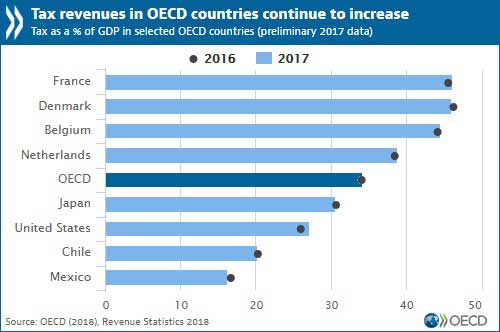
Tax revenues in advanced economies have continued to increase, with taxes on companies and personal consumption making up a growing share of total tax revenues, according to new OECD research.
The average tax-to-GDP ratio in OECD countries rose minimally in 2017 to 34.2 percent from 34 percent a year earlier.
The OECD average is now at a record high and exceeds previous peaks of 33.8 percent in 2000 and 33.6 percent in 2007, the OECD’s annual Revenue Statistics publication shows.
The trend toward higher taxes is, however, not universal. A majority of 19 out of 34 OECD countries saw an increase in tax-to-GDP levels, while the tax revenue fell in relation to the size of the economy in the remaining 15 countries.
In 21 countries, tax revenues are higher than before the financial crisis and all but eight countries – Canada, Estonia, Hungary, Ireland, Lithuania, Norway, Slovenia and Sweden – managed to grow tax revenues compared to overall economic output.
A separate OECD report on consumption tax trends underscores that value-added tax revenues continue to be the largest source of consumption tax revenues in the OECD. They represent one-fifth (20.2 percent) of total tax revenues and about 6.8 percent of GDP.
Standard VAT rates stabilized at 19.3 percent, following a gradual increase after the financial crisis. Ten countries now have a standard VAT rate above 22 percent compared with only four in 2008. Greece and Luxembourg increased their standard VAT rate between January 2015 and January 2018, while Iceland and Israel lowered their VAT rate during this period.
Due to the difficulties in raising already high VAT rates further, many countries are implementing or considering measures to broaden the base that is subject to value-added tax to protect or increase VAT revenue.
This is done by increasing reduced VAT rates, limiting or narrowing their scope and curbing VAT exemptions. A growing number of tax authorities are also tackling the challenges of collecting VAT on the ever-rising volume of digital sales, including sales by offshore vendors, in line with new OECD standards.
The Revenue Statistics also highlights ongoing convergence among OECD countries toward higher tax levels, with greater reliance on corporate income tax, VAT and social security contributions, and a slight downward shift in personal income taxes over the past two decades.
The data shows that corporate income tax has grown its share of total tax revenue to 9 percent in 2016. This is still below the peak of 11.1 percent in 2007, but higher than at any point since 2009. Personal income tax revenues decreased from 24.1 percent to 23.8 percent of total tax revenues, according to the latest available data for 2016.
In that year, 23 countries experienced tax revenue growth from corporate income taxes, while 20 countries saw a fall in personal income tax.
Israel reported the largest jump in its overall tax-to-GDP ratio in 2017 in the wake of income tax reforms. The 1.4 percent increase even exceeded the tax-to-GDP ratio growth of the U.S. (1.3 percent), which benefited from the one-off deemed repatriation tax on foreign earnings.
Related Videos













When looking at these numbers one must consider what the taxpayer gets for their money.
I am no fan of the very high taxes in France. But they do have an excellent health care system at virtually no cost to taxpayers.
The USA on the other hand nominally looks like a “better deal” for taxes. But not when you take into account the very high cost of health care.
While the USA does have a system of healthcare for the aged and the poor, the average working person pays a good chunk of money every year for private health insurance. And even if their employer pays this, isn’t this just a covert Corporation Tax?
The same applies to further education. A top university in the USA can cost $50,000 per year for 4 years.