


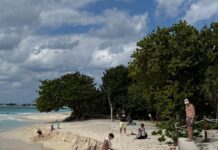
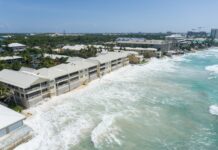
The loss of the beachfront on the southern end of Seven Mile Beach remains a concern for property owners as well as the Department of Environment.
Grand Cayman Marriott Beach Resort general manager John Hazard believes the plan proposed by the hotelier to install ‘geotube’ marine structures along the coastline will make a difference.
“We feel that currently there is no proactive beach management strategy being implemented, therefore; we are eager to get the Government’s approval to pursue this trial study. We hope that we can encourage the Government to expedite the approval process,” he said, in a recent statement to the Cayman Compass, adding the hotel wants to undertake the study “as soon as possible”.
Two solutions proposed
Earlier this year, a $1.25 million government-led ‘beach nourishment’ project was proposed to address the erosion at the southern end of Seven Mile Beach.
Endorsed by the Department of Environment, the project was suggested as an alternative to the Marriott’s geotube plan to rebuild its disappearing beach.
The DoE and its consultants, Olsen Associates, dismissed the Marriott’s proposal as unsightly and unworkable, and has urged Cabinet to reject it.
The hotel, along with nearby condominiums have proposed a full-scale trial study to restore and stabilise the beach together with adding some foreshore protection.
“We would expect this trial study to be a minimum of one to two years at which time the findings will be openly assessed and further proposals made for changes to the design of the study area,” he said.
Following the passage of storms, including Delta and Eta, Cayman’s prized Seven Mile Beach suffered some beach loss due to the resulting rough seas along the coastline.
The Marriott has been battling a slowly disappearing beachfront for some time, but the recent storms washed away most of the coastline in front of the resort.
“Unfortunately, the unusual storm activity that we have experienced in recent months has worsened the condition of our beachfront at the Grand Cayman Marriott Beach Resort,” Hazard said.
“We have a long history of periodic beach removal by natural forces along the south end of the Seven Mile Beach coastline; however, over recent years the loss of beach has become progressively worse and this season’s unprecedented weather systems have exacerbated the situation not only for us, but also for many adjacent properties.”
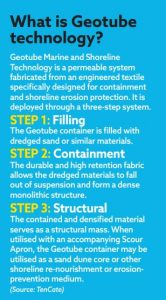 He believes the Geotube marine structure technology will work here.
“The application of GeoTube geosynthetic technologies have been applied successfully as sustainable options for technically managing beach profiles, especially in heavily trafficked recreational tourist destinations. This solution is adaptable, visually discreet, environment friendly and is a completely removable technology,” he added.
The Marriott plan involves a system of sand-filled mattresses and ‘geotubes’ along the impacted area to reduce erosion.
Coastline development must be managed
The DoE, in a recent assessment of the beach loss, suggested beach nourishment as an option as well as removing/ rebuilding infrastructure away from the sea to combat the erosion.
“Finding a suitable source of beach quality sand is one of the challenges that nourishment presents. In the medium to longer term, there are options such as managed retreat which can be explored. This involves removing and rebuilding inappropriately sited infrastructure away from the sea,” the DoE said in its assessment.
“As you can imagine this is a complex strategy as it requires a clear and deliberate plan, it needs extensive and fully inclusive stakeholder engagement and raises some challenging issues such as who carries the financial burden of paying for managed retreat,” it said.
The DoE also pointed out it consistently advocates for developments to be positioned away from the active beach to reduce the vulnerability of development and to preserve the coastline.
“However, it is for the decision-making bodies to ensure that they follow these recommendations,” the DoE said.
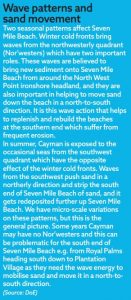
The issue of erosion at Seven Mile Beach was discussed at an 18 Nov. National Conservation Council working group meeting which concluded that “it was important that the Ministries of Environment, Planning, and Tourism work together and follow a coordinated approach to the beach erosion issue to minimise the opportunity for actions or permissions that would serve to exacerbate the problem to be authorised”.
It was decided that the NCC would communicate its recommendation in writing to the various ministries.
The DoE pointed out that the beach at the southern end of Seven Mile will recover, “but it will not occur as quickly as other parts that have also suffered erosion, as the only natural way for the sand to rebuild and form a beach is from high energy wave activity from the north-west”.
It added that if the developments at the southern end were built away from the active beach, the beach would likely have a natural sandy beach ridge which would provide an additional source of sand to help repair the sand losses.
“All of the beach ridge sand reserves at the south end of Seven Mile Beach are locked away under the foundations of hard infrastructure. It is worth mentioning that the sand that has moved off some parts of the beach is not necessarily ‘lost’, it has simply likely been redistributed to other parts of the beach e.g. Public Beach, heading in a northerly direction, has had significant beach growth,” the DoE assessment said.
Related Videos









Let me understand this, the Marriott and other surroundings condos are going to pay $1.25 million for a trial study for these geotubes and not ask the Government for any money? The article said “DoE and its consultants, Olsen Associates, dismissed Marriott’s proposal as unsightly and unworkable and has urged Cabinet to reject it” Why? I understand the only suggestion they made is let’s dump $3 million dollars of sand on the beach, (which would just be renting it) Or they say it’s your fault for building to close to the waterline. If I understand correctly, Marriott is trying to find a solution for something that was allowed by the Planning and DoE 40 years ago. Instead of blaming everyone else, let’s embrace a solution. Our SMB problem is not new and it happens to beaches all over the world, the only difference is these other beaches have solutions and an environmentally friendly plan. We have a plan but its ‘lets do nothing as the beach always comes back at one point in time”.