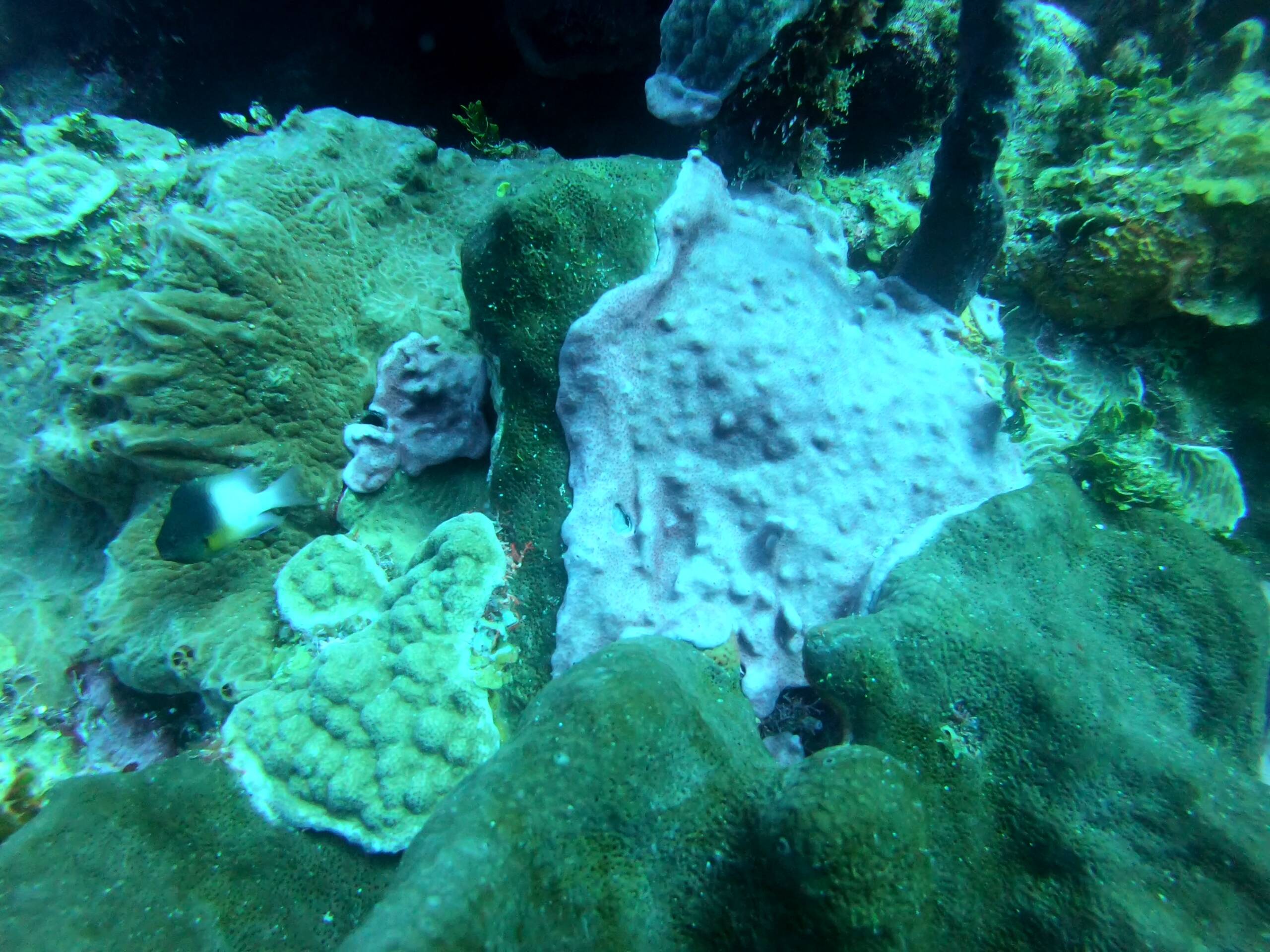
The compound encrusting ascidian (tunicate), Trididemnum solidum, is very common on our coral reefs.
A blue-green, leathery mat – some 5 milimetres thick and upwards of a couple of metres in surface area – may cover and eventually kill portions of living coral heads as well as sponges.
The beauty and tranquility of the reef belie the real and constant turf-war taking place. Every organism is either fighting to maintain its property or attempting an expansion. A pecking order of dominance exists which is generally responsible for the fantastic diversity of life. The ingenious reproductive strategy employed by the mat tunicate has, in some cases, disrupted the balance.
The tunicate develops numerous tadpole-like larvae which are released throughout the entire year. During the first few minutes of their 15-minute swim, they are attracted to light, or the surface where currents are stronger and dispersal wider. Signals change, so then they shun the light by swimming to the bottom.
This same sequence occurs with many reef denizens, however, unlike the others, these larvae are very poisonous. Planktivorous fish have learned to avoid them and eat more of the other species’ larvae. This same toxin gives the tunicate a leg-up on fighting to hold the new substrate they landed on, and once a foothold has been secured, the mat can expand very quickly – as much as 13 centimetres a month, which smothers and kills.
Noxious chemicals called didemnins repel any would-be predators and in studies where these mats were removed, it took just six weeks for colonies to return.
On a positive note, pharmacology studies have discovered that didemnins have powerful anti-inflammatory properties and are likely to be very beneficial to human health.
Tom Byrnes is the owner/operator of Cayman Marine Lab. He acquired his Coast Guard Captain’s Licence when he was a teenager and worked as a commercial fisherman in his youth. He got his first diving certificate in 1974 with the YMCA. He has worked in the local dive industry for more than 35 years and has a PhD in marine biology.
Related Videos