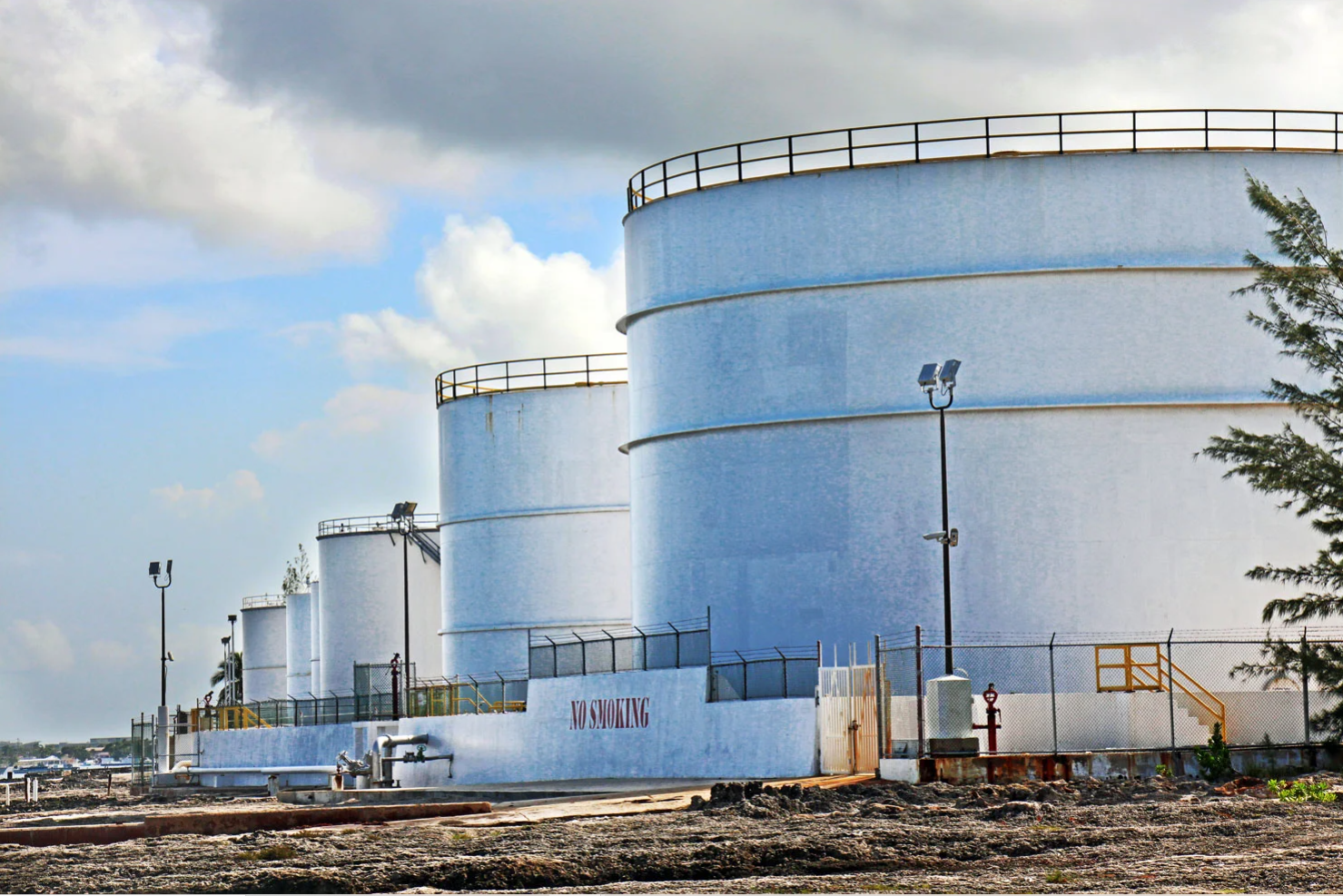
More than two years after a ‘significant’ leak from one of the Rubis diesel tanks at its Jackson Point Terminal, the company was in Summary Court last week facing a charge of breaching the Dangerous Substances Act.
As a result of the November 2019 leak from the tank at the terminal in George Town, the company was charged with failing to take reasonable precautions with dangerous substances under that law.
According to a report from the Utility Regulation and Competition Office, included in the court files, “Rubis Cayman Islands Ltd. continued to operate one of its key terminal assets without an effective cathodic protection system and tank maintenance programme in place, while being knowledgeable and aware of the critical requirements.”
The cathodic protection system “minimises corrosion in areas of the tank which are difficult to visually inspect or access”, OfReg said in a press release issued after the Tuesday, 22 March hearing.
The court files do not state how much fuel leaked. However, in the release, OfReg said, “While a significant quantity of diesel was released from the tank, there was no significant impact found on the surrounding environment, according to an assessment by Water Authority Cayman.”
The summary of facts of the case states that OfReg’s report concluded Rubis’ “key decision makers, and relevant staff… failed to take all reasonable precautions contrary to section 12 of the Dangerous Substances Act (2017 Revision)”.
Attorney Alastair David, who represents Rubis, told the court there was a “fundamental flaw” with the wording of the law.
“The law was enacted sometime in the 90s, and it is believed that this is the first time that a company, or anyone for that matter, has been prosecuted under it,” said David. “It is for this reason I believe that it has gone unnoticed this long.”
Section 12(1) of the Dangerous Substances Act (2017 Revision) reads in part, “The operator of any regulated premises – (a) shall take all reasonable precautions for the prevention of… any release or spillage… involving dangerous substances in the ownership, control or possession of that person; and (b) shall not abandon, discard or otherwise neglect to dispose safely of any dangerous substances in the ownership, control or possession of that person.”
David said that the way the law was written, anyone charged under section 12(1) would have to contravene both (a) “and” (b), and that was the basis of his argument.
The lawyer told the court he was consulting with the Office of the Department of Public Prosecutions on this point.
The hearing was adjourned with no subsequent court date announced.
Related Videos