

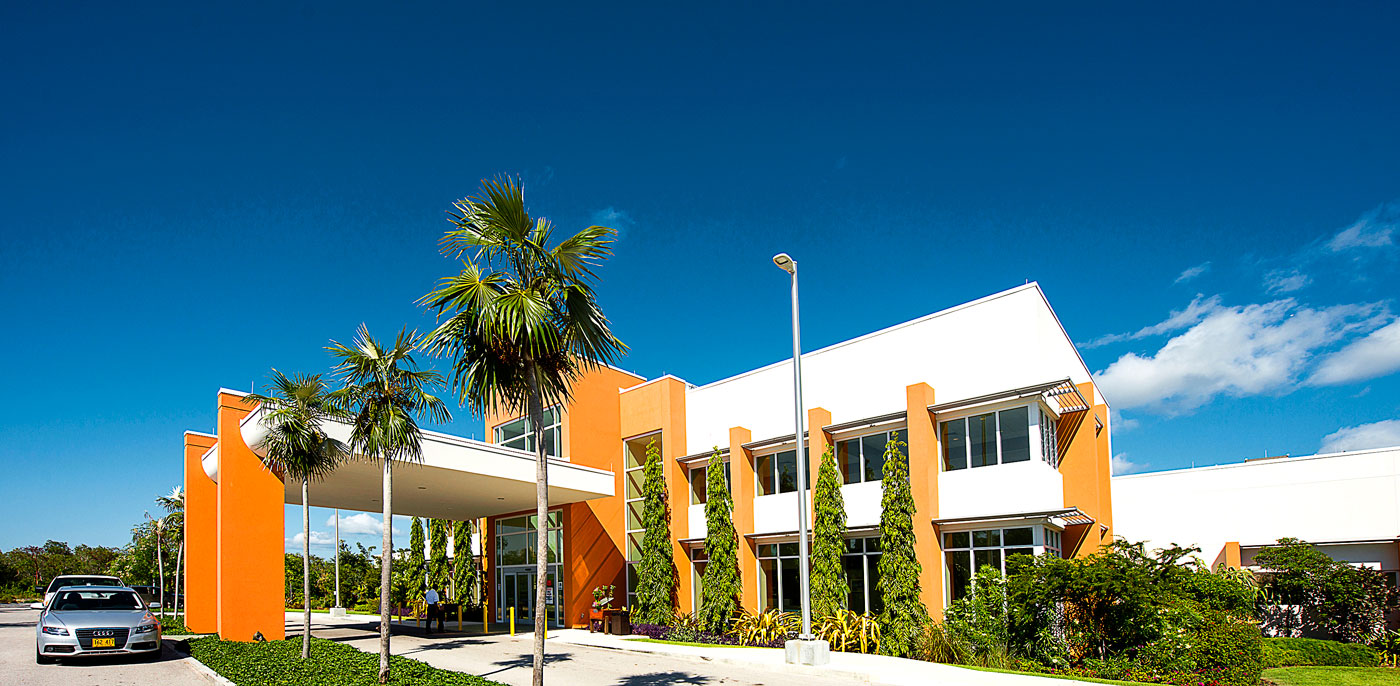
Current and future governments are not bound by deals signed by the previous United Democratic Party and Progressives-led administrations granting hundreds of millions in tax waivers and concessions to the Health City and Aster Cayman MedCity hospital projects, the Grand Court heard on Wednesday.
Justice Richard Williams is presiding over a three-day judicial review hearing of a challenge brought by Doctors Hospital, under the name CTMH Holdings Ltd., against the government of the Cayman Islands, with Health City (under the name Narayana Hrudayalaya Private Ltd.) and Aster Caribbean Holdings Ltd listed as interested parties in the case.
Throughout the opening day of the hearing, the court heard from CTMH’s barrister, Chris Buttler, QC, on the objections to the ongoing waivers on work permit fees and import and stamp duties, and to the role of healthcare practitioners registered under an ‘Institutional List’, who are allowed to meet different criteria than healthcare staff registered on a ‘Principal List’.
Tax concessions
CTMH is challenging the wide-ranging import and stamp duty waivers granted by the UDP in 2010 to Health City, which opened its hospital in East End in 2014, and to similar concessions given to Aster, which signed a deal with the Progressives-led government in 2020 to pave the way for a proposed new hospital in West Bay.
Under the 2010 deal, Health City, as well as being granted indefinite concessions of 15-30% off work permit fees for medical staff, was exempted from paying customs or import duty on the first US$800 million it spent on equipment and medical supplies. Once that US$800 million had been exhausted, for the 15 years following that, its duty payments on equipment and supplies would be 5%, and in the next 15 years, it would be 10%. Also, for the first 50 years of operation, it would not pay duty on any life-saving equipment.
Buttler noted that, if regular import duty of 22% was levied on the $800 million worth of equipment for Health City, that would have brought in taxes of $176 million for the Cayman Islands.
In the 2020 Aster contract, the government had agreed to a number of concessions, including a 100% customs duty exemption on all medical equipment and supplies for 25 years once construction began, he said.
He argued that the current government or future ones would be within their statutory rights to withhold the waivers outlined in the deals with Health City and Aster, and that the UDP and Progressives governments, by signing those contracts, “could not legally bind their successors” in this way.
Buttler cited a 2015 audit report by then-Auditor General Alastair Swarbrick, which noted that the government had acted unlawfully when it granted the concessions to Health City, as they were not authorised by the Legislative Assembly, now known as Parliament.
In that report, Swarbrick had said, “No approval from the Legislative Assembly was sought, even though the agreement committed government to hundreds of millions of dollars in tax, duty and fee concessions and contained obligations for infrastructure upgrading and expenditure.”
Buttler told the court that, as the Health City and Aster contracts were not approved by Parliament, subsequent governments were not bound to adhere indefinitely to the undertakings set out in them, and therefore would not be subject to legal action for not giving the tax concessions laid out in those documents.
“The rule of law requires that the present and future democratically elected governments of the Cayman Islands are free to raise or waive taxes as they see fit, according to the will of the people and the economic conditions of the country,” he said.
No published criteria for waivers
Buttler pointed out to Justice Williams that no criteria is publicly available that sets out in what circumstances the government can grant or withhold a duty waiver, therefore putting anyone who applies for a concession on import duties or stamp duties at a “unfair” disadvantage because they would have no idea what benchmarks they would need to meet.
He told the court that, in his 2015 audit report, Swarbrick had also highlighted that there was “no checklist with established criteria and requirements against which revenue waiver applications were assessed for approval or rejection. The use of such a checklist would help ensure that all applications are assessed fairly and consistently.”
Swarbrick, at the time, recommended that government implement criteria to formalise the granting of waivers, but no such criteria has been published.
Buttler cited three examples in recent years when Doctors Hospital had applied for import duty waivers. In the first instance, it was granted a 100% waiver on an neonatal travel incubator; in the second, it was granted a 50% duty waiver on an ultrasound machine; and in the third, the waiver application was rejected when the hospital was importing an ultrasound bed.
“In the absence of any policy for the determination of waiver applications,” he said, “it is impossible for the applicant, or any other business, to predict whether [the government] will grant a duty waiver in any particular instance, and it is impossible for the public to assess whether the [government] is foregoing revenue, that would otherwise be spent on public services, in a reasonable way.”
Institutionally registered practitioners
As well as considering the issue of tax concessions, the judicial review also deals with where medical practitioners who are registered under what is known as the ‘Institutional List’ can work.
Medical staff under the ‘Institutional List’, drawn up initially to enable Health City to hire staff who received their qualifications from outside the seven countries on the ‘Principal List’, can only work at designated medical institutions.
Buttler explained to the court that under Section 24 of the Health Practice Act, and associated regulations, practitioners must meet specific, identifiable standards, such as being registered in one of the designated jurisdictions and must satisfy the Medical and Dental Council that they have sufficient experience and relevant qualifications. Also, a person can only be considered a specialist doctor if they can produce the necessary post-graduate qualifications and at least three years of specialist training in posts recognised by the council.
Legislative amendments made in 2011, as part of the agreement with Health City, allowed for doctors who had qualified outside the designated jurisdictions to obtain ‘institutional registration’. Buttler said, under those amendments, a practitioner could be registered based on a qualification from any school listed in the World Directory of Medical Schools, which purports to list every medical school in the world; and could practise as a specialist without any proof of post-graduate qualifications or any specialist training.
Among the documents presented to the court was a disclaimer issued in February 2014 by the Medical and Dental Council, signed by its members, in relation to the registration of a doctor on the Institutional List. It noted that the council was ‘obligated’ by guidelines set out in the Health Practice Law to register the doctor, but did not have the resources to investigate the applicant’s qualifications or credentials.
The council stated in the disclaimer, “The said guidelines are not consistent with the mandate of the MDC… and in their present form effectively compromise the MDC’s statutory obligation to exercise due diligence in its investigation of each applicant’s qualifications and credentials.”
Buttler stated that the council had concluded that the legislation amendments that introduced the Institutional List had lowered the registration standards for doctors allowed to practise in the Cayman Islands.
The hearing is expected to continue on Thursday, when the government’s legal counsel will present its arguments relating to the judicial review.
Related Videos








As i mentioned in another article about the need to good competent practitioners:
For us that conduct medical research throughout the world it is critical that only qualified doctors and associated practitioners treat patients. I fell that the list of qualified countries (Australia, Canada, Jamaica, New Zealand, South Africa, United Kingdom and United States) is woefully incomplete. The most important point is to have a Caymanian confident that only qualified people treat them for their illness. The point may arise – did Health City employ physicians that are not qualified to treat people. Just because these physicians are not educated from the qualified countries does not mean they do not know what they are doing or cannot communicate their directions to the staff and patients. Towards that end we who live in Grand Cayman want that assurance. I recommend that the staff who was not qualified in one of those 7 countries be tested for their competency. This is done in the US as a foreign practioner is evaluated accordingly.
Going forward i fell this is critical so we do not lose quality care while at the same time have those clinicians at Health City and Aster prove to us they are qualified. This testing needs to be done by an outside group to remove bias in the evaluation of competency.