

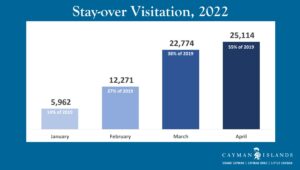
By April this year, Cayman was seeing 55% of its pre-pandemic stayover visitor numbers, Tourism Minister Kenneth Bryan told Cayman Islands Tourism Association members at their latest meeting.
Comparing statistics from 2019 – the last full year of tourism before COVID-19 and the most successful year in terms of tourism for the jurisdiction – the minister acknowledged that ongoing travel restrictions, such as a ‘travel declaration’ authorisation from Travel Cayman and pre-arrival testing, were impacting visitor numbers.
However, numbers have been steadily increasing since January this year, when young children of travellers could take on their parents’ vaccination status and therefore be allowed into Cayman.
In January, 5,962 stayover visitors were recorded – 14% of the number of air arrivals in January 2019. By February, that had more than doubled, to 12,271, equating to just over a quarter of the February 2019 figures. That almost doubled again in March, to 22,774 visitors.
Although the size of the month-on-month increases was smaller in April, with almost 25,114 visitors arriving, Bryan said, “Visitation is moving in the right direction, with an upward trajectory, indicating that our tourism recovery is strengthening day by day.”
He said the Department of Tourism has set a target this year to reach 40% of the 2019 tourism accommodation revenue, which equates to 200,000 visitors by the end of December. He added that, based on the current trend, it was likely that this target could be “exceeded by many margins”.
The vast majority of visitors to Cayman in the first quarter of the year were from the United States, with 70% of arrivals originating there, followed far behind by Canada at 9% and the UK at 6%, Bryan told the CITA members.
Challenges remain
“When analysing these first quarter results,” he said, “it’s important to view them in context, by noting that, first, restrictions on travel with children were only relaxed in January of this year, allowing families to return with children assuming their parents’ vaccination status. And, secondly, the requirements for LFT testing on day 2, 5 and 7 were lifted in February and allowed a hassle-free process for visitors on the island.”
While explaining how these relaxation of restrictions had led to an upswing in arrivals, Bryan told the tourism industry representatives at the meeting, “I want you to know that the government is well aware that our current regulations, though they’re better than before, still create some restrictions for potential visitors.
“As minister, I also want you to know that I recognise we could have stronger numbers if our restrictions were relaxed, like some of our competitors in the region. The government’s precautionary approach is for the safety of our community, though it comes with setbacks. I would like to assure you, though, that we’re continuing to evaluate the situation to find the perfect balance.”
Representatives of a number of tourism sectors, in their presentations, highlighted that they were getting complaints from potential visitors about the travel declaration requirement and the ongoing mask mandate, which requires masks be worn in indoor public areas and on public transport.
Bryan said he had been urging his fellow government members in caucus to rethink the islands’ mask mandate but had met resistance, and he encouraged CITA members to lobby MPs to lift the mandate.
Airlift issues
 One major challenge to Cayman returning to the types of record visitors numbers seen in 2019 is airlift, Director of Tourism Rosa Harris, and other private tourism sector representatives pointed out at last week’s meeting.
Airlines in the US have been citing rising fuel costs, a shortage of pilots and other staff, and training bottlenecks as reasons for having fewer flights.
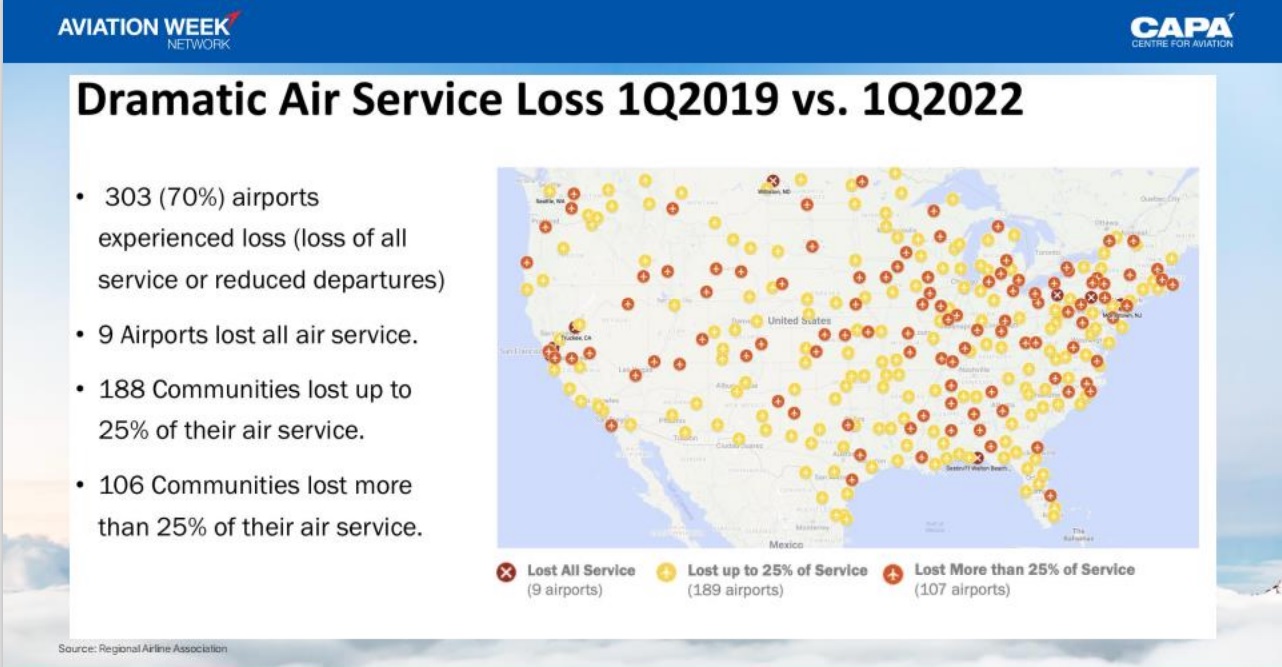
Harris, citing a Centre for Aviation market intelligence report, said the seat capacity on US airlines is only expected to surpass 2019 levels, regardless of demand, by October this year.
She noted that the report also showed that reduced departures had been recorded across 70% of US airports in the first quarter of this year, compared to the same period in 2019.
Bryan also acknowledged the airlift problem, noting that, as of May, the number of seats available on inbound aircraft was 20% fewer than that of May 2019. But, the airlift capacity has been improving since the start of the year, when it was 65% less than in January 2019.
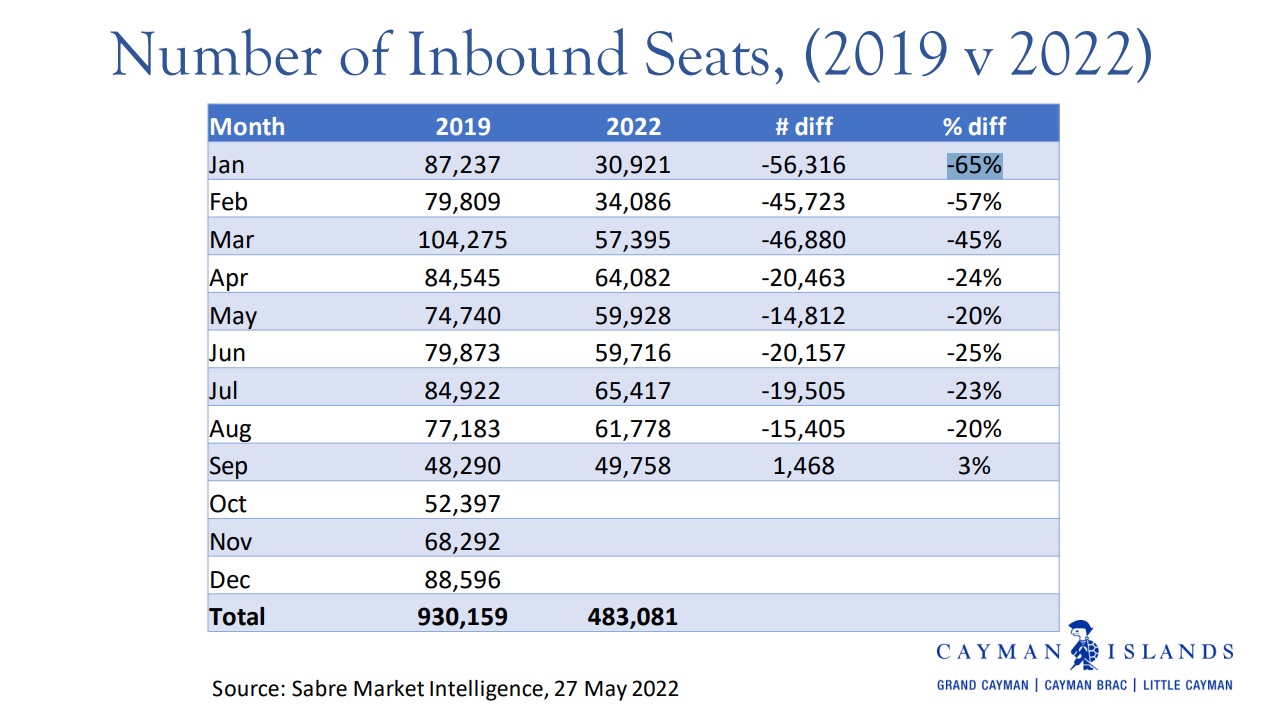 Harris and Bryan were quoting a Saber Market Intelligence Report, released last month, which noted air capacity is expected to exceed 2019 figures by September this year.
Bryan stated that, in terms of room stock to accommodate incoming travellers on those flights, there are 7,112 rooms across condos, villas and and hotels in the Cayman Islands, with 6,678 rooms in Grand Cayman, 267 in Cayman Brac, and 167 in Little Cayman.
Tourism as economic driver
Bryan said, between January and March this year, the Cayman Islands government collected CI$3.8 million in tourism taxes and fees.
He added that the forecast direct tourism spend for the full year of 2022 was US$381 million (CI$312 million) in tourism taxes and fees. By comparison, in 2019, the stayover visitor spend was almost double that, at US$737.4 million (CI$604.6 million).
Bryan said government has committed to spend more than $2 million in advertising, with the aim to bring visitors here over the summer period. He admits that with a “cost of living crisis” occurring in the US and worldwide, it could be a hard sell, and he urged the tourism industry to give “some serious thought” to offering value-added summer promotions to increase the incentive for tourists to come to Cayman.
Highlighting some other data relating to stayover visitors, Bryan noted that the average length of stay on island had increased slightly, from six nights to 6.5 nights.
He also pointed out that between January and March this year, 45% of arrivals were first-time visitors, compared to 56% in 2019, and 55% of travellers were returning visitors versus 44% in 2019.
He said room rates were returning to pre-pandemic levels, “even though occupancy is still lagging behind”.
“This tells us that in the first quarter of the year, travellers have been willing to pay more for the chance to get away on a vacation after the challenges and stresses of COVID-19. Though we have a long way to go before we get back to pre-pandemic arrival numbers, the month-to-month increase demonstrates that for every key performance indicator, the needle is moving in the right direction.”
Regional tourism conference for Cayman
At the CITA meeting, Bryan announced that the Ministry of Tourism and the Department of Tourism had partnered with the Caribbean Tourism Organization to host a “high-level regional conference” in Cayman on 12-15 Sept.
He said attendees would include regional ministers and senior airline executives, as well as regional and international media and delegates.
“I’m very excited about hosting this prestigious event here in the Cayman Islands. It will provide a forum for the Caribbean leaders and captains of industry to discuss some of the challenges and opportunities specific to our Caribbean region. It will also help to solidify our islands’ position as a key player in the regional tourism arena.”
Related Videos













This is so stupid. Dump the portal. Get rid of the testing requirement like everywhere else. Get rid of masks like everywhere else. If this were done, we would schedule a week stayover the next day at a condo and spend probably $10k over a week. How hard is it? Why do the stayover passengers have to go through the hassle and the cruisers, who spend hardly anything can just walk on in, whenever? The only logical reason I can think of is that the portal and associated nonsense are simply a jobs program.
So, for now, USVI and Turks and Caicos or Mexico it is. Just had a lovely time in Mexico for a week and they were happy to have us. Maybe we will just not come back to Cayman forever.
There is no need for visitors and returning residents to fill in the Travel Cayman Application.
All that should be needed is notice that visitors need to be fully vaccinated and have a negative test.
Just red tape that serves no purpose.
Of course the world economy and very high inflation will cause problems for some visitors. Travel is a discretionary expense that is easy to cut out of one’s budget if one is struggling to pay an increased mortgage.
Came twice so far (Feb and Apr) – the tests were a pain and all the regulations but it was worth it. For some, they won’t go through all that when other islands don’t require it. Second, hotel prices were way too high given the light demand. If you don’t want to be seen discounting the rate, reach out to previous visitors and give them 2 free nights after staying 5.
What is glaringly obvious to me is that families with unvaccinated children between the ages of 12 – 17 are not going to visit here because their unvaccinated kids must be quarantined. Sure families with unvaccinated kids age 11 and under were welcomed back as long as parents/guardians were fully vaccinated but let’s face it not all families that visit here only have kids ages11 and younger. What about all those folks with teenagers? We’ve effectively eliminated a large group of tourists.
Until ALL families are welcome and until ALL entry restrictions are dropped tourism will never return to the levels seen in 2019. There is no reason for Travel Cayman to exist, applying to visit is just another step to deal with, then testing, then making sure you have all the proper documents, UGH I don’t blame people for going to other destinations where you don’t have to do all of these things. And as another poster mentioned, these restrictions only apply to visitors arriving via air. Those on a cruise ship do not have to get permission to visit and they do not have to test one day before arrival.
Let’s talk about testing…is there really any point to this anymore? And if we are going to continue to require testing then let us welcome back the unvaccinated along with vaccinated and a negative covid test before arrival. Let us move forward like so many other countries.
Here is one question that is always at the back of my mind: at what point will those who are currently considered fully vaccinated be considered not vaccinated? For example, I completed my 2nd dose of the vaccine in April 2021, I was boosted in December 2021. In December 2022 will I still be considered fully vaccinated or will I be forced to get yet another booster?
Beth is correct:
1. ALL families should be welcome.
2. ALL entry restrictions should be dropped.
3. Travel Cayman should cease to exist.
4. Covid testing is pointless, and should stop.
Until the above happen, Cayman will remain comparatively unattractive, and will never regain previous tourism/revenue levels.