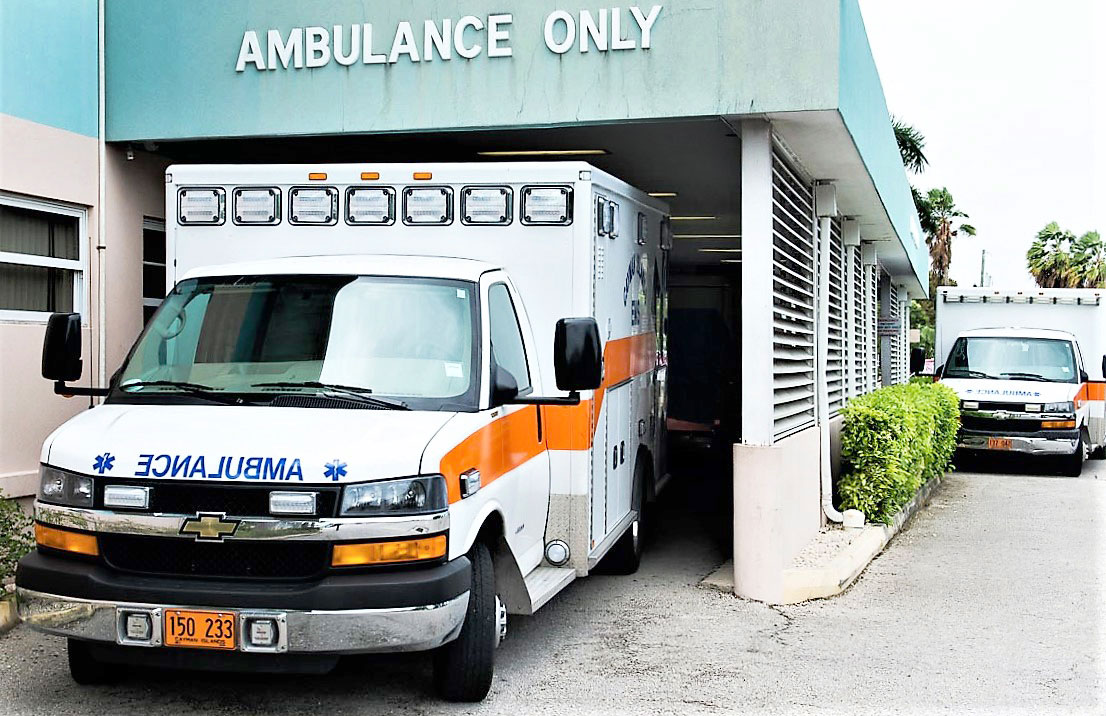
The death Sunday of motorbike racer Kashwayne McKenzie, who was taken by ambulance from Bodden Town to the Cayman Islands Hospital in George Town, has again raised public debate over why emergency cases that occur in the eastern districts are not transported to the much-closer Health City in East End.
The ambulance drove McKenzie 14 miles to the hospital in George Town after the horrific high-speed crash at the Parker’s Raceway in Breakers. Health City Cayman Islands is located just over 4 miles from the track.
Family and friends on social media have been questioning why the ambulance did not take him to the much-closer Health City, which also has an accident and emergency unit.
The issue has arisen a number of times over the years when life-and-death cases have occurred in the eastern districts.
Under the existing protocols, when 911 calls are received, it is the HSA’s ambulances that are dispatched to the scene of medical emergencies.
Chief officer in the Ministry of Health and Wellness, Nellie Pouchie, speaking at a press briefing on healthcare issues on Wednesday, when asked why emergency cases that occur near Health City are not immediately taken there, said it was not as “simple” as transporting a patient to the nearest hospital.
“We have to make sure, if we’re redirecting an ambulance or services elsewhere, that that entity is equipped to be able to attend to it,” she said.
“However,” she added, “we at a ministry level always look at how best we can improve – are there other providers out there that can support that sort of emergency situation? Those assessments are ongoing as to the extent to which we can say we can comfortably divert an ambulance elsewhere and know that the level of care is exactly what we would expect under emergency conditions.”
In response to queries from the Compass on whether the decision to take McKenzie to George Town rather than to the hospital in East End was a matter of policy, a Health City spokesperson did not directly address the question, but said it was looking forward to “continuing engagement toward the expansion and enhancement of collaboration” between it, the HSA and the government in providing world-class healthcare services.
Health City emergency services run 24/7
Health City says it has had a 24-hour, seven-day-a-week emergency wing, with six beds and an ambulance bay, since late 2018, enabling the hospital to deal with medical and surgical traumas, apart from paediatric emergencies.
In its response, Health City said the Health Practice Commission had approved it to provide emergency and intensive care services at the unit, which is fully staffed around the clock by ER physicians.
“Our ER physicians are qualified with Masters in Emergency Medicine and capable of managing various medical emergencies, including where there is trauma involving multiple organs,” the hospital said. “Our ER physicians are supported by a team of nurses who have experience working in advanced trauma centres, prior to joining Health City.”
The HSA Medical Director Dr Delroy Jefferson, in a statement issued by the authority in response to the controversy, noted that, historically, the HSA has been the “only national provider of life-threatening multi-trauma emergency care in the Cayman Islands”.
He said the HSA has “always welcomed efforts by other health care providers capable and willing to play a role in filling any identified gaps in emergency care. For many years there has been and still is a collaborative approach between HSA and Health City Cayman Islands to coordinate emergency medical patient transfers based on the patient’s medical condition.”
Speaking at the media briefing, Health Services Authority CEO Lizzette Yearwood outlined that the emergency medical services team from the George Town hospital assesses, treats and transports patients to the Accident and Emergency Unit, while communicating with an emergency physician at the Cayman Islands Hospital. She said that in certain cases, such as cardio-thoracic emergencies, patients are diverted directly to Health City after consultation with the A&E doctors at the HSA.
“This transport protocol requires communication with HCCI to advise them of the patient’s clinical needs. These life-threatening emergencies do not require Chief Medical Officer approval prior to the ambulance being diverted to HCCI,” the HSA stated.
Reshma Ragoonath contributed to this story.
Related Videos