Caribbean Utilities Company has grown the number of customers and sales in the third quarter but a marginally lower average residential electricity use shows that consumers are attempting to conserve energy amid high fuel prices.
Global fuel prices continued to rise in the third quarter impacting CUC’s fuel costs, according to a press release announcing the results.
The utility’s power-generation expenses for the third quarter totalled $52.4 million, an increase of 70% over the same period last year.
This was primarily the result of a 75% year-on-year increase in the average fuel price per imperial gallon.
The average fuel cost charge rate billed to consumers in the quarter was $0.29 per kilowatt hour, compared to the average rate of $0.17 per kWh 12 months ago. CUC passes through all fuel costs and renewable costs to consumers on a two-month lag basis with no mark-up.
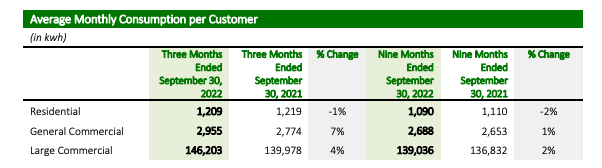
The average monthly consumption of 1,209 kWh per residential customer declined by 1% during the third quarter and 2% during the first nine months of the year at an average of 1,110 kWh.
Subsidised electricity bills
Between July and September, residential energy bills were subsidised by government’s Electricity Assistance Programme, which capped electricity charges at $0.15 per kWh and paid the excess costs to CUC.
The programme has been extended until the end of the year, with government contributing up to $0.05 per kWh on fuel factor charges exceeding $0.15 per kWh.
Additional fuel factor costs above $0.20 per kWh will be covered by CUC’s separate Fuel Factor Relief programme. CUC’s own scheme, which was approved by regulator OfReg, is available to residential and commercial customers.
Unlike the government scheme, CUC will recover the costs of its programme with higher electricity bills over a 12-month period starting in 2023.
Record peak load
Despite energy conservation efforts by residential customers, the electricity provider recorded a new system peak load of 113.573 megawatts during the period.
The number of CUC customers, 32,865, at the end of September was 3% higher than a year earlier.
In the third quarter, CUC increased its total energy sales by 4.1 million, or 2%, to 184 million kWh. Higher sales reflected both more customers and increased commercial sales.
The company’s net earnings $10.4 million during the quarter were up 3%, or $0.3 million, year on year.
Net earnings marginally higher
Net earnings benefited from a decrease of transmission and distribution costs and higher foreign exchange gains. But they were negatively impacted by increases in depreciation expenses, general and administration costs, and finance charges, CUC said.
Depreciation charges related to the Seven Mile Beach and Prospect substations and other growth-related capital projects coming into service.
In the first nine months, net earnings of $24.2 million were up 10% compared to the same period in 2021.
The company’s president and CEO, Richard Hew, said in a press release, “The state of the current global fuel markets emphasizes the need and our desire to advance activities under the Integrated Resource Plan as quickly as possible, particularly utility scale solar projects, to transition to more sustainable energy solutions that bring price stability and reduce carbon emissions.
“Tropical Storm Ian also reminds us of the importance of building resilient systems such as our indoor substations to adapt to more frequent storms brought by climate change.”
Battery project
The company said a highlight of the third quarter of 2022 was the signing of an agreement with the technology group Wärtsilä.
Wärtsilä will supply two 10-megawatt storage systems to CUC.
The utility said the project is primarily designed to reduce the online or spinning reserve requirement provided by diesel engines and will improved fuel efficiency by approximately 6%, with a corresponding reduction in CO2 emissions.
It is CUC’s first energy-storage facility, and it will also enable the company to increase the amount of intermittent renewable energy connected to the grid on Grand Cayman from mid-2023.
During the third quarter, the company said it promoted four Caymanians to its management team as part of CUC’s ongoing restructuring programme.
Related Videos