

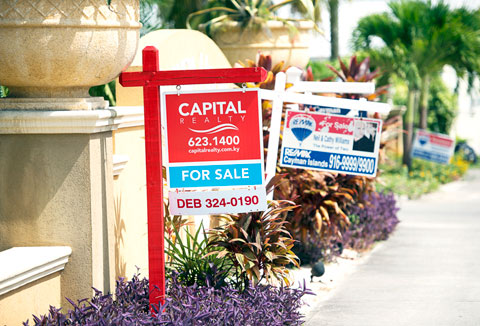
The Cayman Islands real estate market is cooling down, but not by much.
After a record year for property transactions in 2021, rising interest rates are putting the brakes on home purchases for those who need financing.
Lands and Survey data shows that the number of freehold transfers in the first nine months of the year is down 14.7% and the value of these transactions has declined by 9.5%.
Last year, the total value of property deals in Cayman reached $1.43 billion on the basis of 3,290 freehold and leasehold transfers, leases and purchase agreements.
In the first three quarters of 2022, total activity has declined 10.9% by value and 16.5% by volume, but it has already exceeded the billion-dollar mark.
The data indicates that after a peak year in 2021, this year is still set to be the second most active year for the sector on record.
Sales down but transaction values are up
Still, there are signs that the real estate market is slowing.
The 204 recorded sales in 3Q are down by more than a quarter year-on-year and declined 20% compared to 255 sales in the second quarter.
Sales values, however, have not declined as fast, which means that the value per transaction is still rising – from $958,854 in the third quarter of 2021 to $1,039,045 during the same period this year.
This does not say anything about whether individual property values are still increasing, because it could simply constitute a shift of activity to the higher-priced end of the market.
This is what would be expected in a rising interest rate environment that narrows down the number of affordable properties for buyers who need a mortgage.
While higher interest rates are one of the biggest factors for the majority of transactions, they tend to affect the overall volume less, because so many high-net-worth purchasers are cash buyers.
RE/MAX broker and owner James Bovell, who analysed the CIREBA sales statistics in a blog post, estimates that 40% to 50% of the sales volume is financed.
“Overall, the real estate market is seeing some slowdowns that started in Q2 2022, but it is also important to note that these slowdowns should be completely expected given how hot the real estate market has been. Things are slowly getting back to normal,” Bovell said.
Normalisation of interest rates
The normalisation of interest rates is part of that trend.
Bovell believes the market still has to come to terms with the new interest rate environment and has not seen the full effect yet.
The Federal Reserve has signaled that rates will rise or remain high for one to two years, before dropping again.
After years of getting “a free ride” at zero or near-zero policy rates, property buyers and owners now face more normal interest rates.
“It’s all relative,” Bovell said. “Our parents were dealing with 14 to 17%.”
It will take time for the local market, Cayman residents and banks, to absorb the change, but the market will then continue to grow, he argues.
In the meantime, activity in the lower and medium segment of the market is easing.
Despite the more challenging financing and fewer transactions, property values are unlikely to drop off.
No housing bubble
With a rising population, demand for affordable properties continues to grow.
The inventory of available properties is down almost 5% quarter-over-quarter despite rising interest rates. There are currently about 1,500 active listings but only about 800 to 900 are available for sale as the remainder is pending.
At the same time, the number of proposed new developments has dropped off significantly.
Bovell said, “It’s not like there’s a whole pile of new inventory that’s going to be coming down the pipe for people to consider.”
In the first quarter, the value of residential building permits dropped by 42.2%, while the value of project approvals was higher year-on-year, but only slightly more than half of the value in the first quarter in 2020.
“We have to recognise that we have our housing challenges,” Bovell said. Because of high costs, “producing housing that is affordable is difficult.”
Opening up access to land that people could afford to buy is one of main challenges due to Cayman’s infrastructure and traffic bottlenecks, he added.
With inventory in the higher-end segment equally tight, the large contingent of overseas buyers in Cayman will ensure that the total value of property transactions will not be far off last year’s record high.
Related Videos











If we want a normalised real estate market we need the brokers’ sky high commission rates to come down, they far exceed any other civilised country. Goodness knows what these people earned during the property boom whilst so many were suffering the effects of Covid.
“Opening up access to land that people could afford to buy is one of the main challenges”. No, it’s one of the main red herrings (in this case put out by people who make money on more sales) since any supply (house or property) is being snapped up by the 50% of people who do not need financing (roughly, based on the article’s own numbers) so if it is a desirable piece or property 50% of the people looking at it are not looking at price as their first consideration so there is no need to set your price low to sell it. If it is an undesirable piece of property why do we want people living there? Thats how we ended up with people living in homes built in swamp that floods every time it rains. Anyone saying that opening up more land will somehow magically fix the problem is just looking to make a quick buck off of opening up someone else’s land for a third person to buy, probably speculatively. The country needs to talk about what is the actual number of people we can support at a standard of living we like and what that standard of living looks like, i.e., how much agriculture land and public open space and public amenities and infrastructure and a long list of non-housing stuff that also needs land. We’re not making more land so we need to either stop increasing the number of people or accept a shift in the vision of how those people are housed. I don’t think most of us want to shift that vision and we definitely shouldn’t have to shift our vision downward so someone else can make commissions on selling our land. (Or building on it and then selling it at a higher price. Because, like the article says, that higher end of the market is where the real profit is. Actually, the profit is in the higher-end rental market, putting even more pressure on the lower end house ownership market. There is no middle any more it seems as that’s the least profitable segment; costs almost as much as high end to build but does not sell/rent for much more than a lower end property and you can only sell/rent a house once but if you put multiple units on the same piece of property you increase your income.) Opening up more land is a red herring in this discussion.