

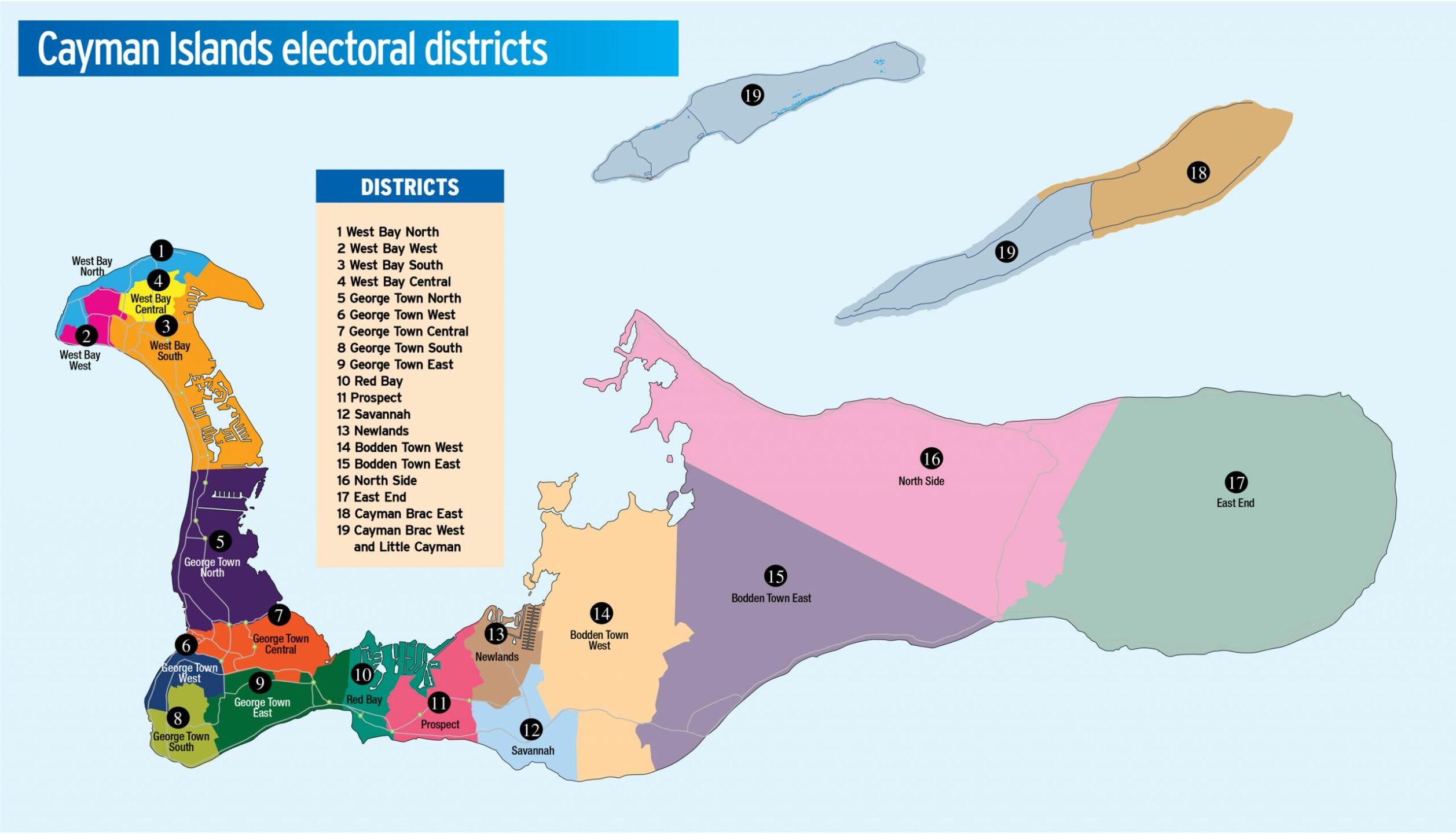
The Electoral Boundary Commission is facing a challenge – how to redraw Grand Cayman’s constituency boundaries to reflect the rapidly growing population in certain districts, while still keeping those borders within the island’s traditional five districts.
Among the options the commission is considering is combining North Side and East End, both of which have a smaller voting population than is considered “ideal” by international election standards, and absorbing any overflow of voters into a new fifth constituency within the traditional Bodden Town district. This is among four possible alternatives to existing boundaries that the commission has been presenting in public forums this month.
The commission, which was appointed by Governor Martyn Roper earlier this year, has begun re-examining the existing boundaries that form Cayman’s 19 constituencies. The commission’s report will be submitted to new Governor Jane Owen and to the Cayman Islands government.
The most recent Electoral Boundary Commission consists of the same three people who made up the 2015 team, with UK expert Lisa Handley as chairperson, and attorneys Steve McField and Adriannie Webb as members.
The commission has been holding a series of public meetings in each electoral district. Speaking at the public meetings, Handley said Grand Cayman’s growing population necessitated a redrawing of the islands’ electoral boundaries.
In its presentation to the public, the commission has noted that the four constituencies in West Bay and the seven constituencies in George Town can all be redrawn in such a way as to ensure that no constituency crosses district boundaries nor deviates by more than 10% from the ideal population size, but this could not be done in Bodden Town, North Side and East End.
It offers four alternatives to the current boundaries.
Option 1
The first option being considered by the commission involves redrawing the constituency boundaries to meet the international standard for population equality, meaning no constituency would deviate by more than 10% from the ideal constituency population size of 1,636.
This option would lead to the addition of a fifth constituency to Bodden Town’s existing four, and combining East End and North Side into a single constituency.
Combining North Side and East End would mean that the voting population size would be 10% higher than the ideal number, so some voters would be moved to one of the Bodden Town constituencies.
Option 2
The second option involves redrawing constituencies so that they are more equal in population but take account of traditional district boundaries, such that no constituency crosses those lines.
In this option, a fifth Bodden Town constituency would be added. North Side and East End would be combined into a single constituency, but voters from those two districts would be retained within a new combined single constituency, with none being moved to a Bodden Town constituency.
Option 3
The third option involves redrawing constituencies to be more equal in population, but ensuring that all traditional districts are guaranteed at least one constituency.
Under this alternative to the current system, the status quo would effectively be retained for the eastern districts, with East End and North Side each keeping their own voting district and Bodden Town retaining its four constituencies.
However, this would mean the Bodden Town voting districts would be over-populated well beyond 10% of the ideal constituency population.
Webb said feedback that she had consistently heard from voters was that they wanted their traditional district boundaries to be respected and retained.
Option 4
The commission has offered a fourth potential alternative – adding a parliamentary seat or two.
This would mean that North Side and East End could retain their own constituencies and Bodden Town could be granted five electoral districts.
However, the commission pointed out that this would involve a constitutional change and was beyond its remit.
Webb told meeting attendees that, if this option were followed, an odd number of seats would be required, to avoid instances of a hung Parliament; therefore, any increase in constituencies or parliamentary seats would have to be from the current 19 to 21.
Once one of these options is chosen and it is determined whether Bodden Town will have four or five constituencies, the commission will begin drawing up proposed maps of the electoral districts, which it will present for public consultation.
Handley said constituency maps with their new boundaries may be available in about six weeks.
Growing population driving change to boundaries
The commission, in its presentations, has noted that the 2021 census showed that the Caymanian population had increased by almost 23% since 2010, but the growth was uneven across the five traditional districts in Grand Cayman, with Bodden Town experiencing the largest increase in population (39.3%).
The Commonwealth Parliamentary Association’s Expert Mission Report on the Cayman Islands 2021 General Election stated that there were significant differences in the numbers of voters registered in each district at the time, giving the example of Bodden Town East with its 1,664 registered voters, compared to North Side’s 836 voters and East End’s 769 voters. It concluded that “a registered voter in East End district has more than double the weight of a registered voter in Bodden Town East”.
It recommended that the Electoral Boundary Commission “should conduct a delimitation exercise and publish a report by 2023 which should carefully scrutinize how international standards and best practice can be met to further narrow the scope of deviation from the equality of the vote. Deviations from the norm should ideally not be more than 10 per cent and in exceptional circumstances 15 per cent.”
1,636: ‘Ideal’ electorate size per constituency
According to the commission, the “ideal” voting population size for a constituency in Grand Cayman is 1,636.
Some districts have considerably larger populations than that, such as Bodden Town West, which has 2,205 registered voters (34.78% higher than the ideal) and West Bay South with its 2,022 voters (22.59% higher than the ideal), while others are much smaller, including North Side, whose population of 978 is 40.22% lower than the ideal, and East End, with a voting population of 846, which is 48.29% lower than the ideal.
Cayman Brac East (voting population 514) or Cayman Brac West and Little Cayman (with a combined voting population of 646) are even smaller, but the Constitution specifically singles out the Sister Islands to ensure that they have at least two representatives, regardless of the small population size.
The commission says the constituencies could be redrawn to ensure that none deviates by more than 10% from the ideal population size, while still keeping them within traditional district boundaries.
The five districts in Grand Cayman are George Town, Bodden Town, West Bay, East End and North Side.
Sister Islands
Some of the feedback given by the public involved urging the commission to recommend that Little Cayman have its own elected representative, rather than share one with Cayman Brac West.
However, Handley says Little Cayman is too small to have its own constituency. She acknowledged that it may be possible at some point in the future for the island to have its own representative, but for now, according to the census figures, it does not have the population to justify being a single constituency.
The 2021 census showed Little Cayman had a population at that time of 161, of which only 48 were Caymanian.
National voting
Some members of the public have also suggested that the commission consider that national or ‘at large’ representatives could be elected.
Former East End representative Arden McLean, who called into Radio Cayman’s ‘For the Record’ show last week on which the commission members were guests, suggested that Cayman follow the voting model of the British Virgin Islands, in which electors can vote for a member in their constituencies as well for ‘at large’ candidates.
McLean queried whether voters in Cayman could have three votes, one for an MP in their own constituency and two additional national votes for politicians who would represent the entire jurisdiction.
An attendee at the West Bay also asked if there had been any consideration given to a national vote to elect the premier.
Handley noted that changes of these sorts would be outside the remit of the commission, as its purview was to review the boundaries, not Cayman’s electoral system.
‘Do nothing’ not an option
At the Bodden Town public meeting last week, Minister of Border Control and Labour Dwayne Seymour asked the commission if a ‘do nothing’ option was a possibility, whereby the existing boundaries could remain intact.
Handley said this was not an option the commission would be considering in its upcoming report, though it would be ultimately be up to legislators to decide whether to implement the suggestions.
But Handley warned, “If you do nothing, by the time you get around to doing something, the changes to the constituencies will be even greater.”
McField, who is also chairman of the Permanent Residency and Caymanian Status Board, said the “massive” growth in the islands’ population, especially between George Town and Bodden Town East, meant there was no choice but to redraw the islands’ boundaries.
“If you don’t do anything about it now, in eight years’ time, you are going to have to do something about it. There’s no solution by kicking the can down the road… Either we have to slow down the massive growth or we have to find a solution to this,” he said.
He noted that a surge in work-permit applications, which he said were numbering between 4,500 and 5,000 a month, meant in the future there would be growing numbers of people obtaining permanent residency and then Caymanian status, which would give them voting rights.
“We now have something like 38,000 work permits in a population of 84,000 people,” he said.
The Constitution requires that a review of Cayman’s electoral boundaries must be carried out every eight years. The last time the electoral boundaries were amended was in 2015, when Cayman’s six electoral districts, in which multiple representatives could be elected, were changed to 19 single-member constituencies.
Public feedback
Public meetings have already been held in George Town, Bodden Town, West Bay, Cayman Brac and Little Cayman, though turnout has not been high.
Voters in North Side will have their say at the North Side Civic Centre, from 7-9pm, on Wednesday, 24 May.
The meeting in East End will be held from 7-9pm at the East End Civic Centre, on Thursday, 25 May.
The deadline for submissions from the public is the end of June, though Handley encouraged people to send feedback “as soon as you can”. Submissions can be emailed to [email protected].
Handley stated that the next step, once submissions have been received, will involve drawing draft maps with the new boundaries. At that point, more public meetings will be held to get feedback and comments on those boundaries. A final report will then be completed and submitted to the governor and the government.
Related Videos










Though it would take a constitutional change, our electoral districts are so, so tiny and the remuneration and early pension benefits for being elected are so out of touch with the number of votes needed to be elected, this has real risks attached.
The U.K. system requires typically at least 20,000 votes to be elected as an MP