135 miles – about six times the length of Grand Cayman. An unfathomable distance to travel by foot, for most.
For Kerri Kanuga, it’s just another race.
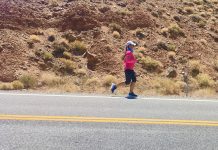
On 6 July, Kanuga, 53, completed her sixth Badwater 135 Ultramarathon: a 135-mile, non-stop running race in California that covers three mountain ranges and is widely dubbed “the world’s toughest footrace”.
An experienced endurance athlete, the owner and broker at Trident Properties Cayman Islands, set a new personal best of 34 hours and 42 minutes at this year’s Badwater event. That time made her the sixth-placed female and 26th-placed overall competitor out of a field of 100 runners (and 89 finishers), handpicked by event organisers from thousands of qualified applications.
“I am thrilled with my Badwater finish this year,” Kanuga said. After encountering stomach issues around mile 80 and being unable to keep down any nutrition or electrolytes for the next 30 miles, Kanuga was able to push through for the final half-marathon that featured an ascent of over 4,000 feet.
“The hallucinations for those [30] miles were extreme,” Kanuga added. “I was really worried I would not make it to the finish.”
According to the official race website, the start line lies in Badwater Basin in California’s Death Valley – the lowest elevation in North America, at 280 feet below sea level – and finishes 8,300 feet above sea level at the trailhead to the summit of Mount Whitney, the highest elevation point in the contiguous United States.
Included in the course is a total of 14,600 feet of cumulative ascent, and 6,100 feet of descent – a challenge made even more gruelling by scorching hot conditions.
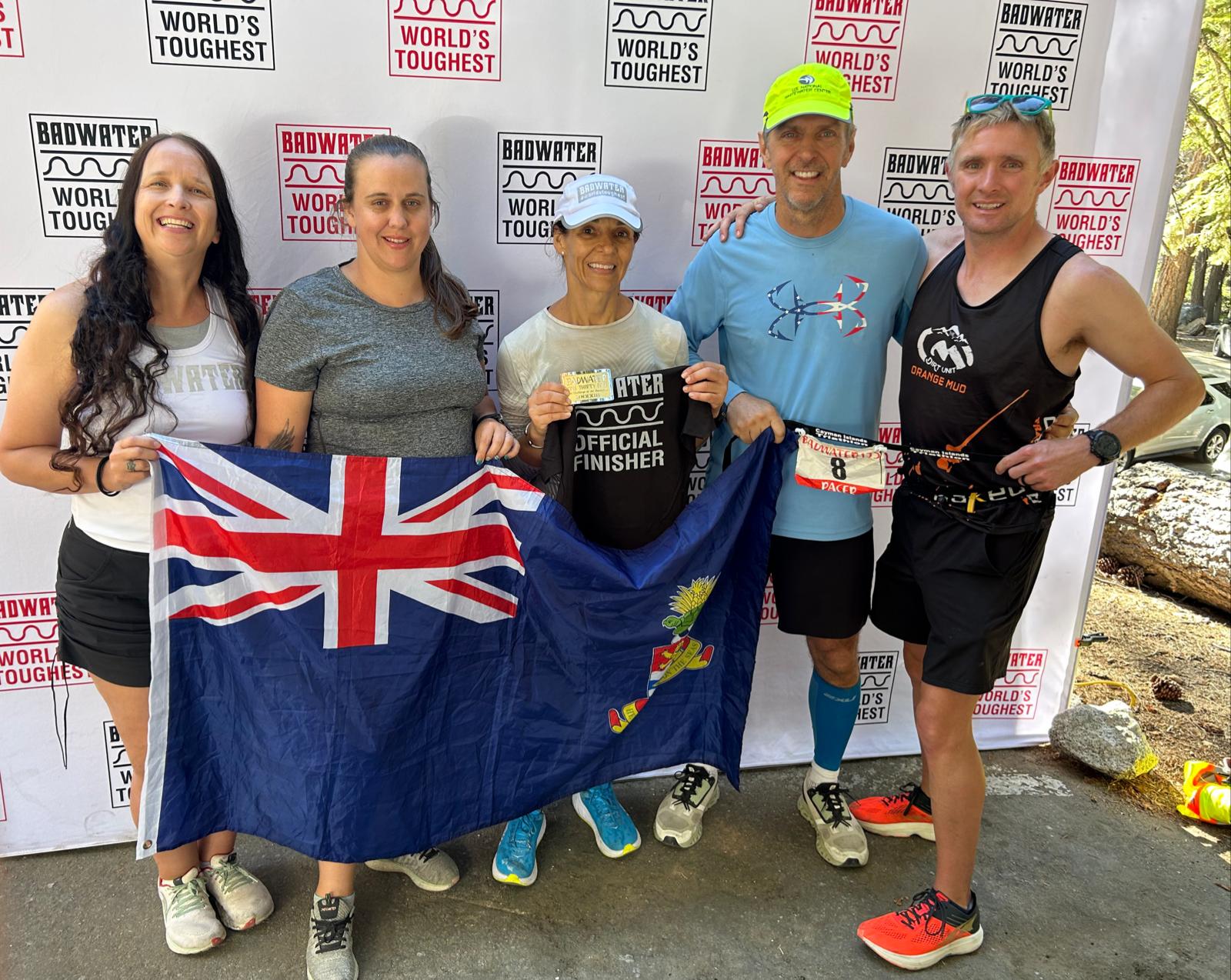
Having completed her first Badwater 135 in 2016, finishing sixth in the field of female runners and never lower than 10th in each appearance since, Kanuga is no stranger to the world of extreme endurance events.
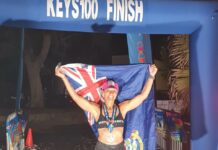
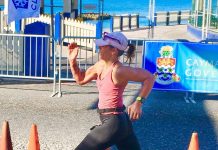
Since completing her first Cayman Islands marathon in 2010 and a 2015 on-island solo fundraising event featuring a 6-mile open water swim followed by a 106-mile run, she has competed at various other ‘ultra-distance’ events around the world – including the Tahoe 200 back in 2018. Most recently, Kanuga completed the 100-mile Keys100 race in May, finishing fourth overall and third among female competitors.
Kanuga – who is next set to run the 2023 Spartathlon, a 153-mile race between the Greek cities of Athens and Sparta beginning 30 Sept. – answered questions from the Compass about her ‘why’, the training for these events, and more:
What inspired you to first get into these extreme races, and what keeps you coming back for more?
I never thought I would run a marathon – I am a swimmer, not a runner. I ran the Cayman Islands marathon in 2010 and felt really good after and wanted to run Off The Beaten Track [a 50-kilometre ultra-marathon held annually in Cayman since 2010] which I did and really enjoyed.
Shortly after that, I read ‘Ultramarathon Man: Confessions of an All-Night Runner’ by Dean Karnazes. Up until that point, I had no idea people ran 100-mile races. Having felt so good after Off The Beaten Track, I started to play with the idea that I might be able to complete a 100-mile race so I set my heart on the Keys100 in Florida. I trained for that race for two years and, unfortunately, each year before the race I would get injured!
The second time I broke a bone in my foot but was still able to swim. I had also read an article about [then] 6-year-old Hannah Meeson and her fight against cancer. I was shocked to learn what little funding research into childhood cancer received and I wanted to do something about it [to date, Kanuga told the Compass she has raised over US$250,000 for various charities]. To raise money and awareness for childhood cancer funding, I swam around Key West (approximately 20 kilometres) and then when my foot healed, I was still ‘run fit’ so I decided to swim across the [North] Sound (from Starfish Point to Barkers) followed by a run around Grand Cayman twice (6-mile swim and 106-mile run).
I have since completed the Keys100 four times, with my best time being earlier this year of 21 hours and 11 seconds, placing third female and fourth overall. This performance currently ranks me as 55th overall and third in my age group in North America. Last year, my final ranking was 76th overall and sixth in my age group with my Daytona100 time of 19 hours and 34 minutes.
What does the training for these races, like the Badwater 135, look like – and is it difficult to do it on an island?
It is extremely difficult to train for mountain races in Cayman. There are 3 mountain passes on the Badwater route with the final 13 miles of the race considered to be the hardest half marathon in the world from Lone Pine to the Mount Whitney portal. This is a climb of over 4,000 feet after already running over 120 miles. I have a great coach, John Fitzgerald from CTS, who tweaks my training for me depending on the event. Training for mountain races includes repeats on the Camana Bay tower with a weighted vest, pulling a weighted sled and running on an incline on my treadmill.
How do you protect against common running ailments like shin splints, blisters, etc., to continue training when preparing for such a long and intense race? How about during the race itself?
Over time, your tendons, muscles and bones toughen up. When I first started ultra running, I had many injuries, but over the years I seem to have less and less. I also have made ‘best friends’ with my chiropractor and my physiotherapist! The mentoring I have received from my coach and other ultra runners has given me many ‘tricks of the trade’ – I now know how to prepare my feet, proper footwear, socks, etc.
Sometimes you can be prepared for everything and still get injured in these extreme distances: I lost 3 toenails at the Keys100 earlier this year and a fourth at Badwater earlier this month. Other than some bad chafing I am no worse for wear. Training in Cayman is extreme, especially during the heat of the day. I tell people all the time if you can train here, you can race anywhere!
Do you listen to music or podcasts when you run, either in training or in races? If so, what are some of your go-to’s?
I really do not listen to much music during my training or racing – I tend to lose myself in the ‘flow’ and the miles just melt away. If I do put on headphones, the music is usually some upbeat alternative rock and comedy podcasts.
How quickly do you burn through a pair of running shoes and have to replace them, with all of that mileage?
I really get attached to my shoes and will run them until there is nothing left. Replacing them is expensive and it is hard to get proper shoes for ultra running on island. I usually have one or two pairs of shoes melt every year at Badwater. I did shoe inventory the other day and my runners in rotation are 24.
I have several ‘categories’ for shoes: some are for shorter distances (up to 10 miles) some are for trails, some are for long trails.
Related Videos