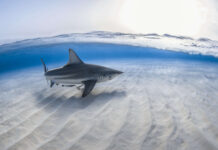
About 180 Caribbean reef sharks and 336 nurse sharks live in the waters around the Cayman Islands, according to the results of a pioneering four-year study.
Most stay within a 7.7 square mile range of the territory but some embark on longer journeys which take them beyond marine park boundaries, the research found.
As well as adult sharks, the study also found numerous juvenile reef and nurse sharks, indicating that both species have been breeding in Cayman waters.
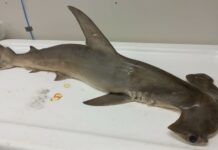
Four other coastal shark species – hammerheads, lemon, blacktip and tiger sharks – were recorded, but too few to estimate their population size.
The multi-agency led study was headed by the Department of Environment, Marine Conservation International and the Centre for Marine Biodiversity at Heriot-Watt University.
From 2015 to 2018, the research team counted sharks using photo identification from baited remote underwater video systems as a non-invasive alternative to tagging.
They detailed their methods and results in an 18-page research paper which was published on 9 Oct. in the Frontiers in Marine Science journal.
It is the first time that reef and nurse sharks have been counted in Cayman, and the first time reef sharks have been counted anywhere in the Caribbean region.
“Understanding the ecology of populations is critical for their effective conservation and management,” the paper says.
The results will provide information for conservation and enforcement locally and contribute towards knowledge of the status and behaviour of sharks in the wider Caribbean.
Protecting populations
Over the past decade, shark conservation has become a global priority due to the substantial decline in some shark populations.
Specifically, in the Atlantic Ocean and Caribbean Sea, this can happen as the result of overexploitation and other human activities such as habitat degradation.
In response, many nations have implemented measures such as fishing bans, quotas and marine protected areas to reduce the impact of fishing on local reef shark populations.
In Cayman, marine protected areas were established in 1986, covering 45% and 50% of the coastal shelf in Grand Cayman and Little Cayman, respectively, during the time of the research.
Sharks are also protected under the National Conservation Act 2013, and offenders who harm a shark risk a $500,000 fine or up to four years in prison.
“The benefits of these measures has, however, been highly variable and depended on population parameters such as population size and home range,” the study says.
Caribbean sharks
Reef sharks play a key role in maintaining healthy reef ecosystems, but the Caribbean’s reef shark populations are much less abundant than in the Pacific and Indian Ocean.
In remote locations, like the Cayman Islands, they are considered ecologically vulnerable to local extinction since they are less likely to be repopulated from other regions.
Nurse sharks and Caribbean reef sharks are the two most abundant reef shark species in most of the Caribbean region, including the Cayman Islands, the study says.
However, information on population size is only available for nurse sharks in the Atol das Rocas Marine Reserve, Brazil, and there are no estimates of the Caribbean reef shark.

In the Cayman Islands, shark research began in 2009 and results showed that the number of sharks is moderately low compared to some other locations.
“Even small recreational fisheries, such as that in Cayman, can impact reef sharks,” the study says.
Until this study, precise estimates of population sizes and home ranges of reef sharks in Cayman had not been available.
“Despite proactive conservation efforts, a lack of information on the status of local shark populations is of concern, since this undermines effective conservation planning,” it says.
Counting sharks
The ‘mark-recapture’ method is traditionally used to count sharks.
This approach requires the identification of individuals in a population so that they can be recognised at a subsequent sampling.
Generally, this is done by capturing the study animal and attaching or inserting a unique tag for individual identification, the study explains.
However, tagging can be difficult logistically, and in many countries, there are legal restrictions that require permits to catch and handle study animals.
Also the success of mark-recapture studies greatly depends on the chance of survival of marked animals.
This can be limited by the potential impacts of physical capture and tagging and by the longevity of the tags or markings.
Photo identification offers a non-invasive alternative to physical mark-recapture techniques using photographs to capture and recapture study animals, the study explains.
But, since this method relies on distinctive markings for individual identification, it may only be practical for species that have noticeable patterns or markings.
Sharks are typically elusive and difficult to capture because individuals often tend to avoid areas where there are boats, or snorkelers and scuba divers in the water, the study says.
So, given the predatory nature of reef sharks, baited remote underwater video systems (BRUVS) are now a common tool for studying aspects of shark populations.
“The use of BRUVS in combination with photo-ID appears to be especially advantageous for populations that are small or endangered,” the study says.
Four years of research
The research took place around Grand Cayman and Little Cayman over a four-year period from October 2015 to November 2018.
On each of seven sample occasions, the same 13 areas on Grand Cayman and eight areas on Little Cayman were surveyed, the study paper says.
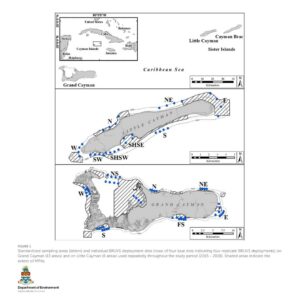
In each area, on each sampling occasion, a set of four BRUVS was deployed with 500 to 1,000 metres between each unit.
They were baited with about 300 grams of sliced Atlantic mackerel contained within a mesh bag attached to the end of a 1.5 metre bait arm.
GoPro cameras were set to record for at least 90 minutes or until battery failure or exhaustion of available space on the memory card.
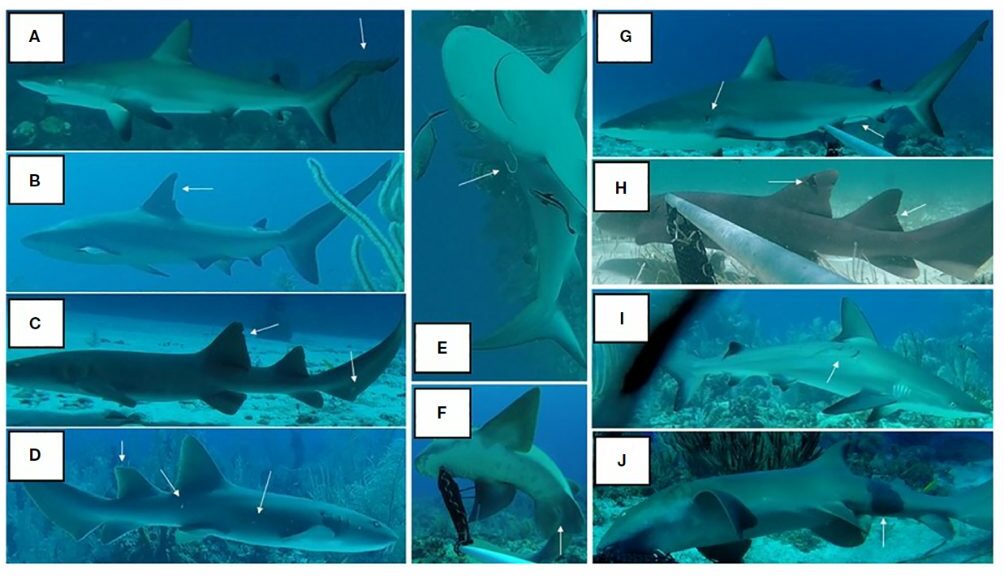
Photographic identification of individual sharks was made using distinctive features such as the presence of natural markings, signs of former or the presence of tags.
The team used a mathematical model to estimate the total population size of both the reef and nurse sharks.
The study was funded both through a Darwin grant from the UK government and the White Tip Fund from Caybrew.
Related Videos