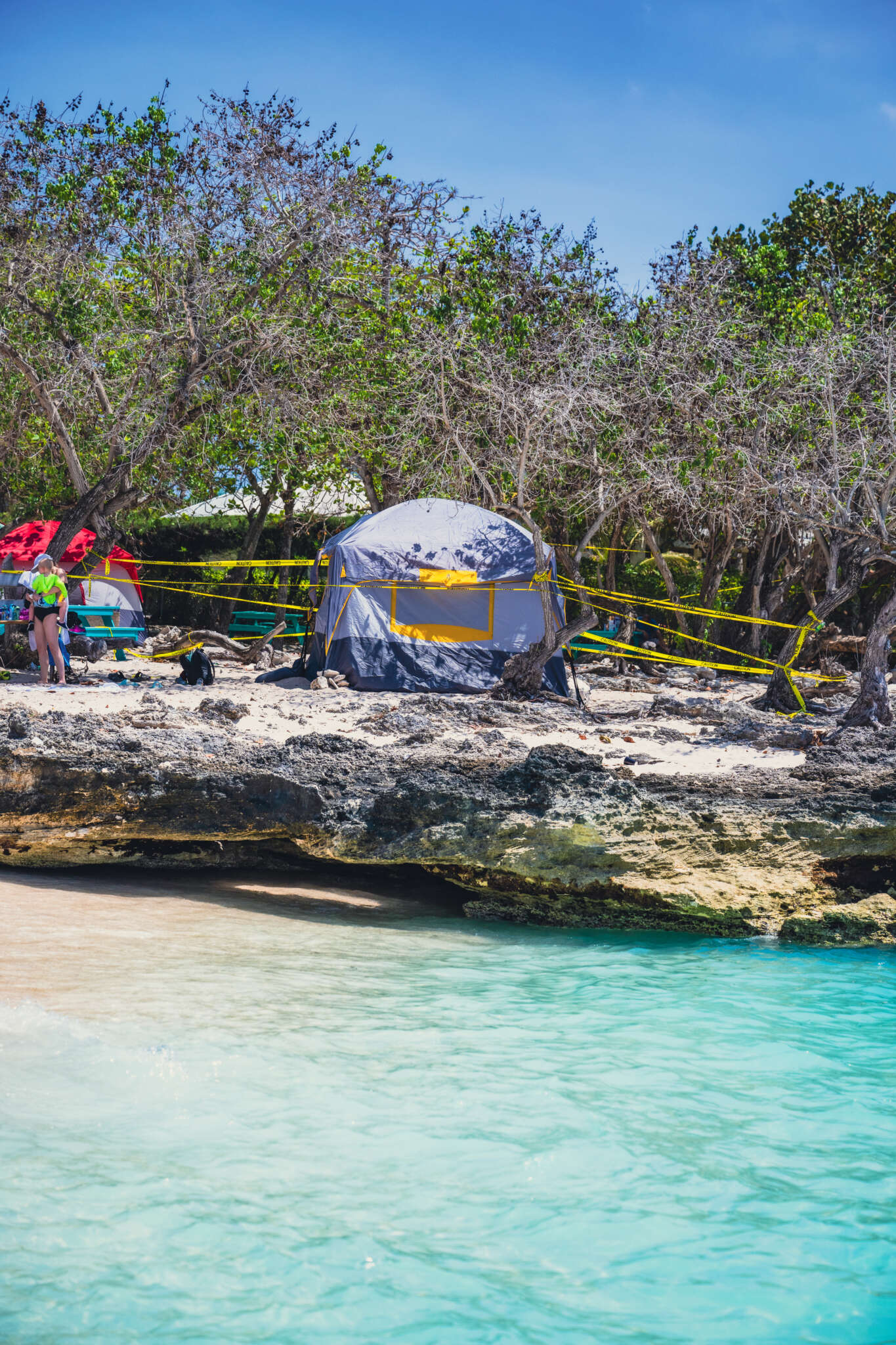
A jigsaw of red-and-yellow caution tape crisscrossing the public beach of Smith Barcadere this week quickly carved up the white sand into tiny no-go zones.
Inside the little puzzle pieces of pristine beach, tents of varying sizes, shapes and colours have been erected inside the caution tape, put in place to reserve families’ Easter spots.
Several miles north, in the remote stretches of Barkers, other families have posted signs advising that the spaces have been reserved.
Easter season is upon us and the battle to secure the perfect camping spot has begun.
“The trick is to find a spot that is just right, not too much sun, not too close to the sea, but not too far from the road either,” explained Paula Scott, 70, a camping veteran.
“Out here, people know me as ‘Brown Suga’ but since last year December, I got a new name, ‘Mayor of the Beach’,” she jokingly told the Cayman Compass before turning to explain the rules to a first-time camper who was trying to find a spot.
“You can set up [your tent] next to mine, but no loud music, no cursing, no ganja and no trouble, we have children here,” she said, while wrapped in a large beach towel, still wet from a moonlight swim.
While the ‘mayor’s’ rules are generally accepted by her family and those who pitch their tents nearby, camping on public lands is actually governed by section 13 of the Public Lands Regulations Act 2021.
No lawless camping
Only people who have resided in Cayman for at least six months prior to Easter are eligible to freely camp on public lands; everyone else must apply for a permit from the Public Lands Commission.
“The law prescribes a fine of up to $500, for a first-time offence, and increases all the way up to $2,000 for a repeat offender,” said a spokesperson for the commission.
He added, “Camping is an important part of the Caymanian tradition; it’s really a right of the people. In fact, it is so important, that is has been protected by the law.”
But while residents are free to set up their tents, there are other rules that apply to them, such as a 10-day limit.
According to section 13(2)(d), campers have a period of 10 days, either before Good Friday or after Easter Monday – anything beyond that could incur a fine of $500 for a first offence.
“It’s easy to pull up the anchor, but dropping it is another thing,” said Scott, referring to her efforts to erect her seven-tent setup, which was fastened into place some seven days before Good Friday.
Other sections of the law also govern the structures that can be temporarily built on public lands for the purpose of camping.
Home away from home
Scott’s setup comprises three main tents, one for her and her Shih Tzu dog Milo, and another two for her daughters and their children.
In addition, there are two smaller changing/showering tents and one tent which serves as an eating area next to an outdoor kitchen with two gas-powered stoves, a couple of coolers and three hammocks.
“This is all we will need to survive,” said Scott.
Everything sits beneath four larger outdoor tents which provide protection from sun and rain. To top it all off, a makeshift fence of green tarpaulin runs behind her changing/showering tents for privacy.
“The only thing I’m missing is a dial radio because I love me some cricket, and right now cricket is hot ‘n’ heavy and I’m missing out,” she said.
In other parts of the island, larger, more-elaborate structures of outdoor kitchens and showers made of plyboard and bamboo have been erected. Some sites have zinc fencing around shallow charcoal and wood firepits.
“The law requires that where these things have been erected, they must be removed once people have finished camping,” said the Public Lands Commission spokesperson. “Persons should also be mindful of the rules around bonfires and outdoor barbeques.”
But while there are clear rules which govern how, when and where people may camp, residents are plagued with a far more severe problem.
Shrinking camping grounds
While campers may be competing against each other to find the ideal place to pitch their tents on the local beaches, they’re also facing other challenges.
Natural ecological pressures, such as nor’westers, tropical storms and hurricanes, have shifted the sand deposits along Cayman’s coastline, where a thriving beach, once ideal for camping, now contains barren stretches of hard limestone.
In addition to the shifting sands, campers contend with the rapid and sustained development of beachfront properties, which has resulted in fractioning of the remaining potential campsites.
“I understand it’s a tradition, but as a property owner I have rights too,” said one homeowner, who asked to remain anonymous.
Her home, which sits less than 100 feet from the water’s edge, was once a camping site along the southern coastline of George Town.
“A few years ago, when we finally moved in, I was shocked to see that persons had gathered in my backyard and pitched tents,” she said. “I was so startled, I went out to speak to them and learned that their family had been camping there for generations.
“They stayed through the weekend, but they were a bit loud and their children kept coming onto my property and into my pool, so I had to ask them not to return.”
While the law does provide access to Cayman’s coastlines to all members of the public, that access stops at the high water mark, leaving little room to pitch even the smallest of tents.
This struggle is one that has been acknowledged by the current and former governments which have since purchased several large plots of seafront land that are now being converted into public spaces.

A changing tradition
Competing interests for land use is not a new problem, though, and over the years campers have had to make do with whatever space they could find.
But recently a new problem has threatened the tradition.
“The sad thing is that it is dying with the older generation,” said Scott, as she paused to think of a few of her friends whose multi-generational Caymanian families have stopped camping following the passing of the family’s patriarch/matriarch.
For Scott and her family, and many others, Easter camping, much like Christmas, serves as a time for family reunions, for people who would otherwise only congregate in times of mourning.
For the past 20 years, the same families have camped roughly in the same patch of sand at Smith Barcadere.
“In all my years, I see more and more people saying they won’t be coming back,” she said. “In fact, just last year there was one woman who used to come every year with her family, but she said that’s it, no more, she ain’t coming back.”
In their place, a new crop of Caymanian families has settled in.
When the Compass visited Smith Barcadere on Monday, 26 March, a family of Filipino-Caymanians were setting up tents for the first time, the children eager to experience the bliss of life by the seaside.
Meanwhile, on the other side of the beach, a Nicaraguan-Caymanian family was also erecting their tents for the first time.
The shift in the family dynamics suggests Cayman’s camping tradition, though largely intact, is beginning to change.
However, Scott and her family say they intend to keep the tradition alive.
“Well, on Friday we are cooking a big pot of beans, to go with some white rice, because you know we don’t cook anything with blood – no, sir!” she said, alluding to Christ’s death and other religious traditions behind the decision.
She added, “But come Monday, oh boy, we going have a stew! There will be traditional Cayman-style beef, homemade ice-cream and then the Swanky Kitchen Band going come down here to sing.”
Related Videos