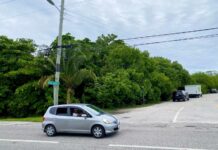
The Central Planning Authority has approved a 40-lot subdivision off Austin Conolly Drive in East End, but rejected the developer’s request to rezone the land from low density residential to medium density.
The planning authority gave the green light to the Breezy Palms development, by Invicta Construction Ltd., which sits on 38 acres of land, at its 14 Aug. meeting. The decision was publicised in the minutes of that meeting which were recently released.
The developer, represented by Troy Burke of Heritage Holdings at the planning meeting, had asked the planning board to recategorise the zoning of part of the land from low density residential to medium density residential, thereby enabling properties to be built on smaller lots than allowed in the planning regulations.
Initially, the developer had applied to create 180 lots, on the site west of Austin Conolly Drive, near Colliers, but in its latest amended application, Invicta outlined its plans for 40 lots. It requested that 11 of these be included in the existing low density residential zone (but with a variance to allow for medium density residential properties), and the remaining lots in the adjacent agricultural/residential zone, which it requested be changed to a low density residential zone.
While the CPA did not agree to rezone the land for the 11 lots, it said it was satisfied that the portion of the development area zoned agricultural/residential was not over a water lens and was “not particularly suited for agriculture”, and as such, agreed to rezone it as low density residential, on which the remaining 29 lots could be located.
The CPA has asked Invicta to submit plans showing a minimum of 10,000 square feet for each of the 11 lots, as stipulated in the planning regulations for low density residential zones, within 60 days of its decision.
Invicta had said changing the zoning classification would allow for the reduction of parcel sizes by approximately 33%, and subsequently lower the price per parcel.
“The primary objective of our project is to address the pressing need for more affordable housing options,” the developer stated in its application.
It added, “By increasing the number of parcels through Medium Density Residential zoning, we can significantly decrease the cost per parcel and make land more accessible to local residents at more affordable prices.”
The Department of Environment, in its response to the application, noted that while the government is in the process of drawing up a new development plan for the Cayman Islands, without an updated plan, a rezone of the scale Invicta is seeking “is not justifiable”.
The department “strongly recommended” that a comprehensive review of the ‘need’ for the subdivision of more parcels be undertaken.
“The impact of a further residential subdivision on existing infrastructure and the environment of the island should be properly considered and evaluated. The overall impact on the infrastructure and population of East End should also be considered given there would be significant pressure on the infrastructure and amenities in the area should the subdivision be built out,” it said.
Invicta stated that, based on market studies it had conducted with real estate agents, “there is a demonstrated need for affordable housing in the area”.
“While we understand the importance of a strategic development framework, we believe our proposal aligns with identified market demands. We are committed to collaborating with relevant authorities to address infrastructure and environmental impacts and ensure our development plan contributes positively to sustainable growth in the community,” the company said.
As part of the terms of the planning board’s approval, Invicta agreed that no land – other than for a single access road – would be cleared without planning permission for such works being granted.
The Department of Environment, in advice it delivers regularly regarding subdivisions, supported a phased approach to the development of the site. The developer agreed not to clear the entire site, leaving the natural vegetation intact until those who purchase the individual lots apply for their own permission to clear and develop those sites.
The DoE had noted that the site consists of a mixture of primary dry forest and woodland and primary dry shrubland, which are habitats for blue iguanas. It also pointed out that part of the site is located over the East End water lens.
In response to the DoE’s concerns about construction in an area frequented by blue iguanas, Invicta said it was committed to preserving the area’s “biodiversity and minimising environmental harm, especially to the blue iguanas”. It said its team would employ “responsible construction methods”, including phased development, which would be done in four or five stages.
The developer said prospective buyers would be advised and encouraged to preserve between 5 and 10 feet of native vegetations at the front, back and sides of their properties.
The site is currently vacant and the proposal is to create 40 new residential lots; three parcels, measuring a total of 94,990 square feet, as lands for public purposes; and one road parcel.
Under the low density residential requirements, house lots are required be 10,000 square feet, but a number of the proposed lots were less than that, the Department of Planning noted.
The application had been brought before the Central Planning Authority a number of times in the past year, and had been adjourned five times for a variety of reasons.
Related Videos