


By Simon Cawdery, Compass columnist

“Democracy is a device that ensures we shall be governed no better than we deserve.”
(George Bernard Shaw*).
Look around the globe at democracy in all its forms. From Europe, to Asia, to Latin America to North America, each region has its share of problems and challenges. There are extreme groups fermenting trouble, there are noticeably unfair elections, and there are those seeking to overturn democracy and instil dictatorships through force.
Since the very dawn of democracy, threats to its continual survival have never been far below the surface and, it must be said, the fact that democracy has survived everything that’s been thrown at it is both a testament to its many benefits and due to the courage of many over the ages.
How does Cayman’s democracy look then?
Democracy, as defined in the popular dictionaries, is “a system of government by the whole population, or all eligible members of a state, typically through elected representatives”.
We will come to each of those in turn, but first off, a potentially unpopular observation: democracy requires the election of persons with the power to act.
Cayman, however, fails this very first test.
Many of Cayman’s decisions, such as security and policing have no accountability to elected persons. Cayman instead has an unelected governor who can, and has, passed laws against the wishes of the elected representatives and who also controls policing and security.
Surely the backbone of any democracy requires the ability to enact one’s own legislation and to manage one’s own very foundation – that of domestic security?
Now let’s analyse Cayman’s electoral system, using data from Cayman’s Elections Office.
As of 1 July 2024, Cayman has 23,464 registered electors. Per the 2021 census, Cayman had a population of 68,811 (which the Economics and Statistics Office estimates is now over 80,000). The ratio of registered voters to Cayman’s total population is extremely low but explained by Cayman’s relatively unique position in having a high proportion of expatriate workers that are, according to Cayman’s rules, ineligible to vote.
Stripping out the expats and the assorted definitions that don’t quite cut the mustard for voting eligibility, the same 2021 census put the number of Caymanians at 36,808. This means that 13,344 potentially eligible voters are not registered to vote. Put another way, 36% of Caymanians are not registered to vote.
Some of these will be children, but however one analyses the numbers, the non-registered ratio seems rather high.
Inactivity versus suppression
Voter suppression is often heard in other countries (the US right now, for instance) where one party tries to stop certain demographics from voting, despite their eligibility. Cayman, as far as I have observed, doesn’t do this. But Cayman’s labyrinthine system for proving one’s eligibility isn’t, in practice, too dissimilar. That should unambiguously be changed – it shouldn’t be so difficult for eligible persons to register to vote.
Beyond cutting back the red tape though, Cayman needs to be far more proactive in its approach to actively encourage registration. A country should not be proud of itself where 30%+ of people aren’t registered to vote. That’s the very definition of disenfranchisement and risks smelling of active voter suppression.
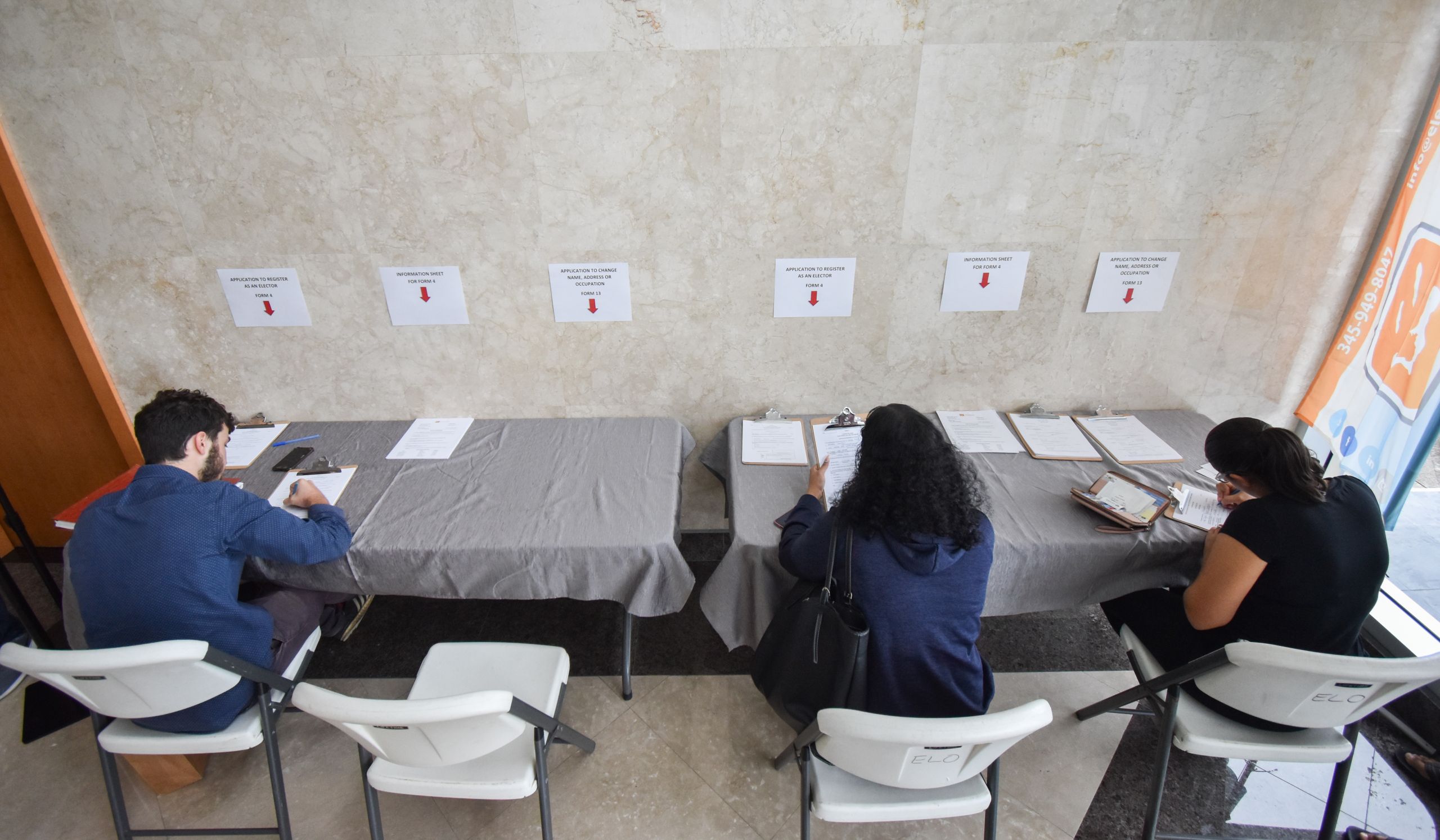
Why don’t more people register?
- Do we make it too hard?
Why don’t we simply auto-register each person who becomes Caymanian?
The government has a systematic process for making someone Caymanian. On that special day, why can’t that person be proudly auto-registered and handed their voter ID? Why create additional needless bureaucracy?
Democracy doesn’t benefit from layers upon layers of complexity. Cayman’s voter registration process could thus be akin to organ donation programmes, which have learned from human psychology and auto-enrolled persons to the great benefit of many patients.
- Are people scared of the implications?
The often-heard narrative from the non-registered is “I am not registering to vote because I don’t want to do jury duty.”
Let’s parse that statement for a moment.
What does that say about those people who want to be Caymanian? Aren’t they basically saying “Sure, I will become Caymanian, but I don’t want any of that civic duty responsibility”?
Let’s go back to auto-enrolment. You become Caymanian, you go on the voter and jury duty roll. End of story and end of excuses. You don’t want to contribute to society through jury duty? Don’t apply to be Caymanian.
Remember also that if the number of people on the electoral registry is increased, the apparent burden of jury duty will be diminished as the odds of being ‘called for service’ would be much lower, therefore mitigating the ‘concerns’.
Nineteen MPs
Nineteen paid MPs exist in Cayman, for a registered electorate of 23,464. That’s one MP for every 1,234 voters in Cayman. Per the whole population, the number of MPs is one for every 3,621 people.
The United Nations Development Programme helpfully has some statistics that it compiled in a 2012 report titled ‘Global Parliamentary Report’.
Cayman’s ratio of people per representative is right at the extreme end of the scale. (For those curious, the lowest ratio reported is a tiny country that has just 517 people per parliamentarian.)
This begs the question, what are representatives for?
Historically, the argument was that a country would need a large number of parliamentarians in order to represent the wishes of the people. Before the telephone and cars, it could take days to travel from villages to the capital and back again, therefore having people who had local knowledge of the views and perspectives of each small community logically made sense.
Today’s world is hugely different. We live in a hyper-connected world. Views, opinions and perspectives can be shared in a heartbeat by anyone at any time.
The old viewpoint of ‘more parliamentarians are both necessary and better’ doesn’t necessarily hold water in today’s connected world. This is not to suggest that it will be easy to gain input and feedback from the public, but if democracy is to remain relevant it should continually seek to better reflect the will of the people, and simply adding warm bodies need not be the only solution.
It can’t be beyond the capabilities of modern technology to establish digital systems that allow citizens to express their views to elected representatives on important positions. Using such technology might then free our minds to think more innovatively about the role of the elected representatives.
Are 19 people needed to adequately hear the views of a voting population of just 30,000?
By no means will this be an easy solution, but surely any conversation about the “right structure for a democracy” should include an honest assessment as to whether all the politicians are really, truly needed.
I appreciate that people don’t typically do things that will put them out of work, but the role of politicians should be about service to their country, and if the current system is far less than optimal, then it behoves everyone to have an honest conversation as to what might work better, and why.
If there is ever a national dialogue on the subject, let’s not close the parameters of the conversation too early, or shy away from apparently awkward topics.
Why a Parliament?

I don’t mean why in the sense of the form of representation. Rather, why the current arrangement? Why did we copy the ‘Westminster model’? Presumably because of the British colonial routes, but is that the optimum approach for Cayman?
Let me put forward a hypothetical alternative arrangement for illustration and debate.
Imagine if Cayman elected, instead of a 19-member parliament, a prime minister through a national vote. This person would be elected similar in a way to how a president or a governor or a mayor is elected. In the US, each elected governor runs their state with executive authority and is supervised by an elected body.
Cayman could have a nationwide vote for its leader where the candidates would pitch their vision for Cayman and what they would want to achieve.
If elected, the winner would then have a clear mandate for action, with executive authority to deliver. Then scrap the current ministerial system where MPs become ministers. It seems to me to be completely anachronistic, unnecessary, and risks the wrong people running important departments.
Rather, give the new executive minister a budget to hire a team of six professionals on market-competitive salaries to run the various divisions of government. Logically, those people would be hired based on their experience or ability to get something done, since the accountability would be clear. Fail to deliver and you get fired at the next election.
This system would instil the executive minister with genuine authority and a clear vision and plan for the elected period. This would also result in big decisions being able to be taken rather than be lost in committees or parked in the long grass.
Cayman today, for instance, suffers from an inability to take long-term decisions. Could this partly be due to the structural system that seems to value politicking over strategising?
What about supervision? In addition to the election of a prime minister or governor, Cayman should elect five nationwide representatives who would form a supervisory ‘senate’.
Their job would be to challenge, to hold to account, to question and to investigate actions. They should be given power and funds to hire persons to investigate and audit the activities of the executive so that they can be held to account. They could also be granted the power to fire (under certain specific conditions) a minister for certain bad actions, thereby ensuring against corruption or incompetence.
What would this system achieve that can’t be achieved through our current system? First and foremost, it would enable longer-term planning. Everyone would be voting for a specific vision and plan.
Secondly, the savings from fewer elected persons would be directed to funds to enable the hiring of talented individuals, with relevant skills and experience onto the executive team.
Departments of government would be supervised by people with experience, gravitas and knowledge rather than their ability to win a 500-person beauty contest.
For those who are concerned about the concept of unelected ministers, allow me to simply point out that the UK has them, and every US minister is also unelected. In other words, it’s common practice, except in Cayman.
The key thing is that their appointment is by someone who is clearly and unambiguously elected to be in charge.
At the moment, in Cayman, we often vote with no clear idea as to who may be in charge, due to patchwork coalitions and bench-shifting that goes on.
One of the reasons people often look at Singapore as a model for governance and operations is that it pays high sums to attract the best into the civil service. The system suggested here would be akin to that – the leadership of a ministry (whether it be education, finance, tourism, etc.), would be led by innovative thinkers and doers, motivated by the opportunity to serve their country and deliver improvements.
Failure would have obvious consequences.
16 days, 30 days and 120 days
The UK had its last election on 4 July 2024. The deadline to register was 18 June 2024; 16 days before.
The US gov.org website notes that the deadline to register to vote in US federal elections, whilst determined by the states, can be as much as 30 days before election day.
Cayman, however, seems to require more than 120 days. Those not yet registered may not be eligible to vote in the upcoming cruise port referendum. Why not?
How does imposing a completely arbitrary 120-day deadline to register empower the population? How does it benefit democracy?
Talking of referendums, it seems that the Cayman Islands government is spending $1.2million of our money (that’s quite a few teachers or nurses) to ask people what they think, but P.S., it isn’t binding. Why?
In my opinion, it is an utterly reckless waste of money to spend over a million dollars on a non-binding referendum. There are dozens of ways to get public feedback through online polling systems that would cost fractions of that which the government plans to spend.
If the elected politicians consider the decision too momentous to take without consultation, then don’t insult the people of Cayman by telling us that once we’ve told you what we think that you may throw away the result and consider it non-binding.
That’s an insult to Caymanians.
There are many, rightfully, passionate views both for and against the cruise port and the cargo port. Cayman has an election in 2025. Is it not possible to blend the two topics into one vote and save a million dollars? Would any harm come from that?
Given the proposal is non-binding, it is difficult to think of any remote harm. No person in Cayman would spend their own money so carelessly and flamboyantly, so why are the politicians allowed to?
The only answer seems to be a combination of a lack of accountability and weariness at the whole process by the public.
Concluding thoughts
Cayman’s democracy is sub-optimal, with too many representatives – and, given the voter participation rate, seemingly too little care from the population.
In other countries, people, arguably, care more about their vote because of the prevalence of direct taxation. Cayman doesn’t have that and, presumably, no one wants to introduce taxation just to focus citizens’ minds. Therefore, Cayman needs to make it easier and simpler to register to vote.
Another idea that might create fresh faces and new ideas would be term limits for representatives. Scrapping the districts to elect a central leader was the first idea in this article.
If that proves unpalatable, how about electing representatives islandwide on a ranked voting system. This would eliminate the small groups that can easily influence electoral races and force candidates to appeal to all, rather than a narrow sub-set of the Cayman community.
Cayman occupies an enviable global position, but it clearly struggles, of late, to make strategic decisions. Such lack of planning and innovation will come back to bite Cayman in decades to come.
While the future is far easier to ignore than the present, it behoves us as a country to give it better consideration, starting with our very democratic structure.
Simon Cawdery, CFA, is an investment manager and governance professional who lives and works in the Cayman Islands. He writes regularly for the Compass.
Notes
*George Bernard Shaw, for those unfamiliar, was an Irish playwright and political activist who was born in 1856 and died in 1950. It’s fair to say that he thus lived through some pretty turbulent world times. Whether his cynicism (realism to some) is attributable to those times or not the quote rings eerily true in many countries of today’s world.
Related Videos











The upcoming referendum “is an utterly reckless waste of money” and “an insult to Caymanians”. Yet the sponsor gets away with it, “spending money so carelessly and flamboyantly -why are politicians allowed to?, lack of accountability” . Lack of accountability has always plagued the whole of the public sector and always will as there are no signs of any steps to address this major problem.