

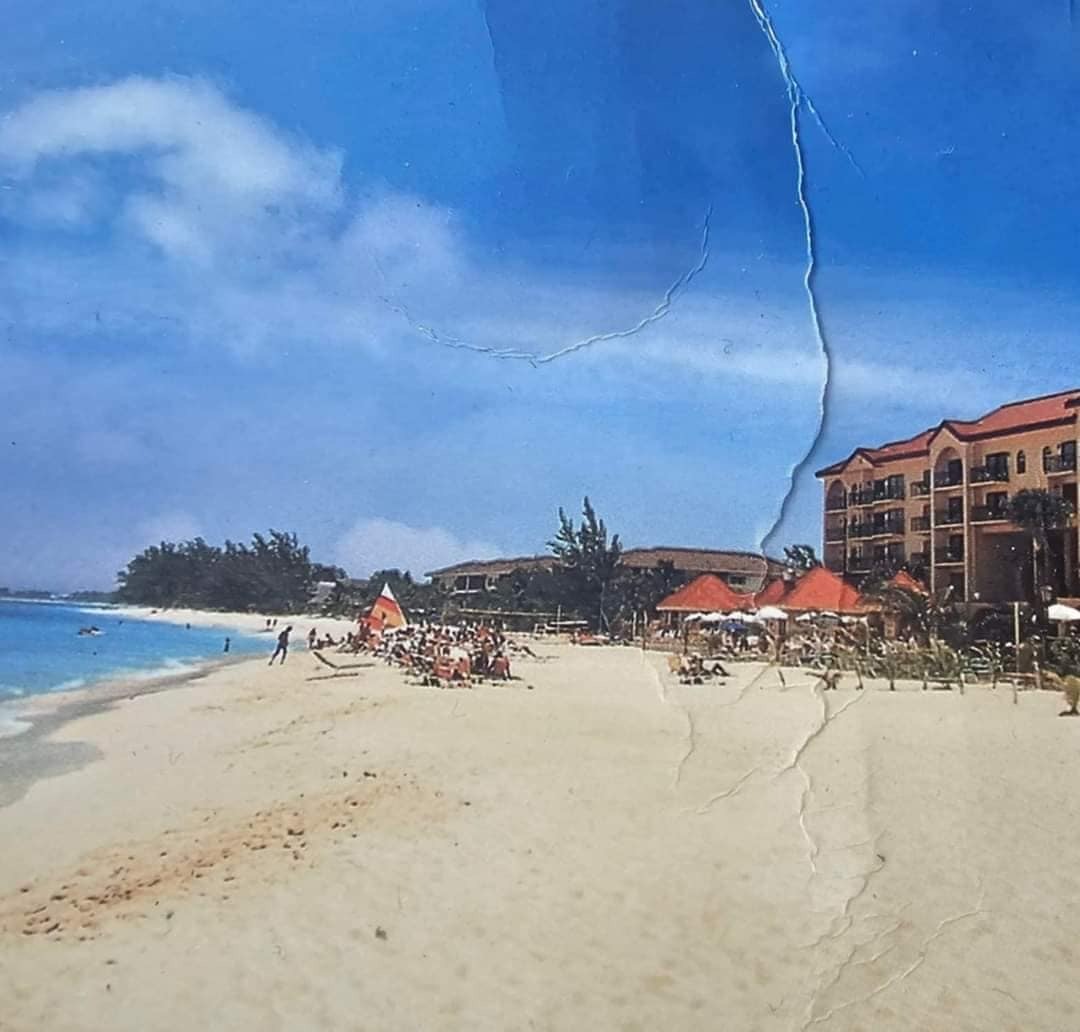
Multiple government agencies and “vested interests” met for “urgent” talks on the erosion of Seven Mile Beach on Monday amid fresh calls for ‘managed retreat’ of structures at the water’s edge.
The potential for a partnership between property owners and government along the severely impacted southern stretch is understood to have been on the agenda. On Friday, Ergun Berksoy, one of the residents in the affected zone pledged US$3 million to help find a solution to the problem.
He said, “We must join forces with this government”, adding that Cayman could not afford to wait any longer to act over the loss of its key attraction.
Meanwhile, a handful of demonstrators took to the streets at the weekend, to call for the beach to be saved and a more considered approach to development along the coastline.
Government has previously indicated that a strategy on managed retreat is needed before any funds can be committed for beach nourishment or other engineered solutions.
There have also been calls for more radical approaches to protect the beach and the accompanying public rights of way.
On Saturday, protesters gathered under the Camana Bay bridge with signs calling for a “managed retreat” – their argument being that seawalls and hard structures are interfering with the waves, causing the beach to further erode, along with their rights of way along the shoreline, and their opportunities for recreation and enjoyment of the seashore.
In response to a Compass enquiry requesting details about the government’s erosion meeting, the Department of Environment said that information “will need to come from the Office of the Premier, as it was a Caucus organized meeting.”
The Office of the Premier this week did not respond to requests for comment.

What would managed retreat involve?
A Department of Environment spokesperson told the Compass that it supports new policies on coastal development, regardless of whether beach nourishment takes place or not.
The department has previously indicated qualified support for a policy of allowing some restoration project to deal with erosion.
But it warns the wider issue will not go away.
“Managed retreat will likely have to form a part of the Government’s long-term plan to manage the national natural asset that is Seven Mile Beach,” the DoE spokesperson said.
“If a decision is taken to put sand on the beach to solve the immediate problem of the total lack of a beach on southern Seven Mile Beach, then there are several policy areas that should, in the Department of Environment’s view, be addressed in tandem with that decision.
“These include changes to how we measure coastal setbacks and whether or not structures can be rebuilt once they are significantly damaged by storm and hurricanes.”
Currently, Development and Planning Regulations require that buildings and seawalls should be minimum of 130 feet from the high water mark in a hotel/tourism zone; however, exceptions have historically been granted in various cases and there are challenges over how the boundary line is measured.
As the Compass reported last year, the official ‘high water mark’ survey for many coastal properties is actually under water.
Can property owners be compelled to move?
Real estate broker Kim Lund of RE/MAX cautioned that asking private landowners, such as the Marriott which has lost its beach to erosion, to rip up beachfront decks and other owners to knock down buildings was “not realistic or reasonable”.
He said, “We can’t go back in time on heavily developed stretches of coastline. Reverse engineering a property is incredibly expensive.”
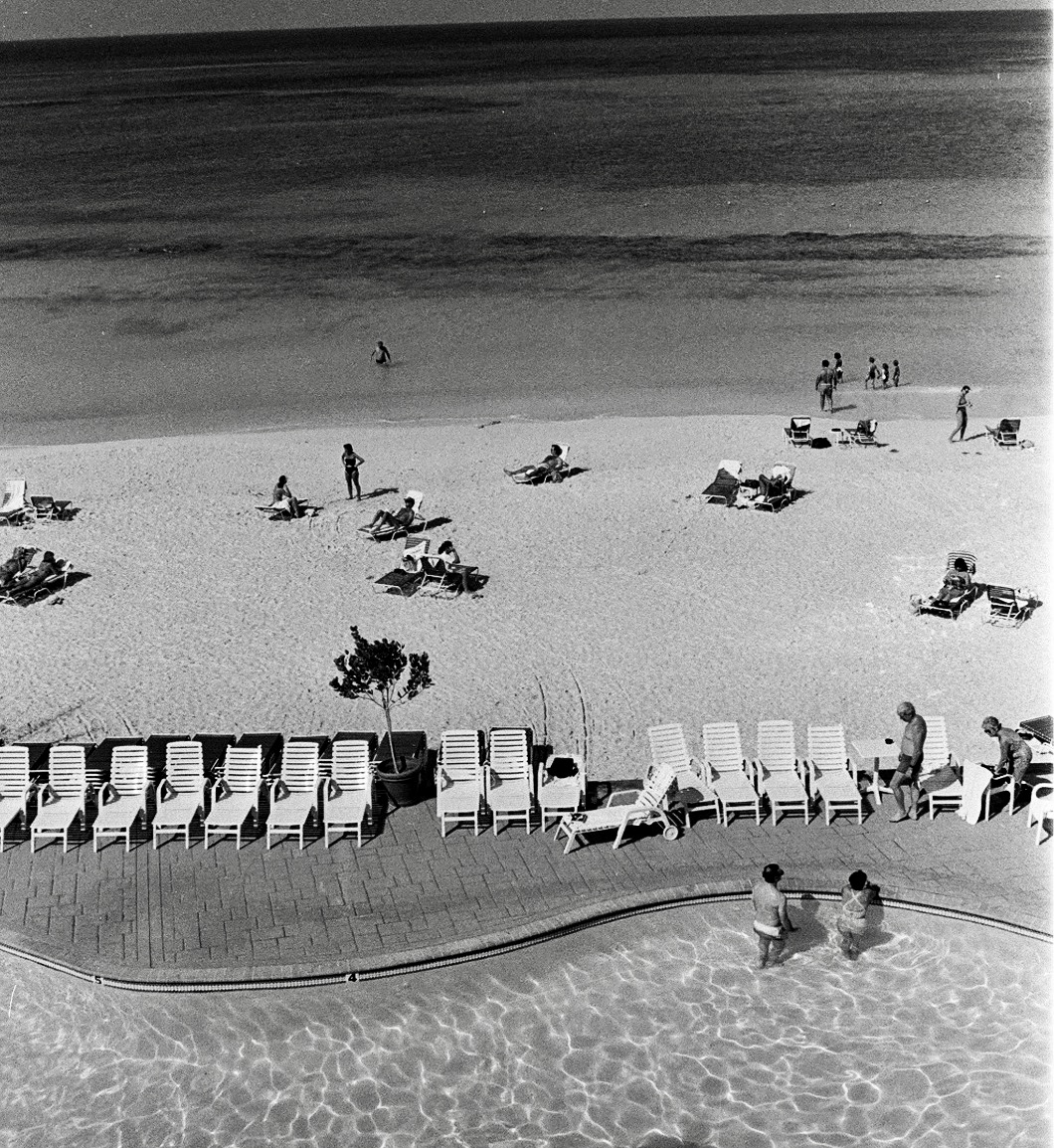
He added that a property “would have to be severely degraded and damaged before the government could step in and condemn it. So, if a patio or part of a ground floor unit was affected by surge or storm-driven waves, that would not typically meet the threshold for a building to be condemned.”
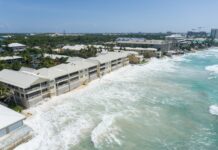
The loss of the beach is also increasing the vulnerability of the buildings from storm-driven waves. That is, in turn, leading to increased calls from the affected property owners to construct seawalls to protect their properties from the waves, even if that means building the walls well within the required setbacks of 130 feet from the high-water mark.
On 9 Oct., lawyers for the Laguna Del Mar property indicated at a Central Planning Authority meeting that they will consider legal action against government if they are not allowed to rebuild a seawall that is now only 37 feet from the high water mark.
“We have been waiting too long for this situation to be resolved,” said attorney Samuel Jackson. “People deserve the right to be able to protect their buildings.”
What are the arguments for managed retreat?
Melanie Carmichael, executive committee member of Sustainable Cayman, believes that government is open to the possibility of beach renourishment, but she said “the sticking point seems to be the landowners, who are unwilling to compromise and do what is needed to address the problem”.
She told the Compass she believes the solution has to “include moving the hard structures back from the active beach area, or creating wash-through ground floors, so the waves can move through freely during storms”.
She added, “Government has the scientific reports, and the evidence is clear that dumping more sand makes no sense unless we address the mistake and the root causes of the problem.”
Carmichael claims that in parts of coastal Florida, single-storey buildings along the shoreline are now being demolished “because no one will insure them anymore.” To support this, she referenced a video posted after Hurricane Milton that shows that the lower elements of larger buildings along the shoreline are being stripped to allow flood-through ground-floor zones.
She also believes “the calls from the condo owners for seawalls in the Cayman Islands are misguided because, in addition to further exacerbating the erosion issue, the walls themselves will eventually be undermined, and they too will collapse and fall into the sea”.
Is managed retreat already happening?
While there is no official policy, newer buildings that have cropped up to replace older properties are generally built further back and with less impact on the active beach zone. The construction of the Kimpton Seafire hotel in place of the Courtyard Marriott, which closed after Hurricane Paloma in 2008, is the clearest example – though that development sparked separate controversy over the re-routing of West Bay Road to facilitate the ‘retreat’.
Realtor Lund says that new buildings under construction along Seven Mile Beach are already incorporating greater setbacks from the sea and building up higher. Advocates of a more managed approach argue for changes to the planning law to compel this.
But, in terms of addressing the current issue of erosion along the southern stretch of beach, Lund said, “If we are talking about managed retreat along developed stretches of coastline, we will have to wait for the owners of the properties to decide for themselves whether their own property should be redeveloped.”
He added, “They sought and received planning permission from government … When these properties were developed, there was an ample beachfront in front of them. They built within the required setbacks.”
What are the current rules on coastal development?
While development regulations require minimum setbacks of 130 feet for seawalls and buildings along most of the southern section of Seven Mile Beach, the current Cayman Islands Development Plan 1997 also states, “the [Central Planning] Authority shall … take into consideration – the elevation of the property and its environs; the geology of the property; the storm and beach ridge; the existence of a protective reef adjacent to the proposed development; the location of the adjacent development; and, any other material consideration which the Authority considers will affect the proposal”.
Plan Cayman, which has been drafted but not yet approved, is eventually expected to replace the 1997 Development Plan.
The draft document, which sets out the long-range policies and guides the overall use of land in the Cayman Islands, includes the following reference to beachfront properties:
“The best way to conserve beaches is to allow them the space to move – in a seaward direction during accretion phases and in a landward direction during erosion phases.
“The prudent use of coastal development setbacks can ensure that space is provided for a beach to move naturally, both during normal events as well as infrequent hurricanes, thereby ensuring that the beach is conserved for all to enjoy and that coastal infrastructure remains intact.”
Carmichael is calling for developers to conduct comprehensive risk assessments before they build on areas that are vulnerable to storm surge and waves.
She says, “It is possible to build in these areas, for example, stilted structures might work, but right now we are literally burying our heads in what is left of the sand and ignoring what needs to be done,” which, she suggests, “is move up and back from the water’s edge, and adapt to the new reality of rising seas and more frequent storms”.
Related Videos








The quotes related to Carmichael relating to uninsurability/demolishment of buildings in FL and infill of sand are not related to each other. Yes it’s true some companies are not insuring in FL, and its also true that buildings are being rebuilt on stilts in some areas to let the ocean wash through, but it is also true that Miami Beach has a deep, deep beach which would long be gone like our Southern SMB which without 70 years of refilling. “Nourishing the beach”, means barging in thousands of metric tons of silica sand each year or two, which gets washed away over time and replaced. It’s an ongoing cycle.
I honestly see “managed retreat protesters” in the same way as “flat earthers”. I mean, think for just a minute. Where would you retreat to? Do we just bulldoze all the condos on seven mile beach, rip up west bay road and plant saw grass?? I’m sure in some radical environmentalists fantasy that’s exactly what they would like, but it would completely destroy your economy. Half of government would be unemployed due to budget collapse and at best it would buy you 20 years before the waves lap up at West bay road. Oceans are rising due to thermal expansion from a change in water temperature and due to sea level change. It’s small right now but it’s real and growing. “Retreating” is no better at protecting against increased storms than aztec animal sacrifice was for the Aztecs. The science of retreat is no match for rising sea levels.
We can all agree that it’s a bad idea to build a seawall in the middle of an active beach, however if there are structures within normal setbacks or a retaining wall, “BEHIND” an active beach and the ocean changes in such a way that the Sea rises, or the reef disappears and the waves 40 years later start washing against that retaining wall, we should defend that wall like we are defending our Country. Our existence depends on it. Running from the beach to please the Gods and let the sand blow with nature is touchy feely and seems right at some holistic level, but it is no match for a new reality of rising sea levels. We can either defend Cayman from the sea, defend the economy we created over the last 70 years here or we can give up our western facing shore to the sea, lose population and an economy, then wait for the waves to lap up along west bay road or Camana Bay, before we tear that down so the sea completes it’s work.
Finally someone speaking the truth. I’ve lived on 7Mile for over 15 years. The erosion started happening as soon as the cove was put in at Treasure Island. It clearly changed the water flow down 7 Mile Beach and has severely impacted the beach….”Cayman’s National Treasure”…at least to some….just not the Cayman Government. When will that be removed? Why is no one discussing it?
15 years ago, the properties on this part of the beach were set back 300+ feet…how much more should it be. If the government was proactive in the slightest, they would have started beach nourishment 10 years ago to protect 7 Mile Beach and their tax revenue. Proactive governments around the world do it….its called proper governance. No one in the government has the “nerve” to make tough / correct decisions….just push it off while collecting their paycheck. You’re elected for a reason…make the tough decisions in a timely manner! Keep putting it off and there will be nothing to save.
When will Government release PLAN CAYMAN?
It is years passed when they said!
She told the Compass she believes the solution has to “include moving the hard structures back from the active beach area, or creating wash-through ground floors, so the waves can move through freely during storms”.
Just pick up 10 story buildings and move them back? Or knock holes though the middle of them? Seriously?
Previous comment I made in related article:
Why can’t we consider using funds generated from a national lottery to fund beach restoration?
Anne Evans
Managed Retreat is inappropriate in Cayman. There is a short distance from the water to the road. If the beach started where the current waterline is, and there were a hundred and thirty foot setback or more, then there would be no room to build.
Removing all of the condos would not guarantee that the beach would come back. First of all, without replenishment, this process would take many years, just as it has taken many years for the beach to disappear. There would be NO BEACH for twenty years, and even then there is NO guarantee that it would come back.
In addition, removing all of the condos and rebuilding is economical suicide. There is over a billion dollars of real estate along this stretch of the beach. If the owners lost their investment, then the real estate market would go into a depression. The government does not have a billion dollars to reimburse owners of real estate.
It is hard to understand the opposition to putting sand back on the beach. As others have pointed out, this is done in many locations around the world. The end result is that there is a beach again which is a temporary solution for a few years or more. If the sand disappears again, then replenishment would need to be done again. The cost of this is on the order of 20 million dollars each time. Comparing 20 million dollars to the loss of a billion dollars in real estate and to the recession caused in the real estate market, the economic solution is clear.
Has any attempt been made to find where the sand went?. Presumably it would be deposited further out to sea, but has it gone over the drop off?. If not perhaps it could be dredged and returned.
One problem is the loss of beach producing parrot fish. A product of over fishing and the loss of live coral due to global warming.
Anyone who has dived here for many years will tell you that the loss of fish and live coral has been dramatic.