

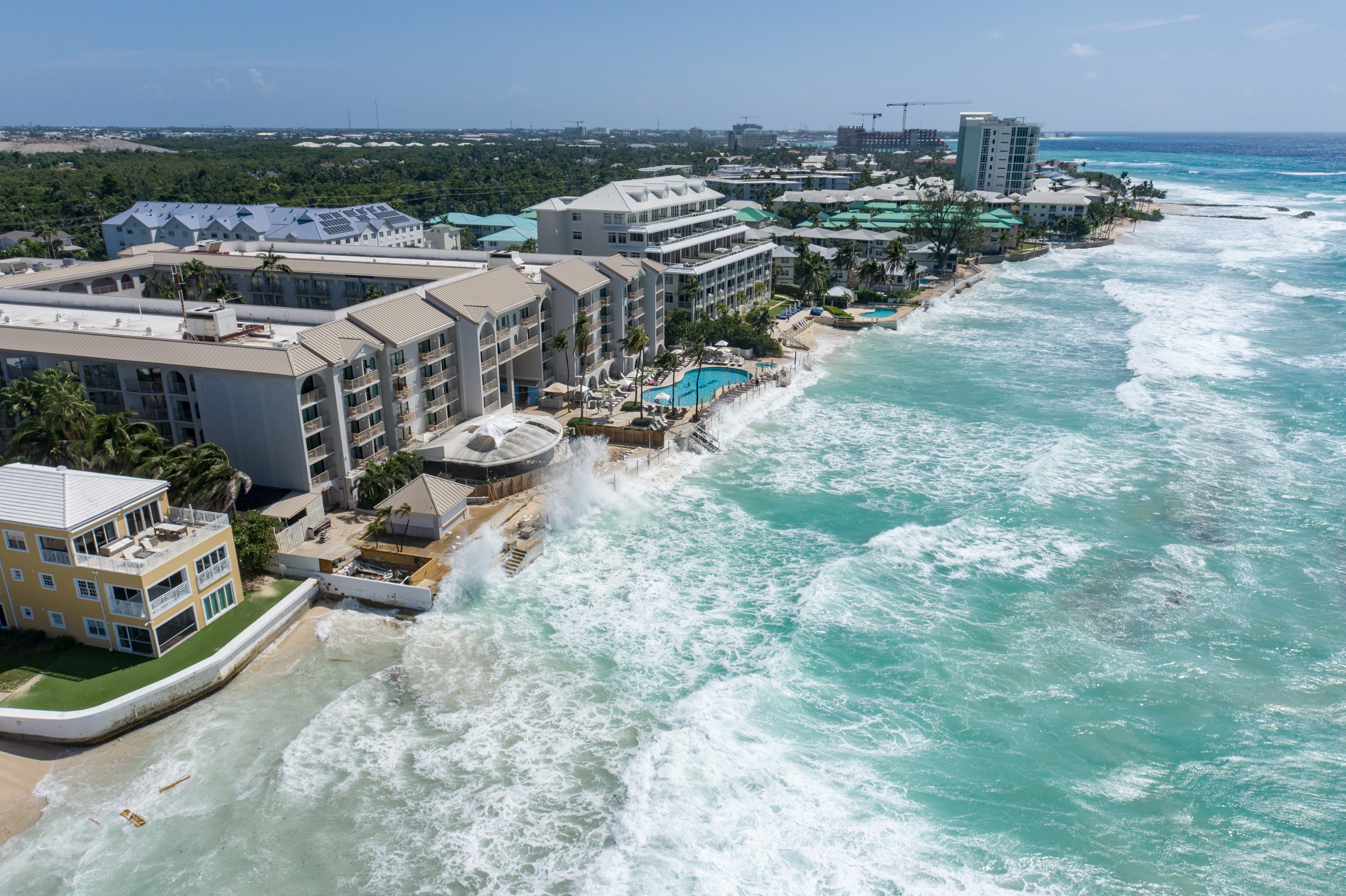
Government has announced a proposed means of financing the cost of beach renourishment, as the urgency, scale and ramifications of the beach erosion crisis took centre stage on Wednesday at the Cayman Islands Tourism Association AGM.
Deputy premier Kenneth Bryan told the 200 members of the association and the newly elected CITA executive on Wednesday, “We have already agreed to increase the national conservation fund or the tourism accommodation tax in order to raise the monies to cover the cost of future re-nourishment initiatives.”

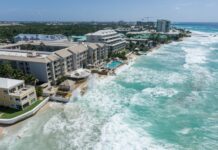
– Photo: Simon Boxall
The tourism minister added that several of those in attendance could expect a call “as soon as next week Wednesday” as government “intends to have talks with the affected property owners and tourism stakeholders about a shared funding model to pay for the initial re-nourishment strategy”.
Several landowners have indicated willingness to partner with government and Turkish businessman Ergun Berksoy has pledged $3 million towards the effort.
Under the previous PACT administration, in which Bryan also served as tourism minister, Premier Wayne Panton had already committed to allocate $21 million to restore a large stretch of lost sand at the southern end of Seven Mile Beach.
But a series of meetings on the issue stopped abruptly in 2022 and the money was left unspent. Nothing was allocated in the 2024/25 budget and government has not moved forward with any of the ideas that came out of the work from the government task force convened in 2021, when Tropical Storm Grace last prompted renewed efforts to address the crisis.
Lack of urgency to address the worsening problem was cited as one of the reasons behind the departure of four members of the current UPM administration.
Speaking at the event at the Marriott on Wednesday, Bryan called the erosion, in particular at the southern end of Seven Mile Beach, “simply staggering”.
He added, “A Cabinet paper has been prepared and government is categorising this issue as a national environmental and economic emergency.”
He said his ministry was finalising options with the Department of Environment in terms of the “fastest way to re-nourish the affected areas of the beach”.
He stressed beach erosion would continue to remain an issue for future generations due to the “global weather changes”.
‘National issues’
The minister echoed remarks by outgoing CITA President Troy Leacock, who stressed the impact of beach erosion was universal.
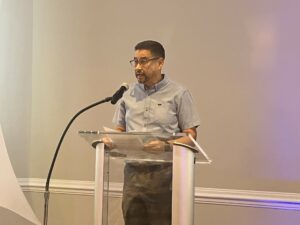
“Beach erosion is not a problem just for the properties with the erosion. Erosion of a section of the beach erodes our tourism image, affecting all,” Leacock told the association members.
Pointing to another major challenge for the tourism sector with wider implications for Cayman as a whole, Leacock stressed the “cruise tourism decline” should, like erosion be considered “national issues”.
These are not issues just for a single sector, or even just for the tourism industry,” he emphasised, stressing the issue was not a “problem just for the businesses which directly depend on cruise visitors. Cruise revenue supports operators and businesses which provide services for stayover visitors and residents.”
Bryan, too, cautioned that the cruise sector was struggling, “passenger arrivals for the first 9 months of 2024 were recorded as 792,880, which is 43.3% below the 1.8 million passengers who visited in 2019… and this downward trend is expected to continue,” he stated.
Echoing the tone set by the cruise lines, most recently in September at the Caribbean Tourism Organization annual State of the Tourism Industry Conference, Bryan warned, “For years the cruise lines have been giving advance notice that without a pier, passenger arrivals will continue to decline as the ships that currently call on Grand Cayman are replaced by larger vessels.”
He stressed, “In short, a pier is the only way for the Cayman Islands to remain on cruise itineraries into the future.”
Citing the ESO report which calculates the cruise sector currently supports nearly 2,600 local jobs and injects as much as $350 million annually into the economy, he also listed a number of reasons why building a pier is in the long-term best interest of the Cayman Islands, including to protect the jobs of Caymanians and the many Caymanian-owned businesses that support the cruise sector.
Previous attempts to bring a cruise pier to the Cayman Islands have faced opposition because of concerns around the large cost, the environmental impact and perceptions that cruise visitors contribute relatively little to the economy in terms of on-island spending.
During his remarks, the minister also sounded many positive notes, stating that a number airlines have now committed to providing increased airlift over the coming months. He also believes the extension of the runway at the Owen Roberts International Airport will bring new opportunities for long haul flights.
New executive board appointed
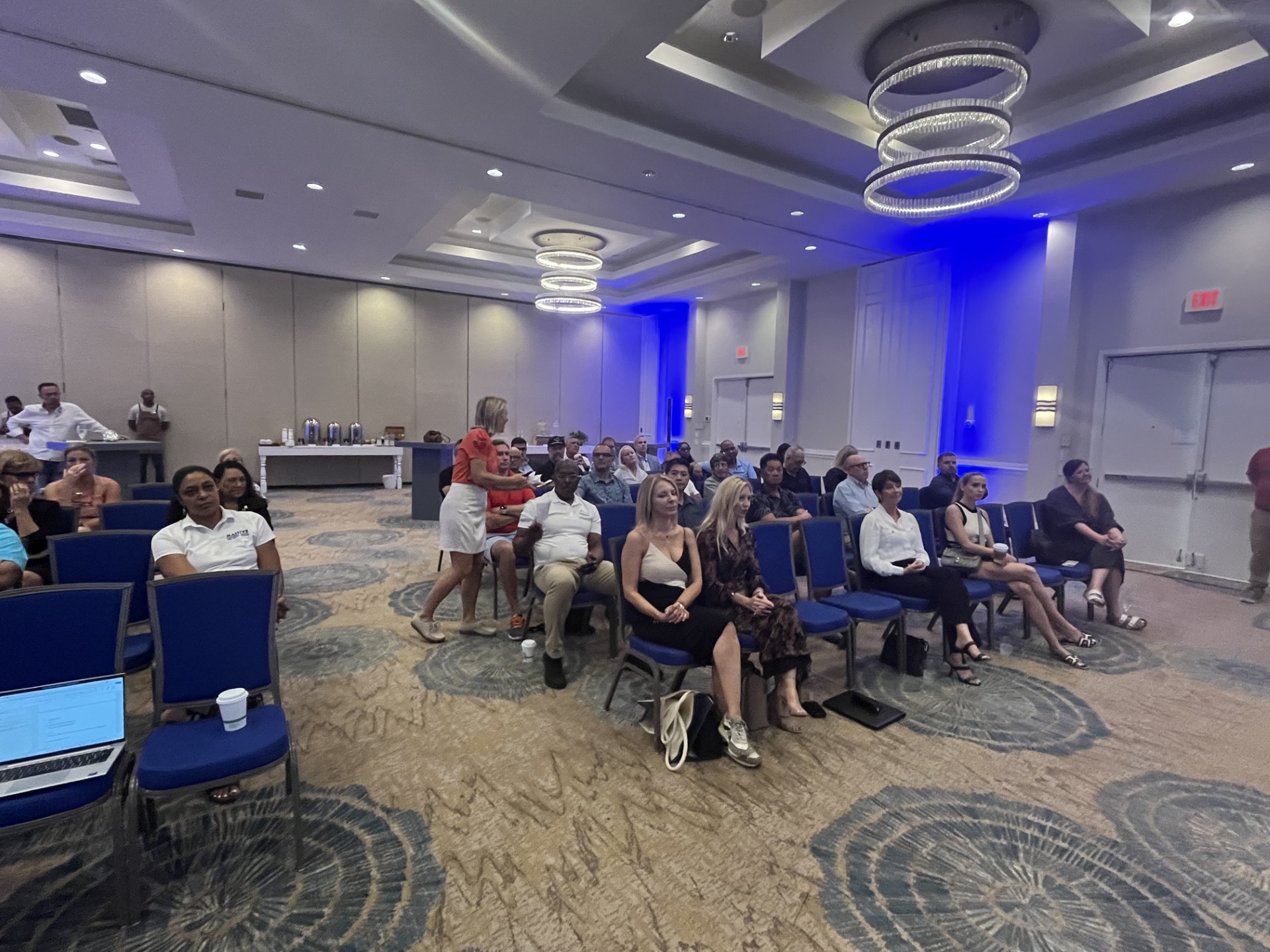
At the AGM the approximately 200 hundred members of the tourism association, which includes representatives from hotels, condos, restaurants, water sports operators, the transportation sector and allied groups, voted for the new executive board who will convene later in the week to select the new president of the association.
After two years serving as president of CITA, Leacock said that he will not be standing again this year for the leadership role, however as the immediate past president, he will retain an executive role on the board.
Related Videos











Finally. Now, there must be somebody in government who can take the bull by the horns and contract a barge to head NOW to the Bahamas or Cuba to bring the initial loads of sand. Let’s barge now and permit later. Pay with any means possible until budgets and systems are defined. Emergencies call for an action mindset. We need to get sand on the beach before the season kicks off then renourish June-October next year so we look right for the next season.
Take the money they want to spend on a cruise port for “spend nothing” passengers and use it to replenish the beach.
The average spend on island by a cruise boat passenger is about $70 USD.
The average spend by a stay over visitor is about $1,200 USD pet person per night.
I will repeat my comment offered on prior articles on this topic:
Why not consider using revenues from a national lottery to fund efforts to address beach erosion?
That’s honestly a great idea. We should have a lottery that’s open to people anywhere “Win tax free”
On reading this article which focuses on cruise piers and beach erosion, it is fortunate that the cruise piers were NOT built, because if they had been, they would no doubt be getting all the blame for the beach erosion. Many said that the constuctuin of the piers would the death knell for Seven Mile Beach.
You’re right.. No scape goat to blame now except the beach walls (which are not the problem either). The real problem is that this island is just a few delicate feet above sea level and has been for a thousand years. So when the oceans warm just a little bit, and expand just a little bit and the seas rise just a little tiny bit, the EFFECT on our beach is massive. Get your head around it people. We are a little tiny fleck in the sea and NOTHING we do here locally (no electric cars, no mangroves, no piers or walls) are going to hasten or slow beach erosion. We are a sail in the wind of a storm we have no control over and we need to take action in our own self interest. Bring barges, bring sand, retain against the sea. The Lord helps those that help themselves.
In 1989, Radisson Hotel was built, there was over a 100 feet of beach in front of Sea Wall. This all changed after Hurricane Ivan in September 11th, 1994.
If Cruise Berthing 30’ deep trench is dredged, what sand shift from the natural east to west is left, sand will just fall into this deep 30’ trench, creating a worse erosion problem for 7 mile beach’s.