


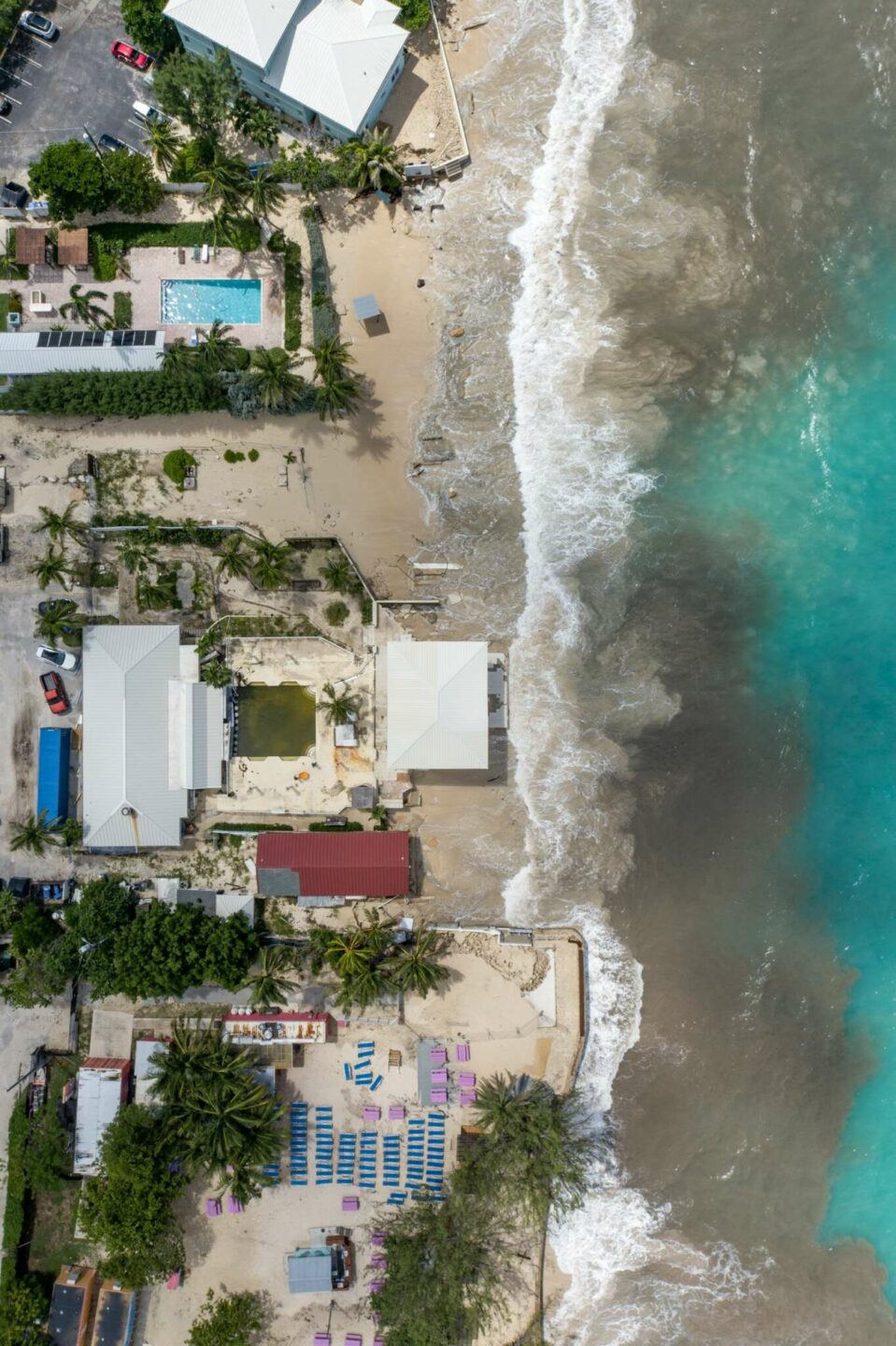
Erosion along Seven Mile Beach following Tropical Storm Helene has worsened and expanded to the point where only a few slivers of sand remain along a mile-long stretch of once prime beach front. Bar owners, hoteliers, residents and holiday rentals are suffering a parallel erosion of their businesses, property values and quality of life. The security and insurability of homes is also in jeopardy as the shore line creeps ever closer.
Meanwhile, more general public rights to the beach are also being stripped away, with the registered property boundary line now under water on many parts of the beach.
Cayman Compass journalists Simon Boxall and James Whittaker take a closer look at the latest twists in the expanding problem of the diminishing beach.
A changed coastline
The gentle putter of the small outboard engine cuts through the quiet of the afternoon as we navigate the contours of Cayman’s altered coastline.
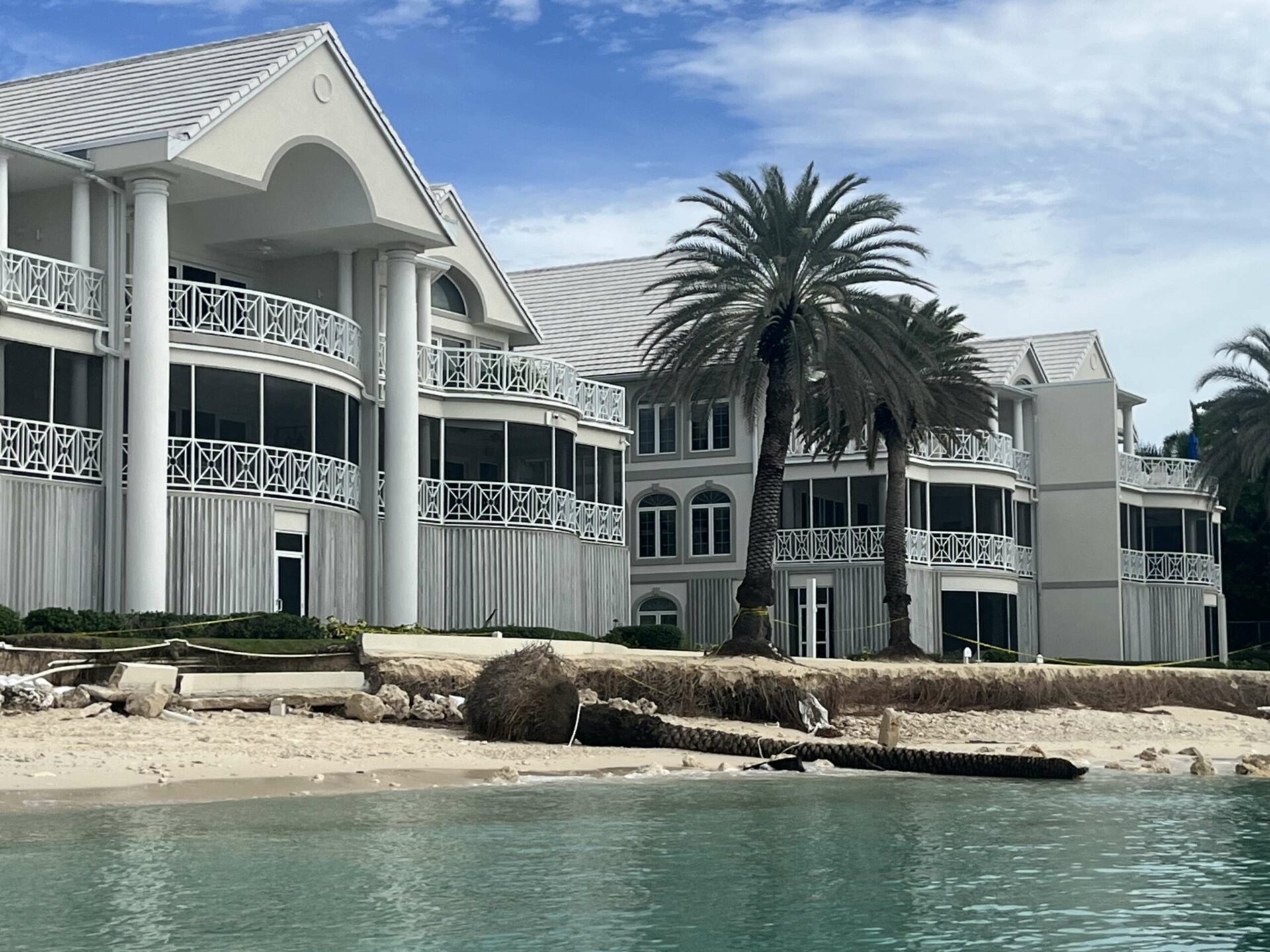
Schools of sprats swim in the shallows in front of The Sovereign where beachfront palm trees have been felled by the shifting sand.
Water laps against crumbling foundations and exposed rebar in damaged developments from the Royal Palms to Tamarind Bay.
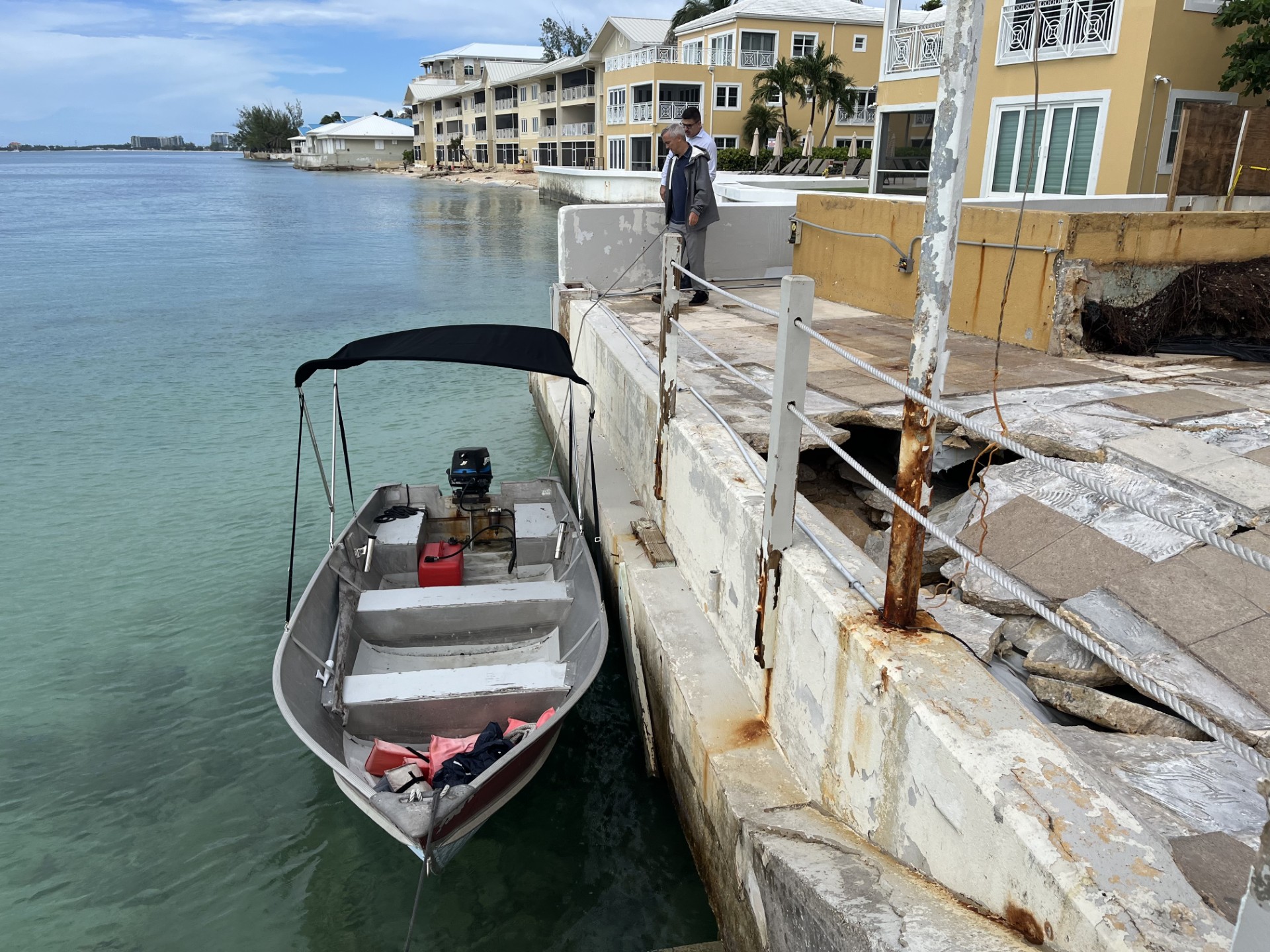
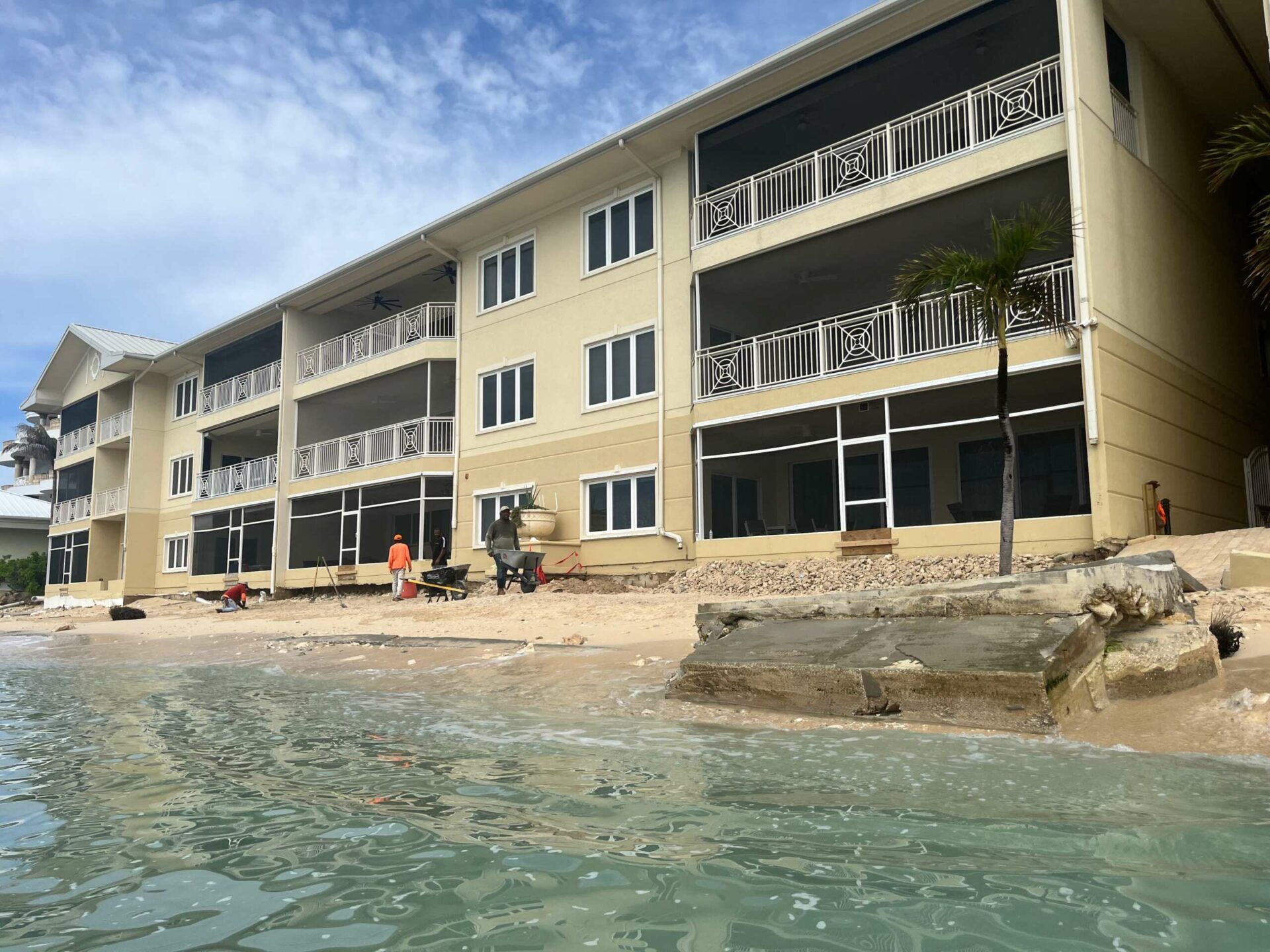
At Laguna Del Mar, workmen clear debris from behind a seawall that has submerged and subsided. At the Marriott hotel, we are able to moor the boat in three feet of water alongside the restaurant and pool deck.
“Seven Mile Beach now starts at Palm Heights,” the Marriott’s manager Hermes Cuello laments.
At the same spot where our boat is now tied up, former Premier Wayne Panton and a handful of ministers and civil servants took a walking tour of the diminished beach following the passage of Tropical Storm Grace in 2021.
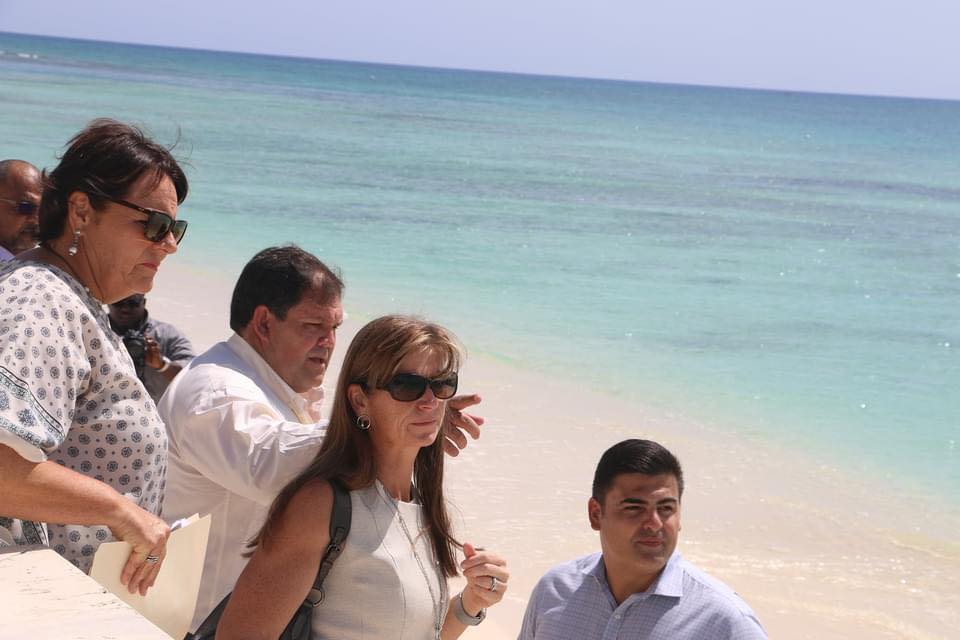
That visit was the start of a flurry of activity around erosion and the formation of a government task force that declared protecting Seven Mile Beach “an urgent national priority”.
A fund of $21 million was allocated for beach replenishment, but the meetings stopped abruptly in 2022 and the money was left unspent. Nothing was allocated in the 2024/25 budget and government has not moved forward with any of the ideas that came out of the committee’s work.
Wilbur Welcome, chief officer in the Ministry of Lands, highlighted concerns around the viability of beach replenishment – which involves depositing significant amounts of new sand into the beach system.
In response to questions from the Compass this week, he said erosion on Seven Mile and in other parts of the island was concerning.
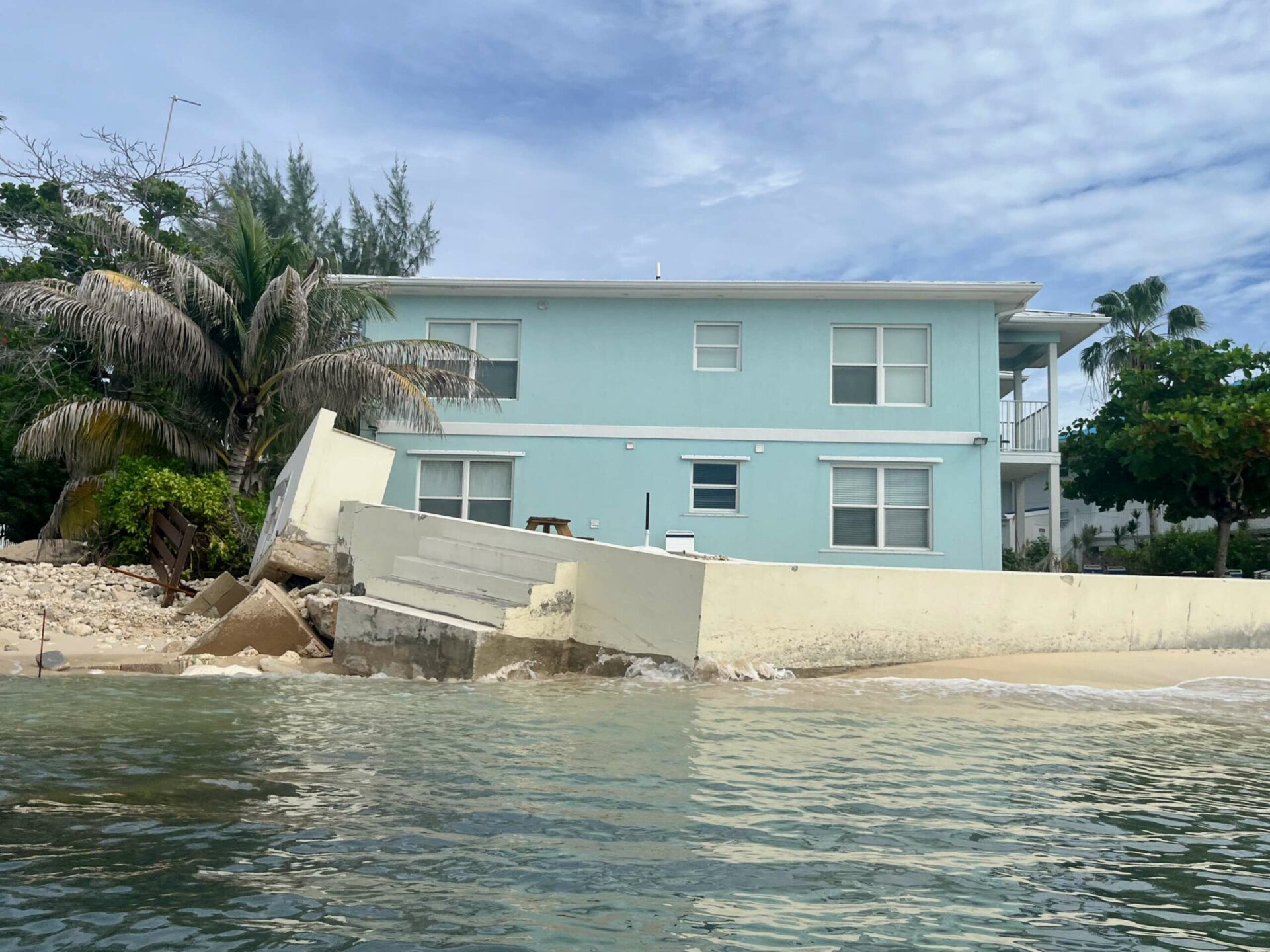
He said any beach nourishment would likely need to be combined with a strategy of ‘managed retreat’ to move hard structures off the active beach, as well as changes to the kind of development Cayman allows on active shorelines.
The same concerns arose during the task force meetings.
Issues were also raised over spending public money on a project that would accrue economic benefits to private businesses and condo owners.
Businesses point to the fact that government is also losing tax revenue from impacted hotels and holiday rentals, as well as public recreation and rights of way along that stretch.
Cuello, at the Marriott, says businesses would be willing to put their own money and ideas towards fixing the problem.
He says Seven Mile Beach is a national asset and he believes a partnership between private interests and the government can provide the best solution for the country.
He estimates the Marriott has lost close to a third of its revenue because of the deterioration of the beach.
Government, which collects a 13% room tax on every night sold at the hotels and the Airbnb properties in the area, would also have lost a couple of million dollars as a result, he believes.
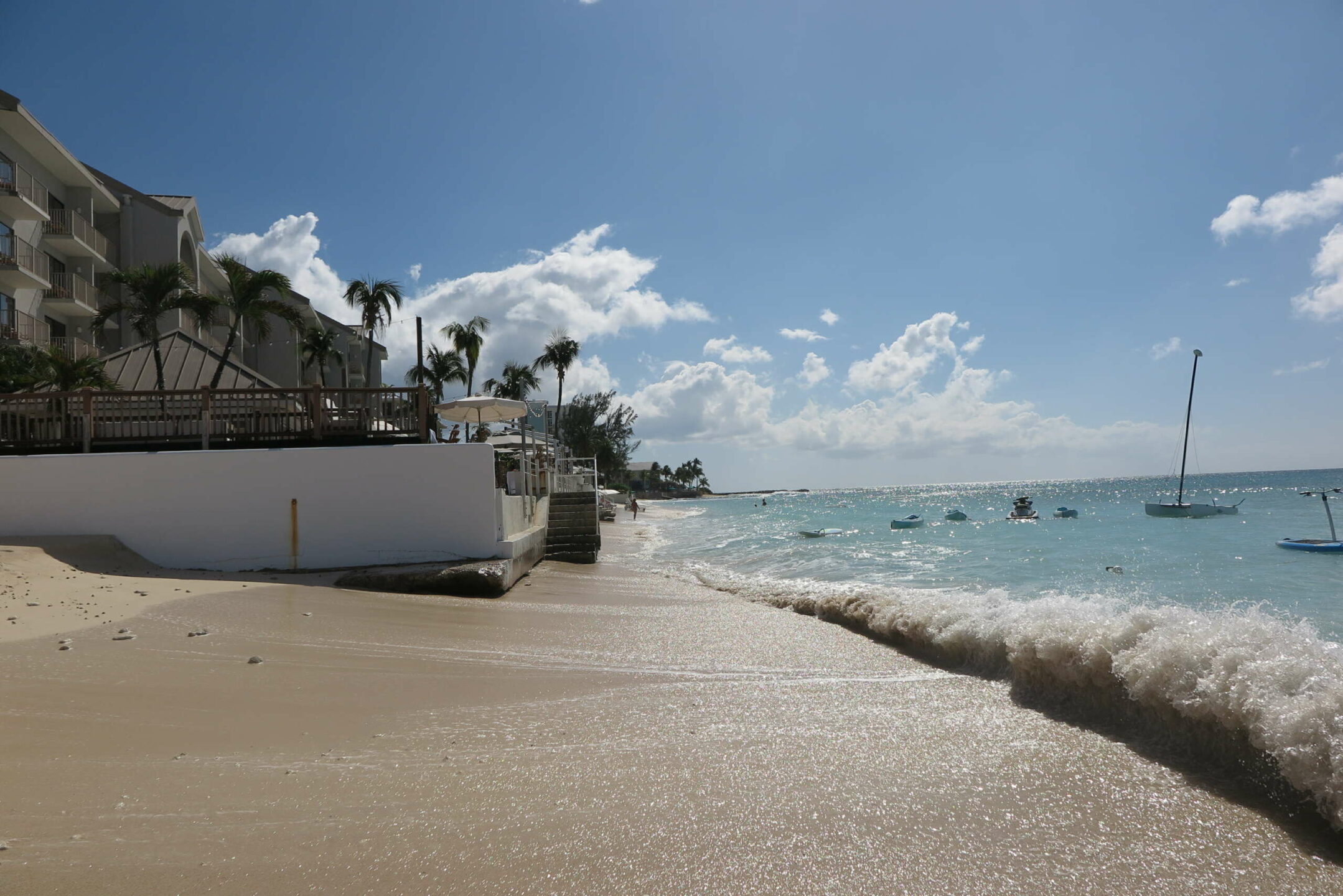
Cuello says he is also concerned for the security of neighbouring properties where the buildings are starting to see structural, as well as economic, damage.
Despite the challenges and several years of stalled efforts to find a solution, he says he remains hopeful that a partnership between the private businesses, homeowners and government along that critical stretch of beach can be brokered.
Economic erosion
The problem, compounded by the hammer blow of Tropical Storm Helene last week, has got significantly worse.
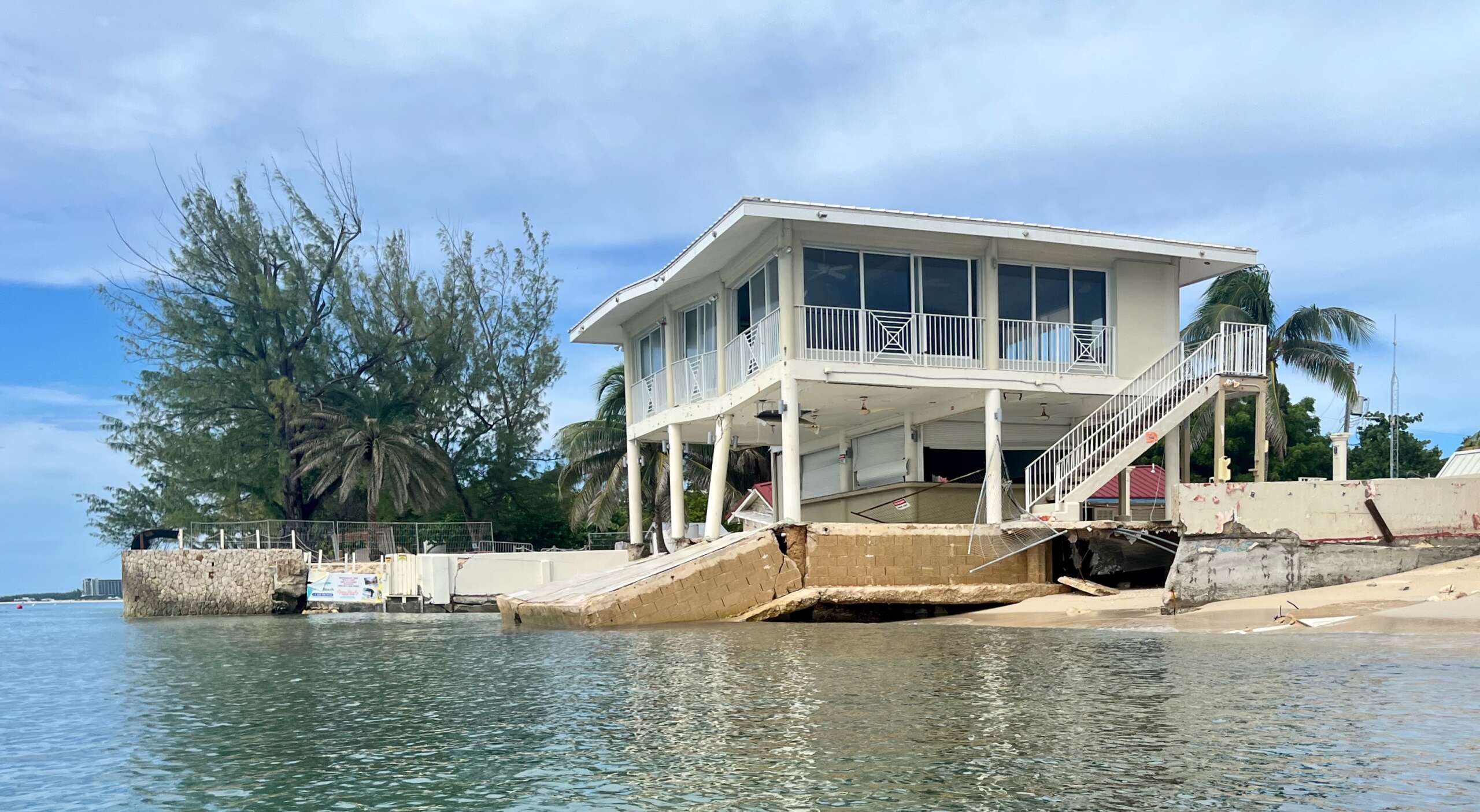
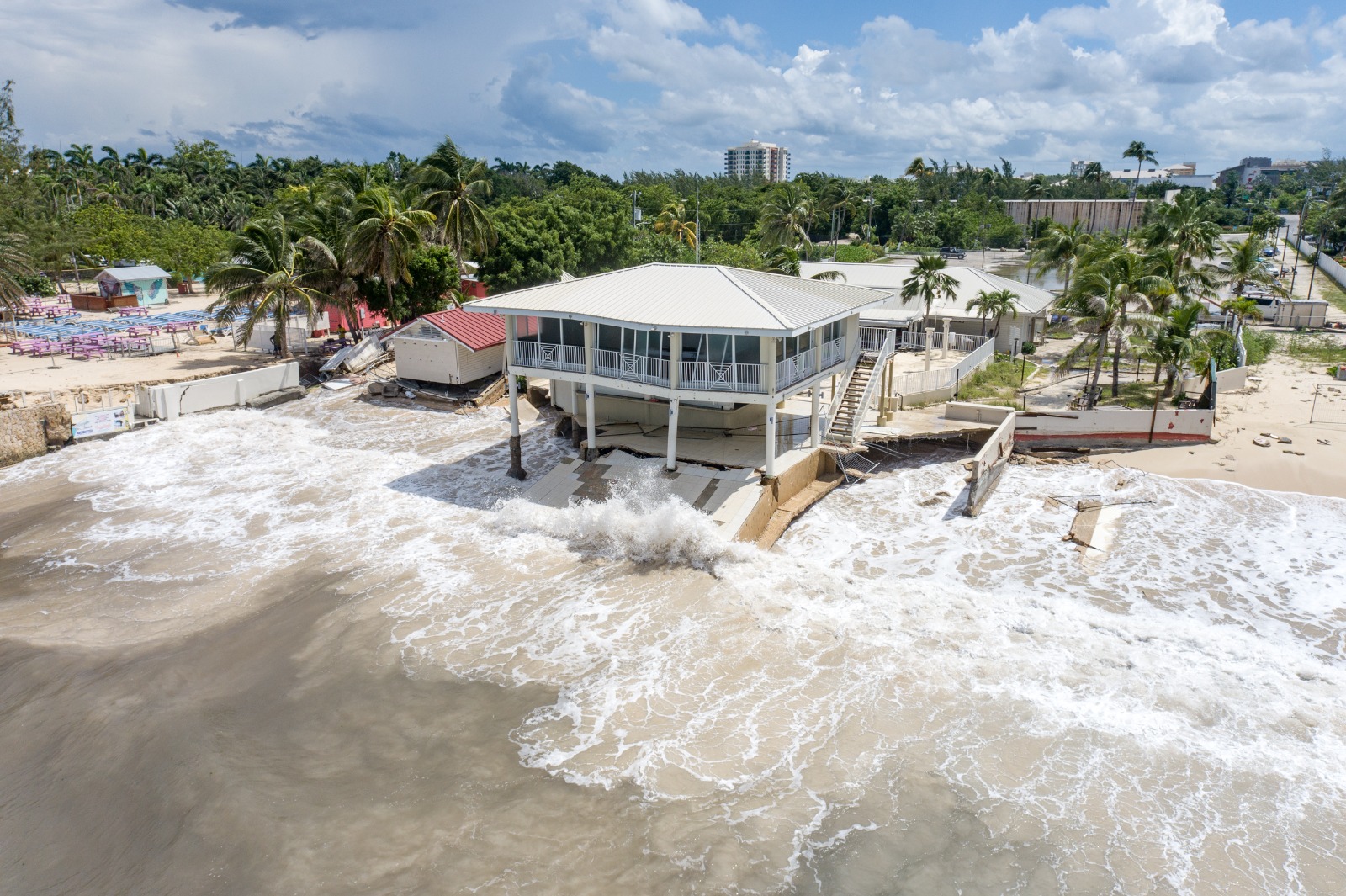
Royal Palms was the biggest structural casualty of the latest storm, with the broken beach bar and deck now collapsing into the sea.
The foundations have been compromised by wave action and the iconic two-storey building is slated for demolition. Plans to reopen – a partnership between owners Dart and former Calico Jack’s owner Handel Whittaker – are centred around the as-yet unimpacted section of the property.
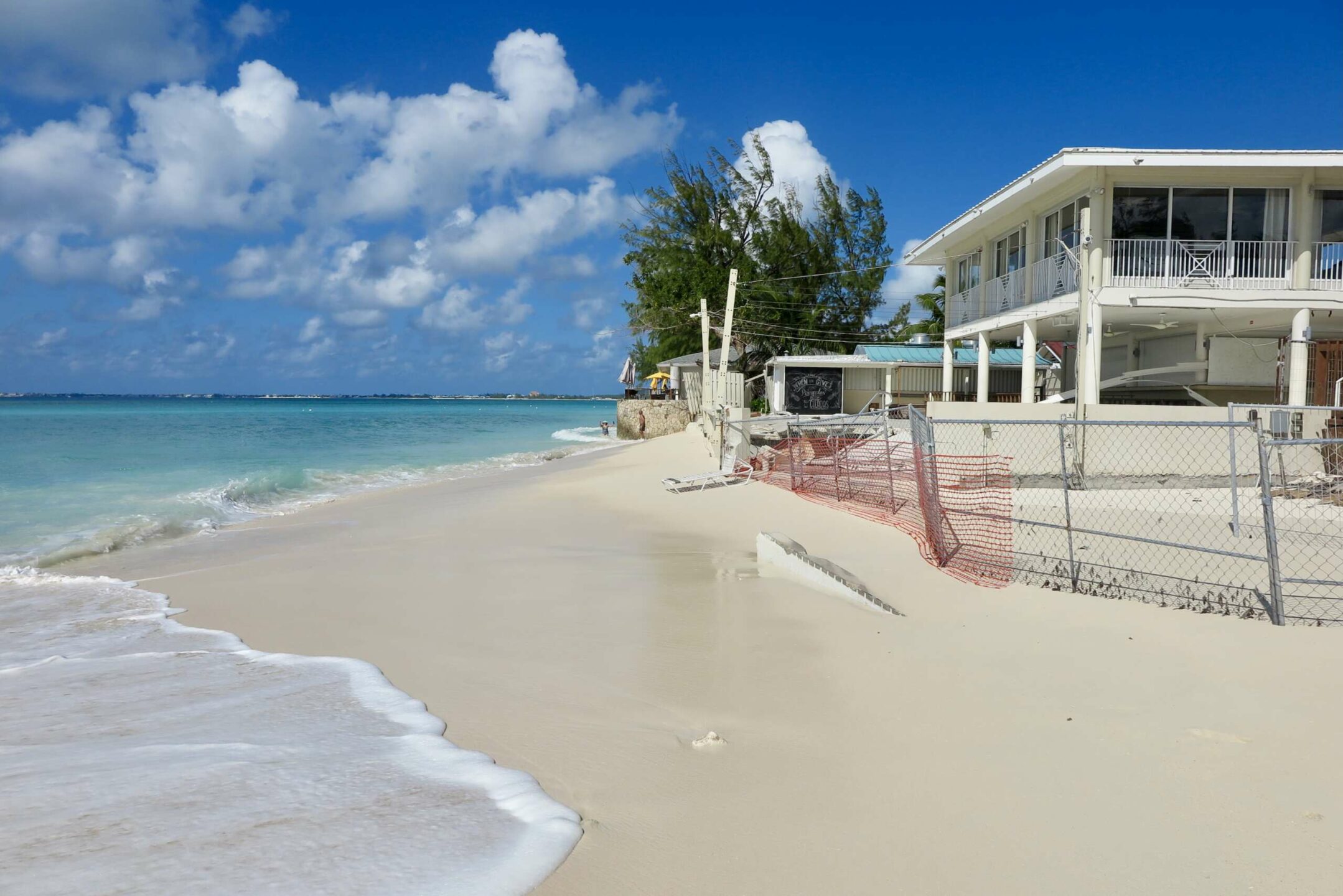
Next door at the Coral Beach bar, Kenny Rankin, on the management team, said the situation was getting desperate.
“The sand has been coming and going for the past two years but it is worse than it has ever been,” he said.
“Right now, we have three to four feet of water in front of the Coral Beach property. The situation is dire and I am worried about what will happen to the property in the next storm.”
The contagion is spreading south.
An emergency meeting was held at The Sovereign condo complex on Wednesday, 2 Oct.
Owners, who spoke to the Compass on condition of anonymity, shared anxiety about the worsening impact of repeated storms on the property.
One resident said it pained him to see what had happened to the beach, where felled palm trees lay in newly scooped trenches, in front of the property.
He said he hoped a solution could be found “not just for property owners but for the future of Cayman”, adding that he would be willing to pay a “sand tax” to help solutions.
Property owners at Laguna Del Mar are expected back before the Central Planning Authority later this month with another effort to replace their beach wall, which they have argued is essential for the resort’s protection from storm impacts.
Multiple condos affected
The erosion now impacts at least nine waterfront condo complexes, many of which are used for holiday rentals.
The economic impact is increasing with every storm.
Juliet Cumber-Forget, managing director of Cayman Villas, which manages and markets properties all along Seven Mile Beach, said she was extremely worried.
“The erosion on the southern end of the beach has devastated our rentals this past year, and it is only getting worse,” she said. “Helene has caused further damages to the beach at Regal Beach and Laguna Del Mar, and it is very, very concerning.”
Rick Riyat, head of valuations at BCQS, said the impact was evident in the length of time properties in impacted condos had been on the market. He said owners were also seeing an increase in insurance costs that is only likely to get worse over time.
“We haven’t yet seen a definite decline in property values, but what we are seeing is lower daily rates for short-term rentals in those condo complexes, and those that are listed for sale are on the market for much longer,” he added.
Some have levelled the blame at developers who built too close to the ocean on an active beach.
Brian Butler – who developed multiple complexes in the area since the 1980s, including The Avalon and Seacrest condominiums, insisted the once-beachfront properties “were, almost without exception, built in accordance with the Cayman Islands government planning codes and laws, and within the required government setbacks” at a time when there was significantly more beach than there is today,
“No laws were broken,” he said.
Tourists vent frustrations
The frustration from tourists is palpable in TripAdvisor comments.
“Regal No Beach”, one visitor wrote in a recent one-star review – before Helene wiped away what was left of that part of the beach. “It’s a nice place but they are advertising a beautiful beach with chairs and umbrellas and this is no longer the case,” the visitor noted.
The recent reviews contrast with previously glowing accounts of the property and its beach-front.
Five-star ratings are being eroded along that entire stretch, with numerous reviewers complaining about the absence of beach compared with images used to advertise the properties.
Similar accusations could be levelled further down the beach where real estate ads for The Sovereign, for example, show a wide sandy beach filled with palm trees. Compass images from this week show a contrasting picture of fallen trees and exposed roots where the storm has sheared away the sand.
Kim Lund, of RE/MAX, said it was worrying to see the extent to which the erosion had now spread north. Even in the space of the past two years, he said, the difference was “incredible”.
He said it was obvious that the value and nightly rates at properties without beach front would be impacted over time.
“It is absolutely shocking to see how the erosion has moved so far up Seven Mile Beach and doesn’t seem to be stopping,” he said.
“I hope government and the private interests along the beach can work together to come up with a solution.”
Search for answers
While there have been multiple previous efforts – from government, as well as individually and collectively from the private sector – to find answers, no concrete action plan has been formulated, either to manage development along the beach or to replenish sand.
Joey Hew, MP for the area and leader of the opposition, said, “The erosion is moving further north at an alarming rate” and that there was no room for ongoing delay.
He said other jurisdictions had successfully managed similar challenges with sand renourishment and managed retreats – essentially using planning policy to move buildings further back as they are redeveloped.
He acknowledged that even after a successful beach renourishment the sand would need to be “replenished periodically”. He proposed a fund could be set up to cover that cost by adding a “dollar or two” to the tourism room tax.
A previous government effort, led by Panton, had achieved some consensus on a beach renourishment plan combined with legislative changes to standardise the property boundary line and restrict future development too close to the water.
But those ideas – only made public through an freedom of information request from the Compass on the work of two beach committees set up by the former premier – never hardened into any definite policy.
The Dart group – which owns Coral Beach and Royal Palms in that area – funded a separate study by a Danish engineering company which also recommended a beach nourishment project and an ongoing investment in replenishing lost sand.
Both those studies showed that while there has always been ebb and flow of Cayman’s beach width and size based on wave activity – the pattern of storms and the impact of building on the active beach has led to a permanent loss of significant quantities of sand from the system.
Robert Weekley, Dart’s senior vice president of development planning, said the company had funded research in an effort to highlight a possible solution and is willing to work with government and private interests to make it happen.
He said, “The situation on Seven Mile Beach is one that requires urgent attention and action from both the public and private sectors based on the technical studies that exist.
“We look forward to doing our part in implementing a solution, as Seven Mile Beach is the primary natural asset to the Cayman Islands, not just from a tourism standpoint but also as an economic driver for the country and its people.”
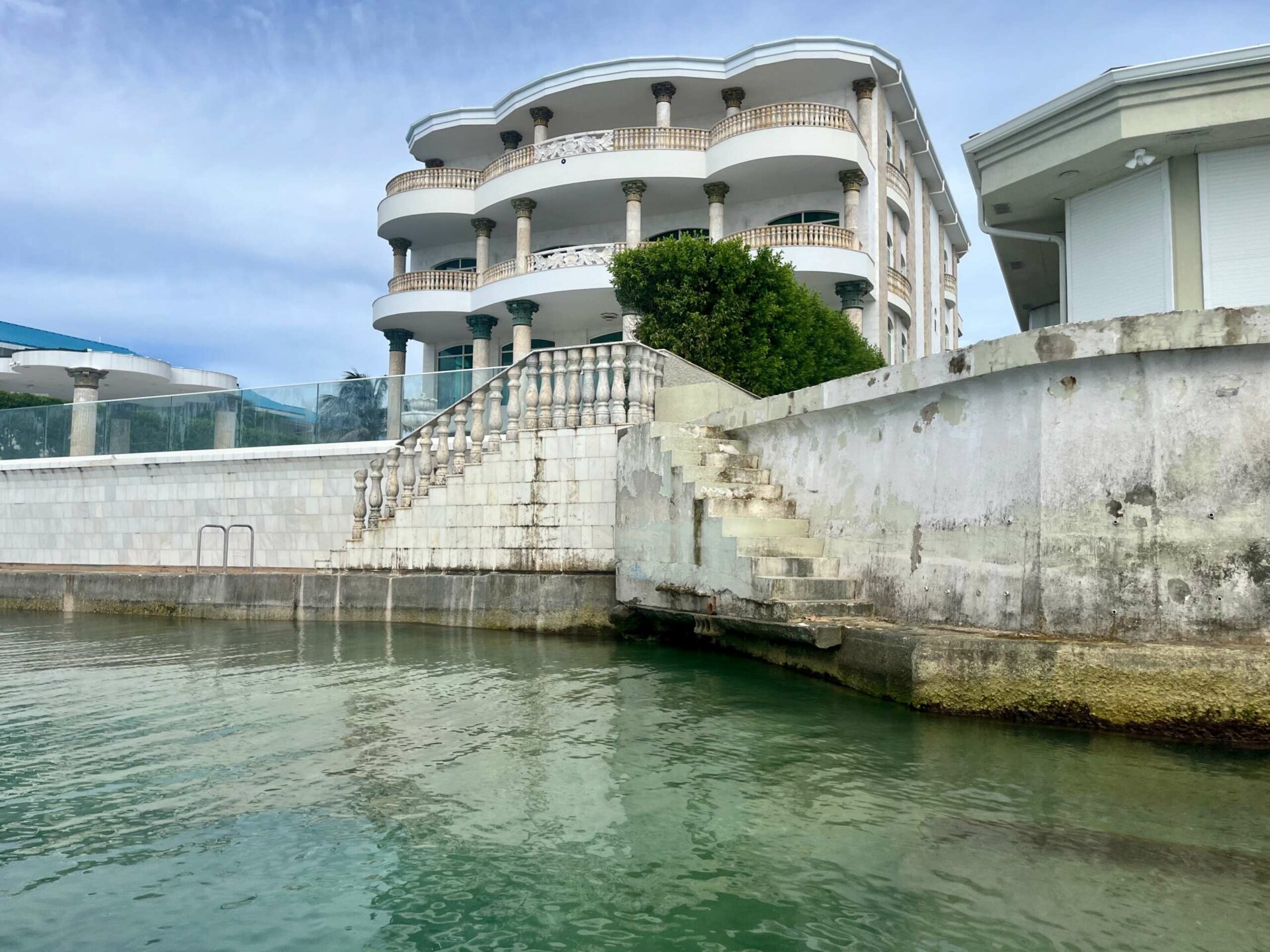
Dart’s study – carried out by the Danish Hydraulic Institute – indicated that while the dimensions of the beach naturally flex with storms, tides and other coastal processes, there had been a significant net loss of sand from the beach system over the past two decades. It suggested putting 200,000 cubic metres of fresh sand back into the system would be a ‘good start’ towards returning the beach front to its former glory.
Government response
The Compass reached out through various channels to the Ministry of Tourism, Ministry of Planning and Infrastructure, Ministry of Sustainability and the Ministry of Lands – all of which were involved in the previous task force under Panton’s leadership.
The Lands Ministry’s Welcome was the only one to provide substantive responses.
He said no money had been allocated towards the issue in the current budget, which covers government spending through the end of 2025.
He said erosion around Cayman is a “significant concern” and is impacting other areas, including North Side and East End.
He said, “The preferred solution is for a public/private partnership that not only focuses on renourishing the beach, but firstly undertaking the necessary managed retreat and changes to how the Cayman Islands develops properties with active shorelines.”
Managed retreat is a concept of rebuilding properties further back from the shoreline when they are damaged in storms. Despite long-standing recommendations for development to be situated further back from the ocean, no policy has been put in place to implement those, and the Development Plan, which would take a bigger picture look at how and where Cayman builds, has not been updated since 1997 when Cayman’s population was around a third of what it is today.
“At this stage,” Welcome said, “I believe all agree that these actions must all be taken together as simply renourishing a beach without additional actions will see that renourished beach disappear with the next inclement weather.”
Meanwhile notes from last week’s Cabinet meeting indicate government has approved a climate change policy for the islands through 2050. The draft of that policy, published earlier this year, included a goal to “update the Coastal Works Policy to include recommendations from the Beach Erosion Committee and other agencies evaluating comprehensive coastal zone management.”
Editor’s note: The Cayman Compass is a subsidiary of Dart Media and Entertainment.
Related Videos








How far do we want to let it go? If we do nothing and we wait and we watch, we’ll all live to see it reach North Sound. The Lord helps those that help themselves.
In the meantime the Minister of Tourism concentrates his attention on the cruiseship industry, attending their meetings and promoting their cause. Not a word about the crisis situation with our outstanding tourist asset – the West Bay Beach.
This problem has been going on for years. I have written in this paper my idea several times Not Sunset Cove has a rock cove that protects the beach. If a wall was built with the same stones from the tip of the cove north to around the Sovereign and then filled with sand the beach would be restored and the wall would keep the sand from leaving. We paid about $600,000 for that wall around the cove I assume for 2-3 million the wall I propose could be build and several thousand for the sand and for less than the $20 million the government said they would spend it could be done.
I know that some resorts were built closer to the water than recommended by the environmental assessment of the day. This raises the question of how much of the problem is man made and how much is natural. Could part of the answer be to demolish some structures that are part of the problem? I ask because if they are part of the problem, any fix to replace the beach are likely only temporary especially with the increase ferocity of storms and rising sea levels.
@Paul N. You’re absolutely 💯 correct! ✅