

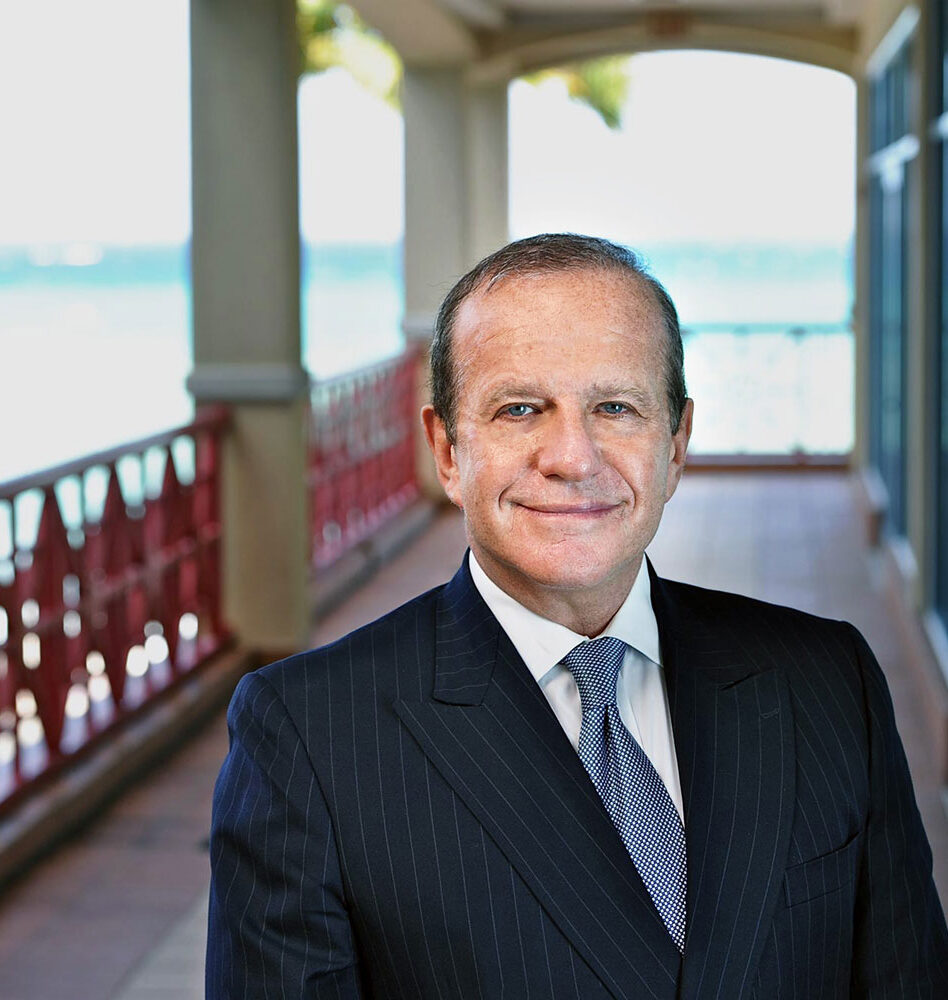
A US Treasury decision to sideline new legislation designed to make domestic company ownership details open to the public has been welcomed by a top Cayman lawyer.
Anthony Travers, a champion of the country’s financial services sector, said the policy meant American authorities would not enforce reporting rules in the Corporate Transparency Act (CTA).
The decision clashed with the UK’s drive to create beneficial ownership registers open to public scrutiny across its overseas territories, including Cayman.
Travers added the decision was in line with existing US law and the Cayman Islands Constitution, and also undermined Britain’s claim that its plan for overseas territory registers to be open to the public was the “global standard”.
The veteran lawyer, of legal firm Travers Thorp Alberga, said, “We can say that the US decision to effectively suspend the Corporate Transparency Act for US entities is totally consistent with the US Right to Privacy Act and the decisions around the Fourth Amendment, which establish a personal right to privacy under United States law.
“This is, of course, not fundamentally different to the right to privacy that exists under the Cayman Islands Constitution contained in the Bill of Rights and so it is difficult to see how, and particularly in the light of the decision of the European Court of Justice, which establishes a similar principle, the Cayman Islands’ government could have been persuaded by the Foreign, Commonwealth and Development Office (FCDO) that the right of the public to consider a beneficial ownership register is a ‘global standard’.
“It is clearly nothing of the sort.”
Travers was speaking after the US Treasury said it would not punish US citizens or businesses who failed to make business ownership information reports detailing those behind for-profit domestic entities.
US officials added, “The Treasury Department will further be issuing a proposed rulemaking that will narrow the scope of the rule to foreign reporting companies only.”
Corporations and limited liability companies would have been forced to make reports, but non-profits were exempted.
The reports would have been submitted to the Treasury’s Financial Crimes Enforcement Network, set up to act as watchdog for financial transactions for national security and anti-money laundering reasons.
The CTA report requirements, which came into force at the start of the year, were criticised for being invasive and too much of a burden.
Travers added that Lady Margaret Hodge, an ex-Labour MP and now a member of the House of Lords, and Conservative MP Andrew Mitchell were driving forces behind ownership registers open to the public, but had failed to explain how that would help clamp down on crime.
He highlighted that the Cayman beneficial ownership register was already available to law enforcement and tax authorities.
He said the two UK politicians and the FCDO, had failed to put forward “a coherent reason” for how opening up the register further would be useful in combatting money laundering and other offences.
Travers highlighted that a wide-open approach to ownership registries could also put people who lived in high-crime jurisdictions at risk.
He said, “The very serious issues of kidnapping, identity theft and home invasion, which are facilitated by a public right of access, appear to have been overlooked.”
But Travers added that Cayman MP McKeeva Bush had made an “excellent presentation” in Parliament on the risks involved during a debate on Cayman transparency legislation last year.
US Secretary of the Treasury Scott Bessent said when the change of heart was announced on 2 March that it was “a victory for common sense”.
He added the action was “part of President Trump’s bold agenda to unleash American prosperity by reining in burdensome regulations, in particular for small businesses that are the backbone of the American economy”.
Related Videos











You can go to this website:
https://find-and-update.company-information.service.gov.uk/
and find the owners of all UK registered companies.
However the UK is the only country in the world that requires this.
It’s an invasion of privacy in the UK and an invasion of privacy in Cayman.
Sadly it was forced on us by the left-wing so-called Conservative government.
If the USA is not making its companies’ Beneficial Ownership details public then there is no reason why Cayman should. The EU are of the same opinion as the USA. It is only the British that want this, that is far from a “global standard”. My right to privacy as a company owner must certainly take precedent over Joe Shmo’s interest in my personal affairs.