Cayman’s population jumped 5% in a year’s time to almost 88,000 in 2024, the latest government figures have revealed.
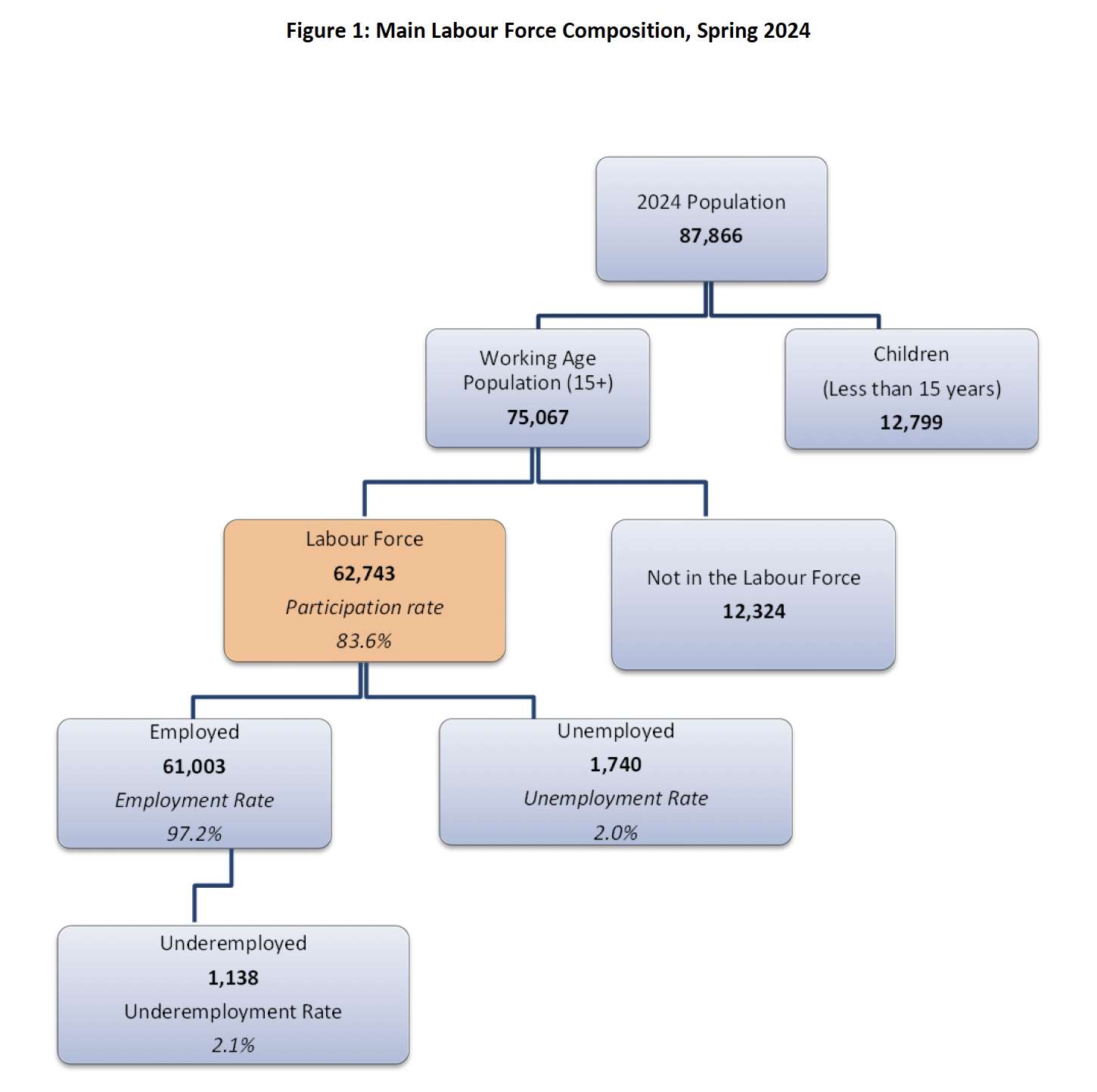
The newest Labour Force Survey Report from the Economics and Statistics Office showed a population of 87,866 in the spring of last year, up 4,195 on the same period in 2023.
The country’s total labour force was 62,743, an increase of more than 4,000 people, or 6.9%.
For the purpose of the report, the population was divided into non-Caymanians, at 40,147; Caymanians, at 39,897; and permanent residents at 7,822.
A total of 61,003 people in the labour force were working, with 1,740 unemployed (2.8%), representing an employment rate of 97.2% and a labour force participation rate of 83.6%.
An unemployment rate of 2.8%, the same figure recorded for spring 2023, was so low as to be regarded as full employment. The Caymanian unemployment rate was higher at 4.9%, representing 1,142 people, who accounted for 65.7% of the unemployed population.
The non-Caymanian unemployment rate was 1.3% and the permanent resident rate was 2.7%.
The report said, “Non-Caymanians made up the largest proportion of the population, accounting for 45.7%, while Caymanians and permanent residents had a population share of 45.4% and 8.9%, respectively.
“Compared to spring 2023, the Caymanian population increased by 2.5%.
“Among Caymanians, the working-age population accounted for 81.2%, while 86.8% of non-Caymanians were of working age.
“The entirety of the permanent resident population was of working age.
“Higher percentages among the two latter groups are expected, given that the residency of most expatriates is contingent upon work permits.”
The labour force comprises people of working age – 15 and older – who either were working, or those who, at the time of the survey, did not have a job but were available and looking for employment.
The biggest chunk of the labour force comprised people aged 35 to 44 (28.7%), followed by 25 to 34 (24.4%) and then 45 to 54 (22.1%).
Labour force distribution by nationality status showed that 37.2% were Caymanians,
53.5% were non-Caymanians, and 9.3% were permanent residents with the right to work.
The total labour force participation rate (LFPR) was 83.6%.
Permanent residents with the right to work had the highest labour force participation rates at 93%, with non-Caymanians was just behind on 92.3%.
The report said, “The outcome aligns with expectations, considering the work permit-oriented immigration system.
“In contrast, Caymanians had the lowest LFPR at 72.0%.”
Education
The survey also showed that labour force participation was closely linked to level of education.
The LFPR was 36.7% among people with ‘primary and below’ education, but rocketed to 91.7% among those who had attained “college/university” qualifications.
The report said people aged between 25 and 54 were the most likely to be employed or looking for work.
The age-specific LFPRs ranged from 86.3% among people aged between 55 and 64 to 95.6% among those 25 to 34 years old.
Men accounted for 52.7% of the labour force, while women made up the remaining 47.3%.
The employed labour force also consisted of more men than women, with a count of 32,243 males (52.9%) compared with 28,760 (47.1%) female.
Further analysis showed that men at 86.2% had higher rates of labour force participation than women, who notched up 80.8%.
The report said, “This trend was consistent when considering educational attainment as well, with males displaying greater LFPRs across all levels of education compared to females.”
The report said, “The majority of the employed labour force consisted of individuals aged 25 to 64 years, accounting for 90.1%.
“In contrast, individuals aged 15 to 24 years and the elderly (65 years and older) made up 9.8% of the employed labour force collectively.”
There were 22,181 Caymanians in the employed labour force (36.4%).
Non-Caymanians accounted for 54.3% of the employed labour force and permanent residents with the right to work made up 9.3%.
The top five occupations were professionals, service and sales, elementary occupations, craft and related trades workers, and managers, which together amounted to 77.5% of total employment.
Professionals were 19.7% of the workforce, and service and sales workers made up 18.2%.
Elementary occupations, such as construction workers, cleaners and security staff, totalled 13.7%.
Craft and related trades workers were just behind at 13.2%, and managers were at 12.7%.
Top occupations
The top occupations among employed Caymanians were managers (20.7%) and professionals (19.6%).
Technicians and associate professionals amounted to 14.3%, service and sales workers were 11.3% and clerical support workers accounted for 10.9% of Caymanians in the workforce.
Non-Caymanians were mainly occupied as service and sales workers (22.6%) and in elementary occupations (19.3%).
They also accounted for 18.9%of the professionals category, 17.2% of the craft and related trades workers sector, and made up 8.5% of technicians and associate professionals.
Permanent residents with the right to work were employed mostly as professionals comprised 24.7%, and service and sales workers amounted to 19.2%.
Managers accounted for another 17.8% and technicians and associate professionals were on 16.9%, while crafts and related trades workers accounted for 8.2% of permanent residents with the right to work.
The survey found that employed people worked an average of 43.3 hours a week, with men working an average of 2.1 hours more than women.
On average, employed persons worked 43.3 hours per week. Caymanians worked 41.8 hours a week and permanent residents with the right to work averaged 43.5 hours.
Non-Caymanians averaged 44.3 hours a week.
Just over half of employed people (51.8%) earned $2,400 or more a month.
For that salary level, the proportion was higher among employed men (55.7%) than women (47.4%).
A higher proportion of Caymanians (62.5%) earned $2,400 or more a month compared with permanent residents with the right to work (60.3%) and non-Caymanians (43.1%).
Related Videos