

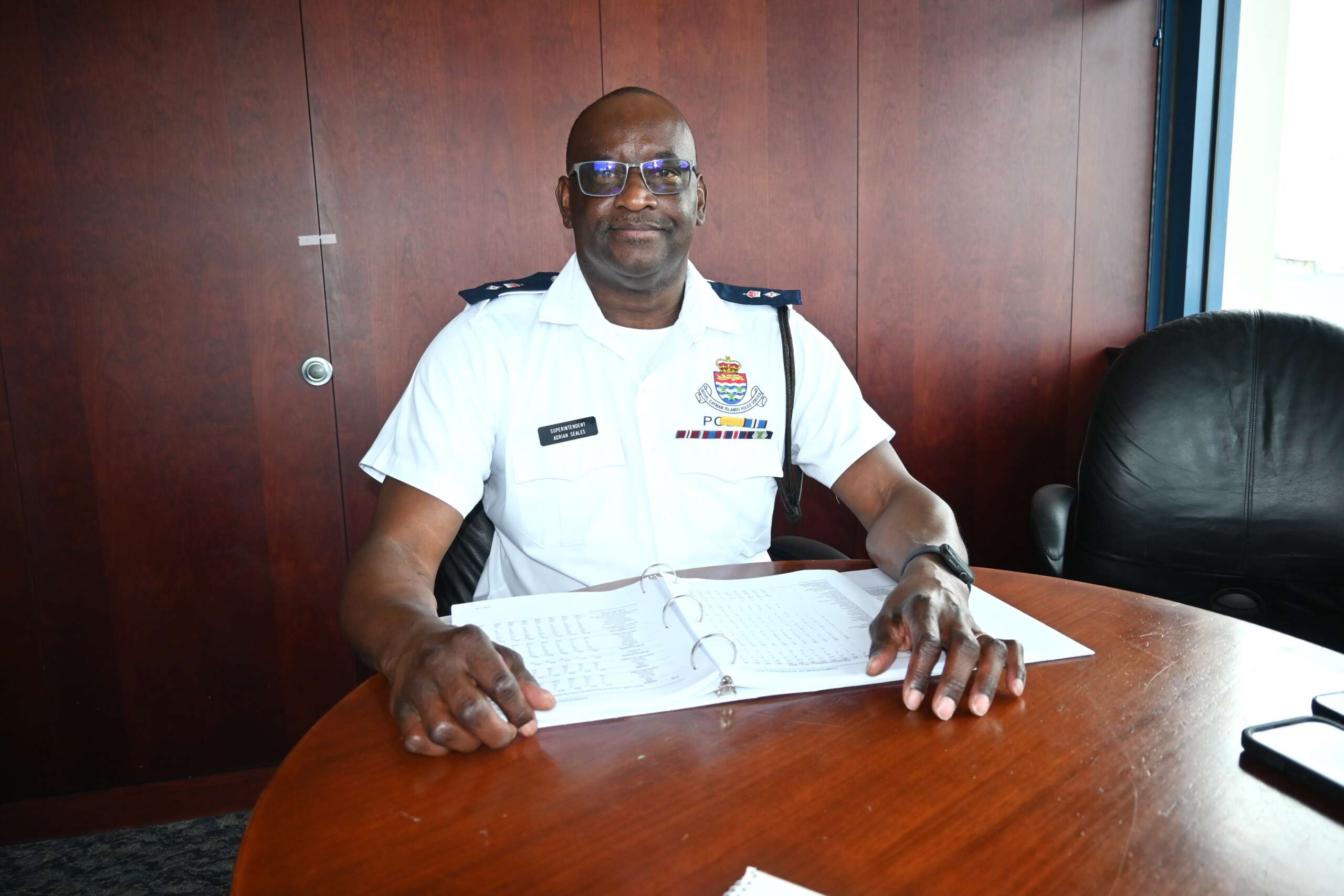
A senior Cayman police officer said the country’s drink driving limit could be cut in a bid to tackle the “plague” of drink driving.
Superintendent Adrian Seales said more needed to be done, including a tougher approach to driving over the alcohol limit, to cut the grim toll of death and injury on the roads.
“On lowering the limits even further, my honest opinion, I would say ‘yes’,” he said.
“We aren’t there yet, but I think we will eventually have to move.”
He added there were 14 road deaths last year from 11 accidents, and nine deaths from nine accidents in 2023.
Seales added that increasing penalties in line with the level of intoxication could also be considered.
But he said the problem was best approached as a multi-agency one, and other groups had roles to play in the reduction of drinking and driving.
He highlighted the use of measures such as special buses, the involvement of the taxi industry and a bigger emphasis on the need for designated drivers.
Seales added, “Looking at New Year’s Eve, for example, if you’re going to revel, you’re going to party, you need to figure out how you get there and how you get back.
“I honestly believe, if people don’t have a designated driver, they must work around another safe way to get back home.”
He added even alcometers or breathalysers fitted to cars to check drivers and disable the car if they tried to drive while under the influence were not off the table.
Seales, speaking at the police service’s George Town headquarters, said, “We need to look at other jurisdictions and take lessons from them.”
The country cut the drink driving limit to a 0.07% blood/alcohol content level (BAC) from 0.1% in 2022.
The level is lower than Jamaica, Canada, Florida and England and Wales, which have a limit of 0.08%, but higher than the permitted 0.05% in Scotland and Australia.
France, Germany, Spain, Italy, Portugal and Argentina also have a 0.05% BAC.
Seales said that drink driving and the resulting injuries put avoidable strain on the health care system, and travel overseas for treatment bumped up insurance costs.
“There is a mandatory 12-month disqualification and that could increase where there are repeat offenders,” he added.
“But if we’re going to be really serious about drink driving, we need heftier penalties and sanctions.”
Seales said he applauded the judiciary and the courts, who were at the forefront of the battle to reduce incidence of drink driving, as well as the National Roads Authority, which had worked to cut the number of known accident danger spots for legal drivers.
Seales said, “You find with drunk drivers, they seldom show any real care for other people and road users, whether it’s sheer lawlessness or poor judgment – I’m not sure which it is.
“They know they could be stopped and prosecuted, but that doesn’t seem to deter them. It’s all about how we get the attitude adjustment.”
Seales added, “When you add up all the costs that one drink driver can actually cause, the cost can be in the hundreds of thousands of dollars, especially if it involves further medical care if they are airlifted to a bigger hospital.”
The superintendent also sits on the Streetskill committee, which promotes road safety, and the National Road Safety Committee, and said that there were “initiatives on the table right now”.
He added, “We are looking at revising the traffic regulations as well and also revision of the road code.”
National Drug Council backs lower limit
A spokeswoman for the National Drug Council (NDC) backed Seales proposal to lower the drink driving limit to 0.05% and agreed more than legislation was required to cut the grim toll of death and injury on the roads.
She said, “Real progress requires a multi-agency approach that includes enforcement, responsible service training, late-night transport options and ongoing public education… .”
She highlighted the NDC’s “Arrive Alive 345” campaign, designed to increase awareness of the dangers of drink driving over the festive season.
The spokesman said the NDC also promoted prevention strategies such as Compass Media’s “Purple Ribbon Pledge”, where drivers promise not to drink and drive.
She also singled out the designated driver programme, the New Year’s Eve Purple Ribbon Bus service designed to get people home safe and the Safe Serve and Sales Training Scheme and Training for Intervention Procedures, which promote a responsible approach to alcohol sales.
The spokeswoman said, “The AA345 campaign demonstrates that coordinated action is effective and we should expand its efforts beyond the holidays.”
She added that a cut in the drink driving limit, with “stronger enforcement, mandatory responsible service training, mandatory education or treatment programmes and reliable late-night transportation” were also required.
The planning, agriculture housing and infrastructure ministry, headed by North Side MP Jay Ebanks, has not responded to a request for comment.
The government unveiled its ‘RoadtoZero’ initiative, a campaign that aims to reduce the number of collisions on local roads over the next 14 years, last March.
The main targets in the Cayman Islands National Road Safety Strategy 2023-2038 are to reduce road fatalities by 30% by 2028 and to eradicate them altogether by 2038.
Related Videos










The problem won’t be solved by reducing the current low limit of 0.07% even more.
The crashes (not accidents) are caused by people drinking substantially more than the current limit.
No weekend bus service.
No late night bus service.
Expensive taxis.
Couldn’t care less attitude.
These are the things that put people behind the wheel when they’ve had much too much to drink.
What’s disappointing about this article is that the writer makes a number of very strong assertions without one iota of supporting evidence. You don’t even suggest statistics to compare jurisdictions who have cut the limit and whether it had any impact at all. It’s a problem at the Compass, that stories are written, with gratuitous subjective opinions about important topics, without any of the real work being done to find consensus or prove the case. As someone who prosecuted hundreds of DUI cases in a past career, I can assure you without equivocation that lowering the limit will do ZERO to help with what “plagues” the island. The current .7 is more than severe enough. People at .7 have no trouble driving. I would argue that current fatals involve 1.5 and higher levels, which records would certainly show – meaning crashes involving people who would have blown past any new lower level anyway. The answer to lowering drunk driving is offering REAL public transit and doing real enforcement – period. Once the drinkers know the odds are against them, they’ll take a taxi or a bus (assuming they can find one) or make better arrangements. Until then, you’re wasting your breath.
Absolutely no point in reducing the limit since there is no enforcement of the current limit. We can legislate lower drink driving limits or lower speeding limits until we are blue in the face but until there is effective ENFORCEMENT of these limits they are pointless. I note that any mention of effective police enforcement is missing from the above statement!
The same with texting and driving- if I can see it happening all the time whilst driving why can’t the police? Usually, because there is not a police car in sight.
Reducing the permissible BAC limit to .05% is a good first move, but there needs to be later night transportation options for individuals that will not require them to undertake a cost benefit analysis between hiring a ride home and driving under the influence, knowing that the odds of being apprehended are very low, indeed. The countries noted with .05% limits are countries which have robust public transportation systems and populations that are not nearly as reliant upon automobiles for their daily travel needs. This begs the next question: when will Cayman enact a proper public transportation system with proper buses and schedules that people can rely on for everyday transit and free them from having to drive or ride in a cramped minivan that comes every so often instead of at pre-determined times?
Any road fatality or serious injury is tragic. Any attributed to the choice of someone driving impaired is more so. It is likely that Superintendent Seales’ suggestion of lowering the legal limit might have the desired benefits. So might banning alcohol consumption totally. But how impractical do we want to get?
When the limit was lowered in 2022, wasn’t the CIPS involved somewhere in that decision? I’d be surprised if they weren’t. So why come with suggestions of lowering the limit again just three years later? Is it because nothing in our public services ever gets done right the first time?
The fact that drunk driving still remains so prevalent after the limit was lowered suggests that lowering the limit is not the answer. Even if alcohol were banned, people would find means to imbibe (review Prohibition in the USA) and uncaring persons would still drive under the influence.
Supt. Seales suggested other approaches which could have benefits, but none of which haven’t been tried before, with limited success: Taxi involvement, designated drivers, increased penalties, changes to the laws and road code, etc. (the latter being Cayman’s favorite ‘remedy’ – make a law).
Conspicuously absent from Supt. Seales’ suggestions was increased enforcement by the police. CIPS just received another big boost in public funding, no doubt for more officers and vehicles. Supt. Seales should be assuring the public that those increased resources will be well utilized in the fight against drunk driving. There’s no question that increased detection and enforcement will help. Instead, his approach came across like a deflection of CIPS responsibilities in the matter.
Note, my comments are not directed towards Supt. Seales on a personal level but as CIPS spokesman in this matter.
What was successful in Canada was a combination of strong anti-drinking and driving media/social media campaigns paid for by MADD (Mothers Against Drunk Driving) that were everywhere for decades, combined with strong, aggressive and repeated police roadblocks catching drivers in the act. The Cayman Islands has used neither of these types of tools in an effective manner.
So question this as a few years ago when the legal limit was reduced from .1 to .08 there was no drop in DUI activity. In addition, instead of basing a decision on opinion let’s dg into the facts. Something like what is the average BAL of a person who dies or is injured in a motor vehicle accident. My opinion is that the BAL is well above the legal limit most likely double. With this in mind you. Oils reduce the level to zero and have no impact on motor vehicle deaths. Use facts not opinions
Sweden.
In 1997 the Swedish Parliament introduced a “Vision Zero” policy that requires that fatalities and serious injuries are reduced to zero by 2020. This is a significant step-change in transport policy at the European level. All new roads are built to this standard and older roads are modified.
Vision Zero has been very successful, halving the number deaths on Swedish roads since the turn of the millennium.
Helsinki
has recorded zero road fatalities over the past year, according to data published by the EU Urban Mobility Observatory. The last traffic-related death in the Finnish capital occurred in July 2024.
If we can have uber style taxis and plenty of them it will be solved in one fell swoop.
The problem isn’t the limit, it’s the lack of enforcement. Lowering the limit won’t make the slightest difference. Those that drink to excess in Cayman do so knowing full well the chances of getting caught are slim to none. Taxis, better public transportation etc etc won’t make any difference either. A dedicated traffic department with a very visible presence on the road, random road blocks, walk through of the bars at closing time, random breathalyzer tests then & there of those that are obviously impaired before they get in a car & drive, & ruthless sentencing /fines if caught drunk driving is the closest we’ll ever get to stopping it. Consequences.
This article shows naiive thinking and won’t solve a thing by lowering the drinking limit. They need to allow UBER’s on the island. It’s extremely difficult to even get a taxi late at night, impossible in Savannah, Bodden Town or East End. Busses do not run there at night either.
If they blow over then immediately let them spend the night in a drunk tank sobering up, impound the car and make them pay a fine to get it back.