At a glance
- At least five cases of injury and self-harm at holding facility in Fairbanks reported over 15 month
- Ombudsman outlines series of recommendations to address staffing and security concerns
- Implementation of recommendations under way by police
Following an investigation prompted by reports of injury and self-harm at the police’s detention centre in Fairbanks, the Ombudsman has highlighted a litany of issues at the facility, including staffing shortages, inadequate training and CCTV blind spots.
There had been five such reports made over 15 months at the detention centre, where people arrested by police or Customs and Border Control are held, the Ombudsman noted.
One involved a detainee who lost the end of his thumb after his hand was trapped in a cell door when it was slammed shut. In another, a detainee drank half a bottle of rubbing alcohol while in custody; he suffered no serious injury. Another man in custody, while being given his anti-depression meds, grabbed the medication packet through the cell hatch and ingested the entire contents.
On two other occasions, detainees inside cells were seen tying bedsheets around their necks. Neither suffered injuries, and both were kept under observation.
Of those five cases, only the one involving the man whose thumb was injured resulted in a formal complaint being filed.
“The above five incidents were reported to [the Ombudsman] in the 15 months preceding the opening of this Own-Motion Investigation in May 2025 and reports of other, similar self-harm or injury incidents at the Cayman Islands Detention Centre were received since that time,” the Ombudsman report noted. “In addition, at least two local attorneys have engaged with [the Ombudsman], expressing concern about issues taking place at the CIDC.”
As part of the investigation, Ombudsman staff visited the detention centre nine times between 5 June and 23 June last year.
The Ombudsman report was tabled in Parliament earlier this month. An earlier version of the report was released last year, highlighting many of the same issues.
Hourly checks
The Ombudsman’s report highlighted that detention centre officers were often not performing hourly prisoner welfare checks as required by Royal Cayman Islands Police Service policy or were not recording these checks when they are done.
“This issue is a crucial one to resolve, given the number of attempted self-harm incidents occurring at CIDC,” Ombudsman Sharon Roulstone said in her report.
The report noted that “understaffing and sheer volume of work both serve to significantly hinder CIDC officers from completing their duties effectively”.
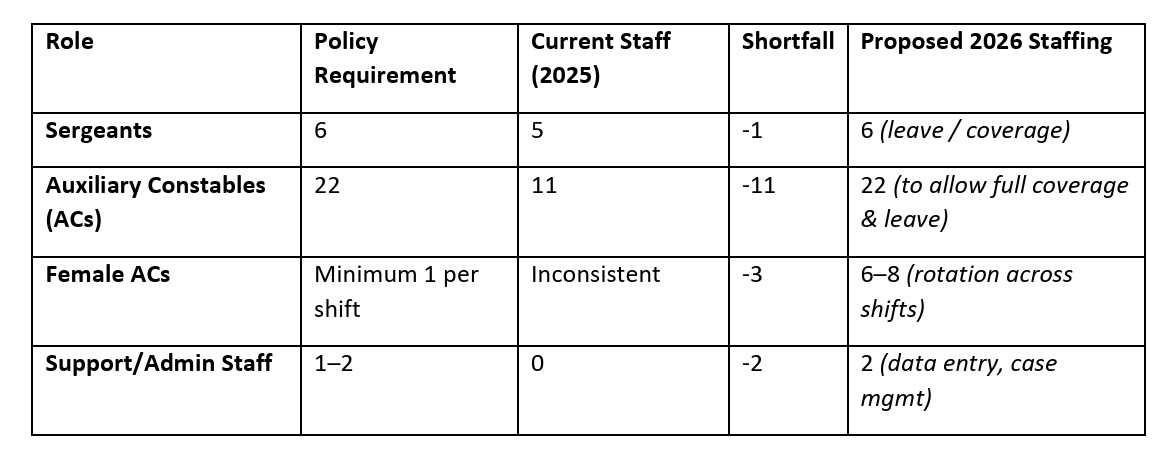
Prior to conducting the site visits, the Ombudsman staff met with senior officers of the RCIPS who suggested the ideal level of staffing at the detention centre was four auxiliary constables and one sergeant per 12-hour shift. “This staffing level was never observed during any of our nine visits to the CIDC and staffing levels for entire shifts were sometimes as low as two ACs and one aergeant,” the report stated.
In its findings, the Ombudsman office noted that the detention centre “is not meeting its own recommended minimum staffing levels on a regular basis”.
The Ombudsman acknowledged that staffing is a “complex problem” at the detention centre, given the volume of work it handles daily. It noted that the RCIPS averaged more than 200 arrests per month in the first half of 2025 and processed police bail for approximately 500 people per month. Also, from January to early June 2025, the facility held 46 Customs and Border Control detainees for more than 24 hours, and another 15 detainees from HMP Northward, often for several days at a time.
The investigators found that at least two custody sergeants worked for 1.5 to 2.5 hours beyond their shifts to process arrest paperwork, following a 12-hour shift and often returning the next day for another 12-hour shift. They also noted that each 12-hour shift is supposed to have one female officer on staff, but this was only observed on two of the investigators’ nine visits.
Among its responses to the issues highlighted, the RCIPS said it had a plan to essentially double the available staff for detention centre operations, with recruitment beginning in January 2026, especially for auxiliary constables to fill the identified shortfall of 11 positions, with a specific focus on attracting females to the role.
“This may prove to be challenging to attract persons to this demanding role,” police acknowledged.
Language barriers
A lack of access to translators, especially of Spanish, Hindi and Tagalog, at weekends and overnight, led to a number of incidents of detainees struggling to understand auxiliary constables, sergeants and arresting officers, the report found.
It stated, “The lack of effective translation creates potential risks for the CIDC officers who may wrongfully detain persons or worse, misunderstand and thus neglect medical conditions.”
The Ombudsman recommended that the RCIPS consider having an on-call rotation of translators, with participants being incentivised to perform this community service as volunteer work.
CCTV blind spots
An incident in which a light inside a cell was broken by a detainee – which led to the cell being unusable for two months – highlighted a lack of CCTV coverage within the centre, the Ombudsman found.
The investigation found that only four of the 12 cells were monitored by CCTV, and that there were camera blind spots at the facility.
In response, police said a full security review had been completed to identify all blind spots in the custody suite, with new CCTV cameras being installed to address gaps, and cameras had been installed in all cells and internal and external areas.
The report concluded that its findings reflected “systemic issues which, if unaddressed, pose significant risks to the safety of detainees, RCIPS staff, the broader public, as well as the integrity of the RCIPS”.
While acknowledging that some work in under way to address some of the problems raised in the report, the Ombudsman’s office stated, “However, the persistence of long-standing issues – such as inadequate staffing, unclear medical transport protocols, poor internal security practices, and delayed maintenance – demonstrates the need for a more structured and accountable approach to facility management and oversight.”
It added, “The Ombudsman strongly encourages the Commissioner of Police and Her Excellency the Governor to treat these matters with the urgency they deserve and to initiate immediate steps toward implementation.”
Related Videos