

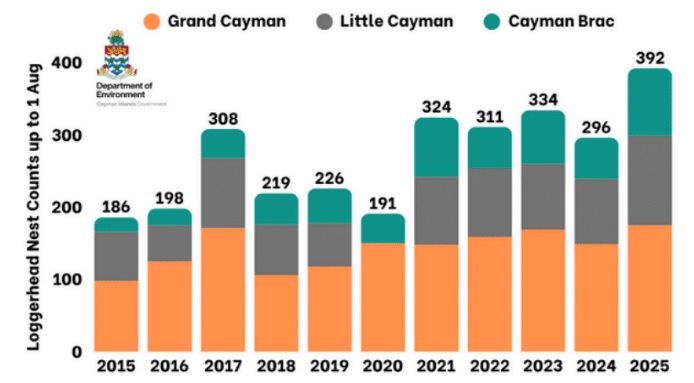
A record number of loggerhead turtle nests have been found in the Cayman Islands so far this nesting season.
By 1 Aug., which is near the end of loggerhead nesting season, 124 nests had been located on Little Cayman and 96 on Cayman Brac. These are both record numbers, and have pushed the overall number found across the three islands to an all-time high of 392 nests since monitoring of nests first began in 1998.
Tim Austin, deputy director of research and assessment at the Department of Environment, described this year as “a very successful and busy turtle nesting season”, adding that nest numbers are still being counted, so it’s possible Grand Cayman may yet surpass its loggerhead nesting record as well.
The first nest of the season was recorded on 16 April, and the busiest week of the season was 3-9 June, according to Department of Environment statistics.
 Green sea turtle nesting
The statistics indicate that this year will not be a record one for green sea turtle nesting, although by the beginning of August, the number of nests found had exceeded what were reported by that time last year.
By 1 Aug., 145 green sea turtle nests had been found across all three islands, compared to 102 by that date in 2024. Last year was a considerable drop on the numbers from the year before, when 262 nests were counted by 1 Aug.
The report on the nest numbers indicates that a clearer picture on the green sea turtle numbers will be known by the end of this month.
“Right now, the field teams are very busy with recording new nests and excavating nests that have emerged,” the report noted.
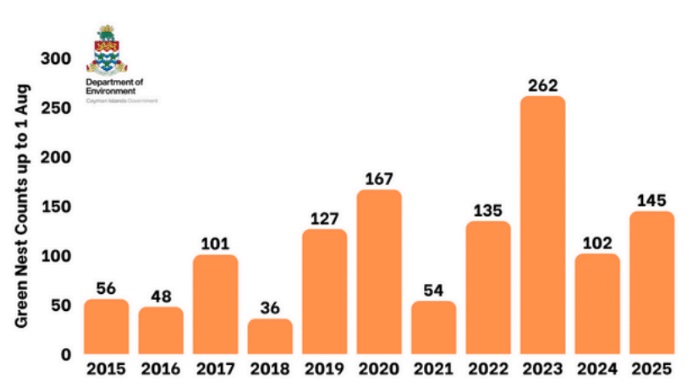 Austin said the department had not expected a bumper season for green turtles this year, as the animals have a cyclic approach to nesting, laying their eggs in two- or three-year intervals, rather than every year.
“So, we tend to see the highs and lows,” he said. “And this year was not anticipated to be a high season, but next year certainly is. All in all, the results are very, very encouraging.”
He thanked “the army of volunteers” who make keeping records of the nests possible. Those volunteers walk the beaches early each morning to find turtle tracks that lead them to the nests, which they then help the Department of Environment staff excavate to count the eggs and to monitor the nests until the hatchlings are ready to emerge.
The volunteers and staff also work in the evenings to ensure that the baby turtles, once hatched, make it to the sea, Austin said, “because the threats for turtle nesting still exist in Cayman”.
“We’re losing our beaches to sea-level rise and beach erosion,” he said. “Increased temperatures are leading to more females in the nest. So there’s still a lot of work that needs to be done, and without the volunteers and the commitment that they give, it would be really difficult to get the achievements that we have, so a very big thank you to those guys.”
Related Videos








A big thank you to the DOE staff and ALL the volunteers that are Ambassadors to the Cayman Islands sea turtles. THANKS