


By Compass Contributor Lynn Markoff
From transcribing Zoom calls and keeping track of appointments to much more complex tasks, artificial intelligence applications are already being embraced by businesses in the Cayman Islands.
That was one of the takeaways from the “fireside chat” held as part of Enterprise Cayman’s ‘CyberSandbox’ series on 3 Sept. at Cayman Enterprise City.
The session, titled ‘Beyond the Hype: Practical AI Solutions’, was moderated by University College of the Cayman Islands Director Tamsin Deasey Weinstein and included four panelists: entrepreneur and business owner Jason Butcher; owner of Grand Harbour Medical, Dr. Scott David; Deloitte Director Alexandra Forssell; and Cayman Management Ltd. Interim COO Asha Karia-Patel.
Karia-Patel discussed how her organisation is embracing AI.
“Anderson Global is treating AI as a business capability, not just a technology,” she said. “We’re investing in a dedicated team to automate routine work, embed intelligence into our core processes, and scale efficiently across markets.”
She also clarified what this meant for clients and stakeholders.
“This translates into sharper execution, faster engagement, and stronger global consistency – with Cayman as a key hub in that transformation. Ultimately, our goal is twofold: to achieve internal excellence by empowering our teams and streamlining processes, and to deliver external enablement by modernising client engagement and strengthening our global brand presence,” she said.
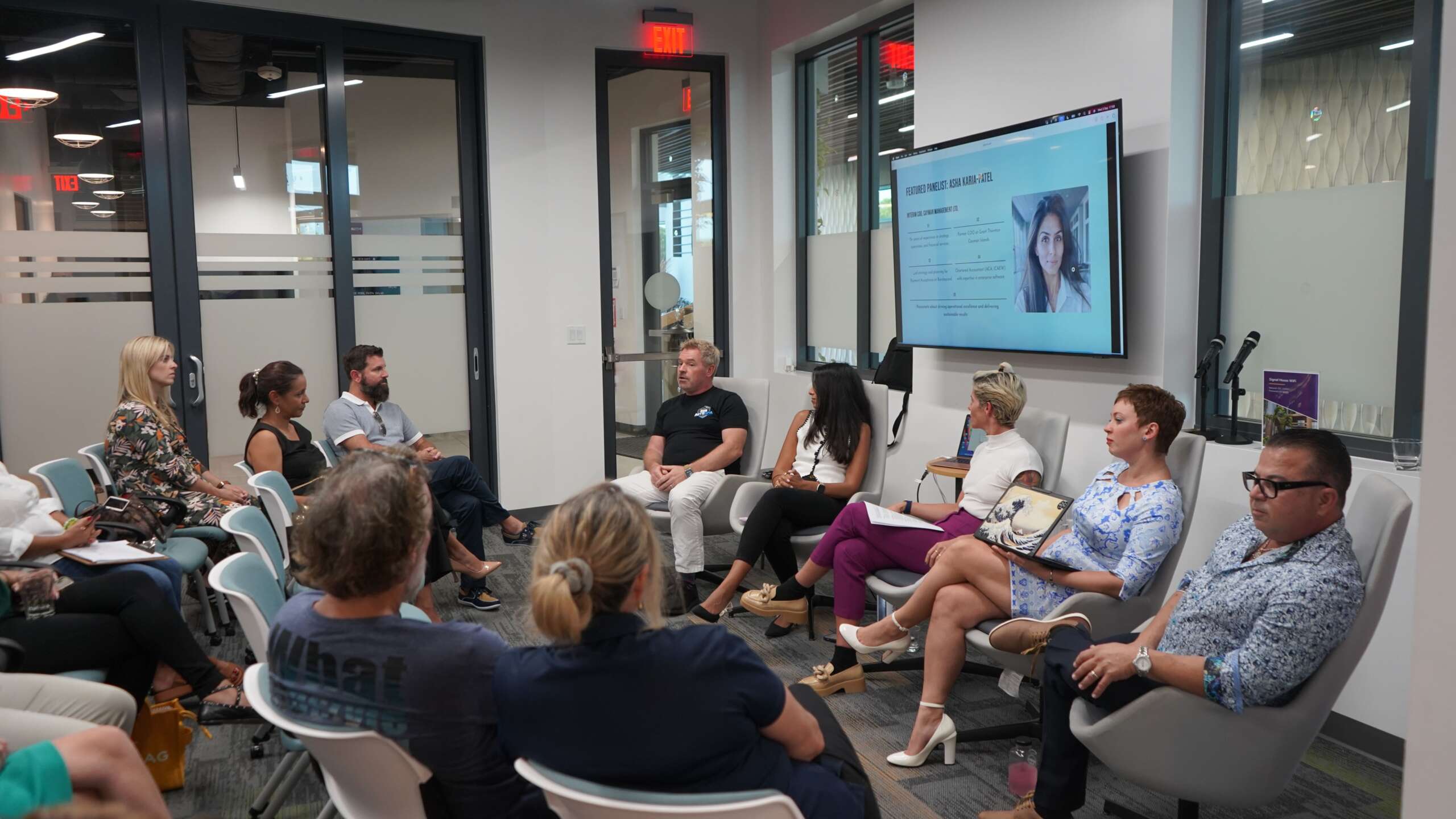
Panelists also mentioned that while AI is introducing changes for humans and pushing boundaries, it is not necessarily smarter than humans – just much faster. The view was shared that AI will create new capabilities and more capacity, thus enabling people to “focus on what they are best at”, and to “get people to think differently”.
Challenges
Forssell said Deloitte is committed to using AI, but that it was also well aware of some of its threats.
“In the rapidly evolving landscape of cyber threats, it’s important to remember that artificial intelligence has emerged as a double-edged sword,” she said. “While AI offers unparalleled opportunities for enhancing efficiency in many areas, including cybersecurity, it also provides cyber criminals with sophisticated tools to execute more effective and elusive attacks.”
Forssell also went on to acknowledge that cyberattacks are inevitable and no system is entirely immune to breaches.
“The sophistication of AI-driven attacks only exacerbates this reality,” she said.
But she also stressed that this does not imply helplessness.
“It emphasises the importance of being as knowledgeable and prepared as possible. On the response side, AI can also help with the policies and response communications, allowing the team to focus on time-critical issues,” she said.
Panelists shared their views on both the uses of AI and how they believed it would impact the future of various jobs and society as a whole. Some key themes that emerged included education and the sense that it was not keeping up with the rate of change required to ensure youth are ready for the workforce.
The complexity of AI and the future of jobs for youth in Cayman was a key topic. The question was raised, “What would you tell a 10-year-old?”
The answers were varied, but it was clear that AI will be changing the landscape for jobs. Also, around the fear of job loss, the audience was reminded that jobs have always historically changed when new technology has been introduced, such as in the cases of elevator lift attendants and telephone operators who were no longer needed in the past.
Lynn Markoff is a freelance journalist who has written for publications in the Cayman Islands since 2017.
Related Videos













What exactly the time-critical issues are? Beyond profit, what is the purpose of every business?
For example, how does AI implementation in business enhance employees well-being or improve customer satisfaction? So far “Faster & 24/7 Support” often cause frustration and anger.
AI-powered chatbots and virtual agents can handle routine customer queries, yet a 2024 survey ( Verint Systems Software) of 1,500 consumers found that more than two-thirds had a bad chatbot experience, citing the bot’s inability to answer questions and its failure to UNDERSTAND their needs. Many chatbots fail to correctly interpret user intent and lack the ability to adapt to unique customer, client or patient issues.
A major source of anger comes from chatbots that prevent or delay a user’s ability to speak to a human agent when the bot cannot resolve the problem.
P.S. Did you watch the Sep 10, 2025 interview of Sam Altman by a famous American conservative political commentator? You should. Someone has said, after watching: “I wasn’t worried about ChatGPT until Altman just defended it now in this interview….”
I asked ChatGPT how to fix the traffic in Cayman. I feel like I should send a bill to the government like Deloitte.
Smart Traffic Signal System
• Install or upgrade signal systems to be adaptive, adjusting to real-time congestion.
• Use traffic monitoring sensors or cameras to feed data.
• Provide variable signal timing or coordination (green waves) along major corridors.
Add traffic gating to Hurley’s roundabout in the mornings.
4. Expand Public Transit and Transit Priority
• Improve frequency and coverage of buses during peak times.
• Consider express bus routes along major arteries.
• Dedicate bus lanes where feasible.
5. Implement Demand Management
• Stagger work start/end times across major employers to flatten peaks.
• Incentives for telework / remote work where possible.
• Possibly introduce congestion charging in particularly heavily used corridors or around downtown at peak times (with revenue reinvested into transit).
6. Improve Alternatives for Non-Car Travel
• Build better sidewalks and safe crossing points; ensure pedestrian routes are shaded, safe from traffic.
• Add actual bike lanes and barriers