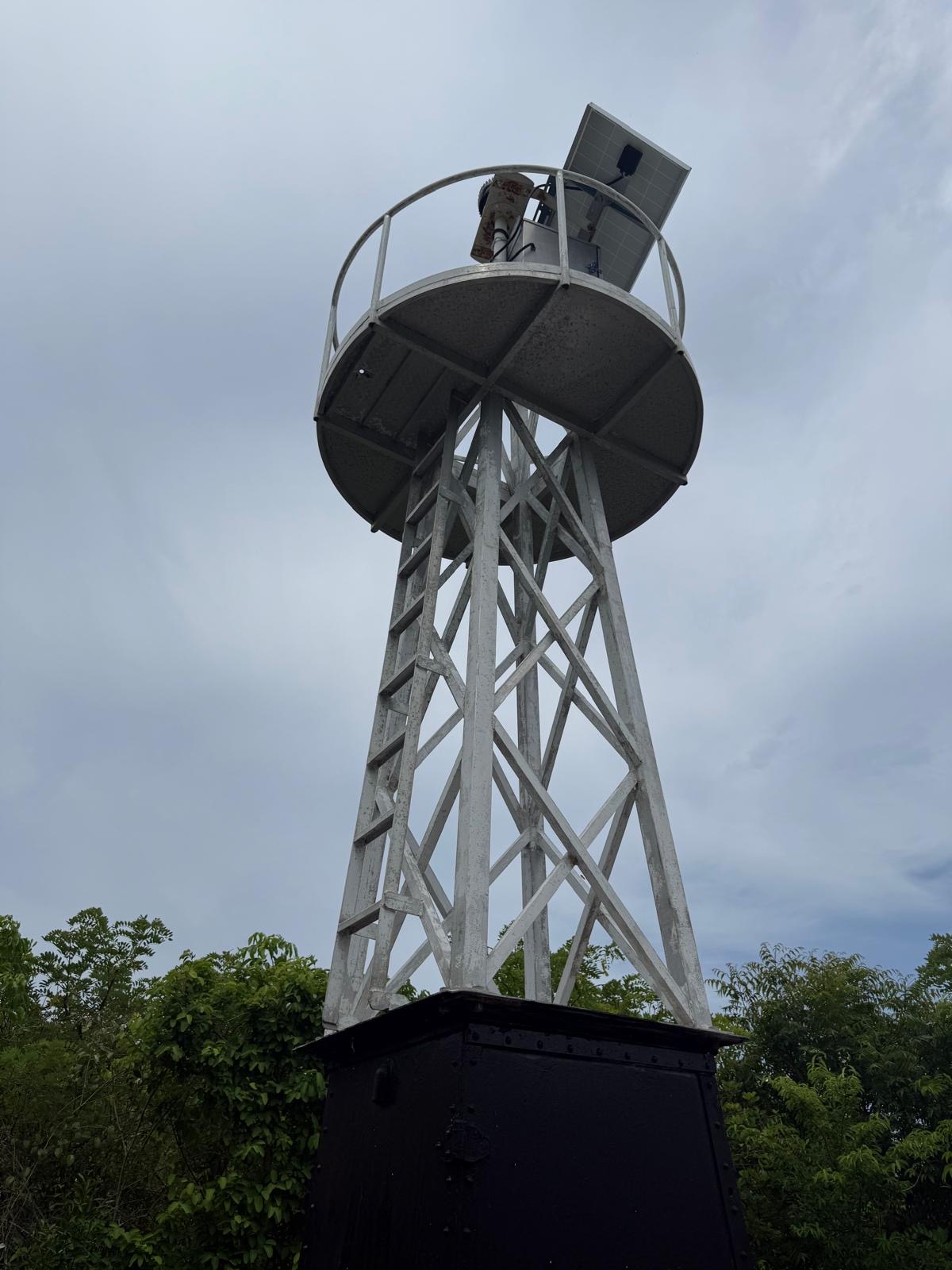
There is something strange, romantic and beautiful about lighthouses. The academic study of these structures is named pharology, but before you enroll in the course with the idea of making a career of it, be aware there is not a lot of jobs in the sector.
Pharology is the name of an area of study derived from the name of one of the first of the world sea beacons: A shining light built on the sea in 3 B.C. Pharos, was a 330-foot structure in Alexandria, Egypt, which was destroyed by an earthquake more than 1,000 years after it was built.
Lighthouses, as they came to be known, were built in varied ways, along many shores in the Caribbean Sea, including in the Cayman Islands,
One of the first accounts of lighthouses in the Cayman Islands is in ‘A handbook of the Cayman Islands’ dated 1908, which is edited by George S.S. Hirst, commissioner of the Cayman Islands.
“Three lights have recently been erected in the dependency: George Town, East End and Cayman Brac,” Hirst noted, adding, “though none can be called ‘lighthouses’, as they are lamps at the top of masts, each gives a light capable of being seen 12 miles out at sea.”
The need for such lights was made clear by Hirst.
“Wrecks innumerable have occurred around the island of Grand Cayman, and in days past the islanders acquired a name none too enviable as wreckers, but those days are gone, and no Caymanian of the present day would dream of tolerating the practices tradition has assigned to the inhabitants of a hundred years ago.”
A further account on the National Trust website goes on to say, “Towards the end of the 1800s, the Eastern Channel in Gun Bay was designated as a port of entry to East End.
Much business was conducted there under the guidance of William Conwell Watler, who gave clearance to vessels arriving in and leaving East End.”
According to the record, the first lighthouse on Grand Cayman was erected at Gun Bluff in the early 1900s under the 1906 East End Light Law.
“This was required under the Justices and Vestry’s East End Light Law (1906). A 60-foot ship’s mast stood on the Bluff and William James Watler was hired as a lightkeeper to ensure that a kerosene lantern was hoisted to the top of the mast at 6:00pm every evening and lowered at 6:00am every morning.”
A fine “not exceeding forty shillings” was to be imposed on him if it was discovered that he had been lax in his duties. The light could be seen 10 miles out to sea.
“By 1918, the need for a more substantial structure was recognised and a French engineer named Terrier was appointed to oversee the project,” the Trust website states.
The account continues: “Land at Gorling Bluff was leased from the Conolly family, and a new lighthouse was built, along with a storage shed to hold drums of kerosene.”
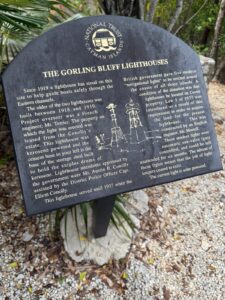
The site was ideal, as it was the highest point in the district and commanded a fine view of the local reefs.
The lighthouse at Gorling Bluff served until 1937, when the British government gave an order for five modern “navigational lights” to be erected around the coasts of all three Cayman Islands.
On 14 Aug. 1937, an official notice by Cayman Islands Commissioner A. W. Cardinall was published, noting the locations of four lighthouses on Grand Cayman at East End, Southwest Point, Northwest Point and George Town, as well as a lighthouses in Little Cayman and Cayman Brac.
The notice continued, “These lights will work automatically and require attending every six months. As would naturally be expected with so low a coastline, the necessity for having well arranged lights to prevent vessels from hitting this Island is most essential.”
Commissioner Cardinall, speaking about the lighthouses in the context of the recent visit to Cayman of the first cruise ship the Atlantis, said, “Of late, many large ocean liners have passed close by to us and avoided calling because of danger through the lack of proper lights; with the arranged lighthouse system there is every reason to hope that Cayman will be included as a stopping place in the cruise of the West Indian Islands.”
On 8 Feb. 1938, A. E. Panton confirmed that the lighthouses had been built and were now operational, “These lights have filled a long-felt need, and as ships and the sea mean so much to us, words are inadequate to express our gratitude for the magnificent gift of the Imperial Government in this connection.”
Panton added, “Ships need have no fear in approaching us now, and we believe that whereas hitherto we were avoided, now we hope to be sought after.”
Today, with advances in automation and GPS, the need for lighthouses has waned, transforming them from active guardians to historical monuments. Many of those that still exist are now automated, solar powered or preserved as heritage sites. In the Cayman Islands, lights still flash on the entrances to channels through the reefs, but satellite navigation does much of the work, and lighthouses don’t need to be the guardians of the reef they once were.
With the utility of lighthouses mostly gone, the Cayman Islands Government recently contracted to purchase the property where the ‘Boatswain Point Light’ or beacon still stands. That property is slated to be the new home of a West Bay police station, meaning it will serve the people as a guardian in a different way.
Related Videos