

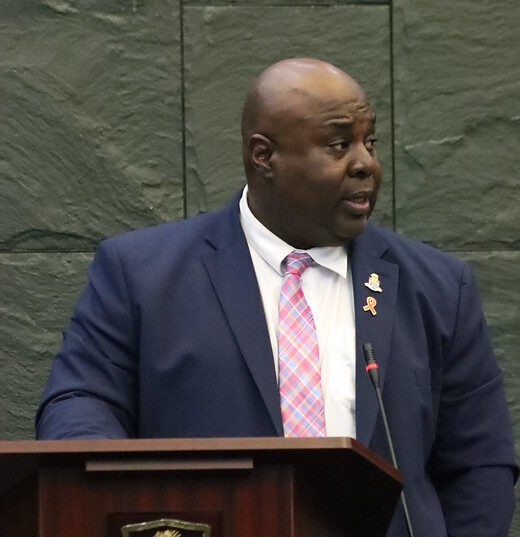
Sweeping changes to immigration laws aimed at protecting Caymanian workers and making it harder for foreigners to acquire residency and status were widely supported by MPs during debate in Parliament on Thursday, 11 Dec.
The reforms, which include a new 20-year residency requirement before most foreign nationals can apply for Caymanian status, were debated after Immigration Minister Michael Myles tabled the bill on Wednesday afternoon. Parliament was adjourned at 9pm Thursday night before several MPs, including Premier André Ebanks, had contributed to the debate, which will continue on Friday.
When tabling the bill, Immigration Minister Michael Myles said the goal was to update an “antiquated” system that had left Caymanians “displaced, marginalized and discriminated against in our own labour market”.
Citing challenges faced by Caymanian graduates in securing appropriate employment, despite government spending $39 million each year on tertiary education scholarships, he said the public was “crying out for reform”.
Myles said the National Coalition for Caymanians government was responding to concerns raised “around dinner tables, in living rooms, at community meetings and on the campaign trail”.
He said many Caymanians felt like “strangers in the land their grandparents built with their own hands”.
The minister insisted the Immigration (Transition) (Amendment and Validation) Bill, 2025 – which government plans to rename the Caymanian Protection Act – would address longstanding “injustices and inefficiencies”, while creating a clearer, more coherent system for businesses.
Myles also argued the changes would help protect Caymanian identity in the face of rapid population growth.
“Beyond the economics of the problem, we also have a socio-cultural problem,” he said.
“The answer is simple and devastating: We lose our identity. We lose our people. We lose the very soul of what makes these islands home.”
He noted that around 80% of the bill had originated under the previous government, with the new coalition adding several additional measures.
Key changes in the bill:
- Extends the timeline for eligible guest workers to apply for naturalisation to 15 years
- Increases the residency requirement for Caymanian Status to 20 years (or 15 years for spouses of Caymanians)
- Introduces term limits for non-Caymanian civil servants
- Raises the minimum income threshold for non-Caymanians with dependents to $5,000 per month and an additional $1,000 for each dependent
- Restricts work permit holders from changing employers for two years to prevent job-hopping
- Expands WORC’s investigative and data-sharing powers and strengthens its authority over Caymanian Status and PR decisions
- A further 17 amendments were tabled on the eve of the debate, including provisions allowing the Director of WORC to revoke Caymanian status grants in certain circumstances.
Opposition voices concerns but supports bill
The late inclusion of significant amendments triggered strong opposition from Progressives leader Joey Hew, who accused the government of bypassing proper scrutiny.
Calling the process “rushed”, he questioned: “Since when do we legislate fundamental rights by surprise?” Hew also doubted whether the changes would achieve their stated aims, saying most of the businesses affected by new fees and administrative burdens are Caymanian-owned.
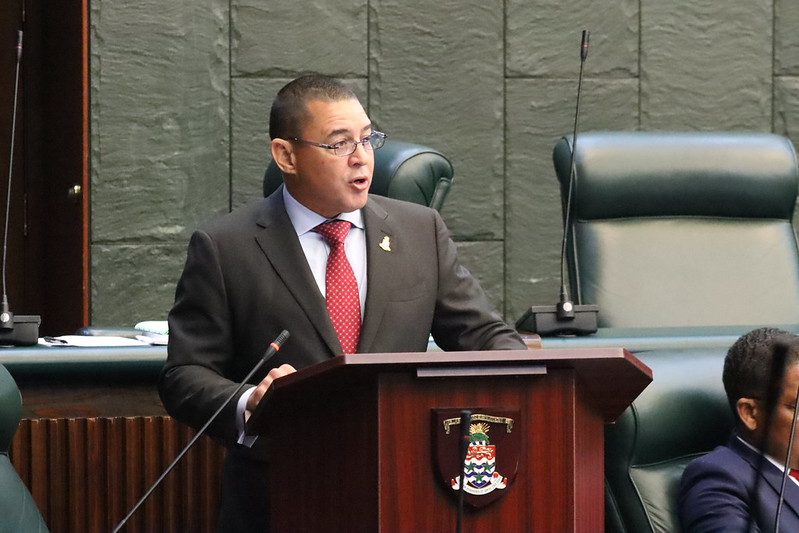
He warned the rhetoric surrounding the bill risked deepening social divisions and argued that several measures would likely increase the cost of living.
“I think it is rushed. It is internally inconsistent, it is procedurally tainted and it is socially divisive,” he said.
Deputy Opposition Leader Kenneth Bryan said he supported much of the substance of the bill but not the “us versus them” tone of parts of the debate. He acknowledged widespread community support for reform saying it would be “political suicide” to oppose the bill, but he added concerns that some elements may not stand up to legal challenge.
Government: Cayman still welcomes foreign labour
Myles rejected claims that the bill could undermine recruitment in sectors heavily dependent on expatriate labour, which include financial services, healthcare, construction, tourism, policing and public education.
“We still very much welcome the labour we need to fuel our economy. We have more jobs than we have Caymanians,” he said.
Quoting former legislator Roy Bodden, he added that expatriates “should never forget they are guests in another person’s country”.
“We owe them a fair immigration process, and we owe them safe and fair working conditions. We do not owe them a fast track to residency or a guarantee of the same privileges as Caymanians.”
He acknowledged that government must modernise work permit processing and improve education and training programmes to ensure Caymanians are ready to fill roles across the economy.
He said the bill is “step one” in a broader immigration overhaul, with changes to the permanent residency points system expected early in the new year.
Cayman status rules set to tighten further
Myles said the existing system made it “too easy” to gain PR and ultimately Caymanian status. More than 9,000 people received permanent residency over the past decade, with almost a third via the points system. During that period just over 7,000 people became Caymanian, a figure he described as “shocking”.
“Permanent Residency and the right to earn Caymanian Status are important,” he said, “but the current parameters are unsustainable for our infrastructure and are creating barriers for Caymanians to live and work in our country.”
Coalition MPs rally behind the bill
Infrastructure Minister Jay Ebanks said high participation in the NICE pre-holiday work programme showed that many Caymanians were willing to work but too often passed over.
Urging MPs to support the reforms and “save the back and forth for the pickleball court,” he said Caymanian Status must remain special.
“Everybody deserves to enter the gates of Heaven, but not this one (Cayman). This one is special. This one is very special.”
Home Affairs Minister Nickolas DaCosta said increases in permanent residence and status grants reflected “structural shifts in demographics” that had left “generational Caymanians in a minority”.
“Without reform we risk cementing a future where Caymanians no longer have pre-eminence in their homeland,” he said.
Health Minister Katherine Ebanks-Wilks argued the bill would enable economic growth “without sacrificing the soul of our nation.”
“Our families and our traditions matter and they are under threat when we allow unchecked immigration and we fail to prioritise our people in employment, housing, healthcare and education,” she said.
Related Videos











Amongst all this rhetoric we should remember that Caymanians have the right to work in the U.K. should they wish with no restrictions, free schooling for their children and free medical treatment. Most perhaps will prefer to stay here, but the option is open.
20 years is gaslighting for residency. They will move the goalposts when you are on year 19 because they clearly are showing a far right movement in this government that isn’t maintaining the ethics and promise that had been told to people 5,6,7 years on island ect. This government currently in shows time and time again, factually they rush things, don’t put a lot of thought in to stuff and honestly just lie to the publics face (a blatant switcharoo for people who have been on island.)
Myles cites discrimination against Caymanians in the workplace but there is no statistics. Its all made up as a far right political game. Him, Ebanks and Bryant are like the D. Trump of our neighbors to the north. Myles-Trump, the guy should change his last name.
I don’t know how one expat would trust this goverment, come to work or want to support a Cayman business with the rhetoric our leaders keep putting out and dividing people. I can’t stand it as a local. I feel for our expats everyday. They are like family and community but this government wants to run to kick them to the curb.
It’s interesting the government doesn’t focus on education but dividing the people. If we could improve the education for our Caymanians, they would be better off. I don’t see the point to divide people for this. What foreign teacher would want to come to the island now?
So now you can stay in Cayman 20 years and they can pull your status at any given moment… nice change.
Joey Hew the only one with a mind here. This bill is going to kill Caymanian businesses in the process. A blind person can see that. What expat will support any Caymanian business if they don’t have to and Myles, Ebanks, Bodden and Bryant drive so much divide. They don’t realize the impact.
Bryant acknowledged widespread community support for reform saying it would be “political suicide” to oppose the bill. – It’s all just a political game to these people. There hasn’t been community review whatsoever and these are massive changes with massive implications. It’s crazy the rush they are doing and little oversight. Bryant is just concerned for his job, Myles, Bodden and Ebanks so anything aside from their rushed, noncommunity reviewed, nonlaw reviewed bill is political suicide.
Myles says- “We have more jobs than we have Caymanians”……………. no kidding, so why are Caymanians not wanting to work and complaining. As a Caymanian, if I want a job, I go out and get one.
Then he says “but the current parameters are unsustainable for our infrastructure and are creating barriers for Caymanians to live and work in our country.”
Guy is the ultimate joke of a politician folks. Says one thing, then says exact opposite then bands together with his far right cronies to rush things along and do anything to keep his job.
There are certainly areas where the immigration law needs to be tightened where it is being abused.
For example: If people are entering into marriages of convenience just for the purpose of remaining in Cayman then it can be easily stopped by questioning each alleged spouse separately, as is done in the USA.
What does he have for breakfast? What side of the bed does she sleep on? What is the make and color of his/her car? Etc.
But we must be wary of demonizing ordinary people who come here to work, love the island and wish to integrate into our society.
They are human beings too, with worries, and loves and fears. To quote Shakespeare:
” If you prick us, do we not bleed? if you tickle us, do we not laugh? if you poison
us, do we not die? and if you wrong us, shall we not revenge?”
Behind this proposed law there is the laudable goal of increasing work opportunities for Caymanians.
But I am worried that it will drive away the very people that we should encourage to move here. And instead ensure that those who do come here to work won’t make any effort to integrate, give to and volunteer in local charities or care about Caymanian culture.
EDS (expat derangement syndrome) is alive and well
Who is responsible for these “injustices and inefficiencies”?, none other than our parliamentary representatives. “Work permit holders will be restricted from changing employers for two years”. An open invitation to exploit their workers during this period, an encouragement to some to treat employees as slave labour.