The government spends $32 million annually on higher education scholarships for Caymanians. The results, in terms of placement of graduates in jobs needed and available in the Cayman Islands, remains uncertain.
The spending has tripled in little over a decade, with thousands of students benefitting from a fully funded further education. But the expansion has come with little oversight.
There is no organised tracking of graduates, no mechanism linking scholarship funding to Cayman’s key industries, and limited quality control over the institutions students attend.
Scholarships are not means-tested and no preference is given for educational institutions in the United Kingdom, where Caymanians can qualify for home-rate tuition fees that are substantially lower than most US universities.
Cayman’s scholarship programme, worth up to $30,000 a year for any Caymanian student that makes the grades, is among the most generous in the world. It is also supplemented by scores of private sector-funded scholarships.
At a time when students and their families in the UK and the United States are going into record levels of debt to pay for higher education, the spending represents a huge opportunity for Caymanians.
But there is currently no certainty that it helps get young Caymanians into high-paying careers in their home country or that it produces the workforce that the islands need.
On the campaign trail last year, politicians on all sides cited stories of graduates returning to Cayman with advanced degrees unable to find work in their chosen fields.
Education Minister Rolston Anglin said he was working to introduce better tracking mechanisms when he was last education minister. At that time, in 2013, annual spending on scholarships was just under $10 million.
Anglin insists funding higher education is a top priority, but reform is coming that will ensure closer links between funding and the economy.
The value of spending public funds on university education and training for Caymanians is one policy agreed by all elected officials. The programme has cross-party support and has expanded under various governments to the point where it now funds more than 700 students at universities in the UK, the US and Canada.
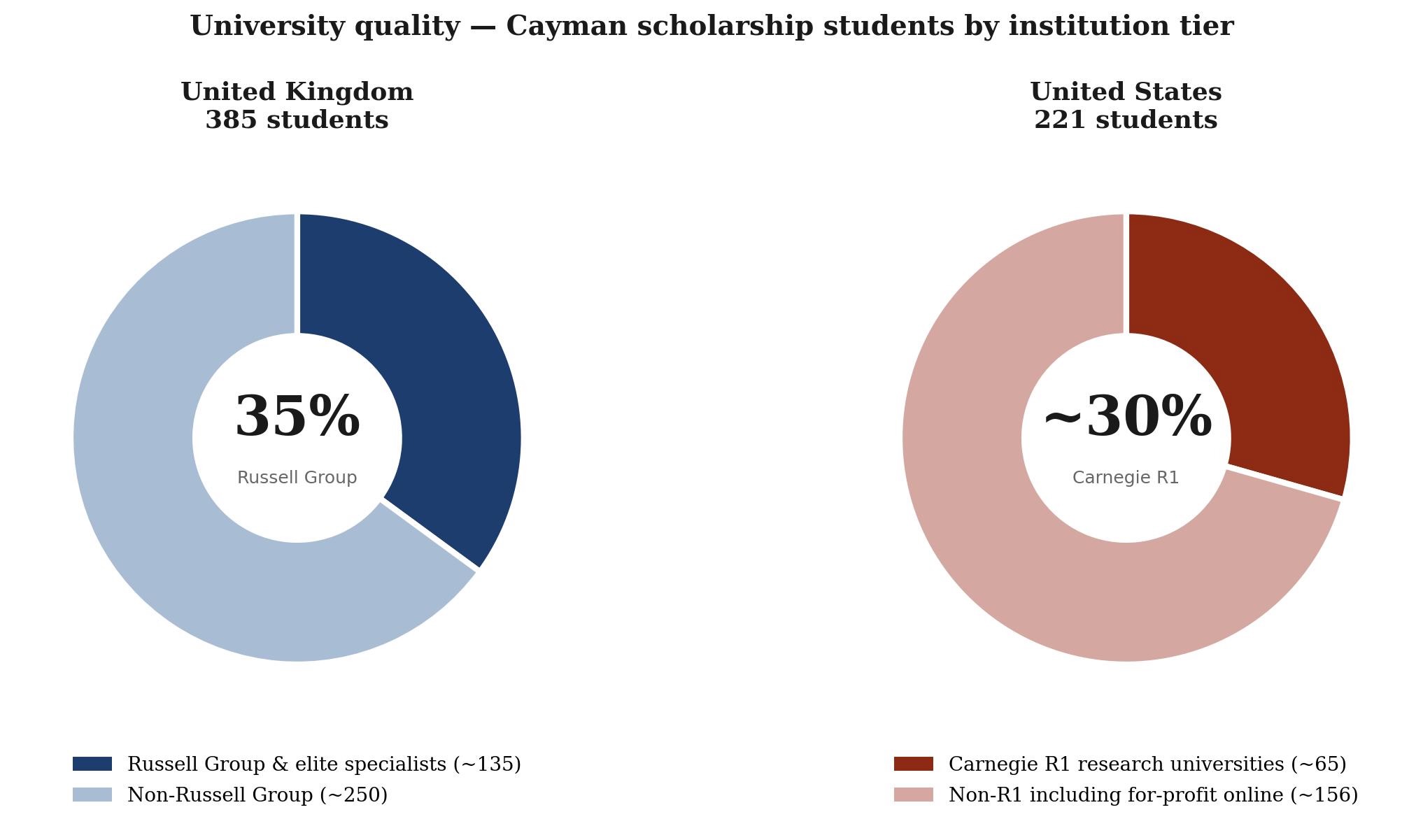
Caymanians are funded to attend institutions ranging from the prestigious Cambridge University in the UK to Walden University, a for-profit online institution in the US. Currently, the scholarship award is generally the same regardless of the subjects studied or the quality of the institution.
Anglin said the government is contemplating enhanced awards for students pursuing studies identified as national workforce priorities.
It is also reviewing the standards of some of the institutions Caymanian students are attending, particularly in the US. A tiered structure of scholarships is one of the ideas under consideration.
“Policy drives behaviours,” Anglin said in an interview with the Cayman Compass. “Every country does it.”
What the numbers show
The government disbursed $32.1 million on higher education in 2025. Of that, $23.6 million went to overseas students, with $19.8 million going to undergraduates and $3.8 million to postgraduates.
The rest was spent on domestic programmes, including A-levels, local universities and local vocational training grants.
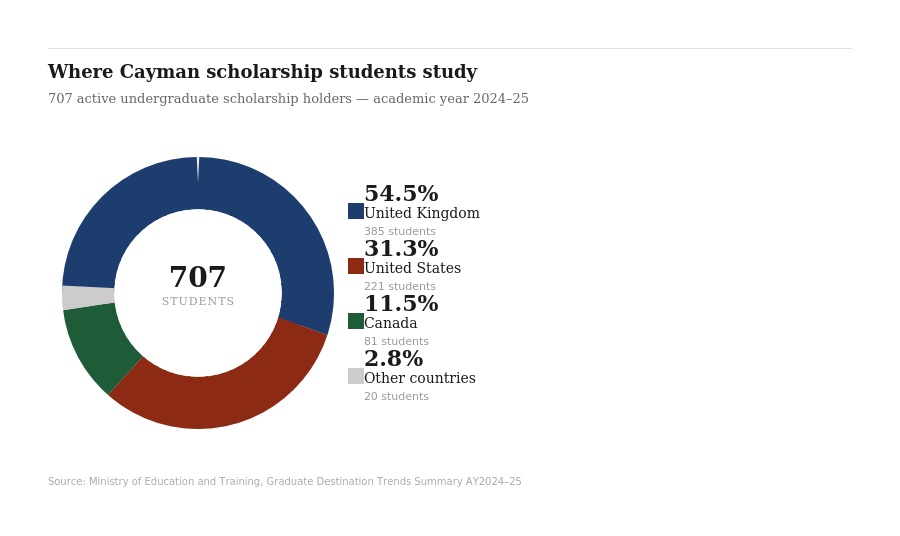
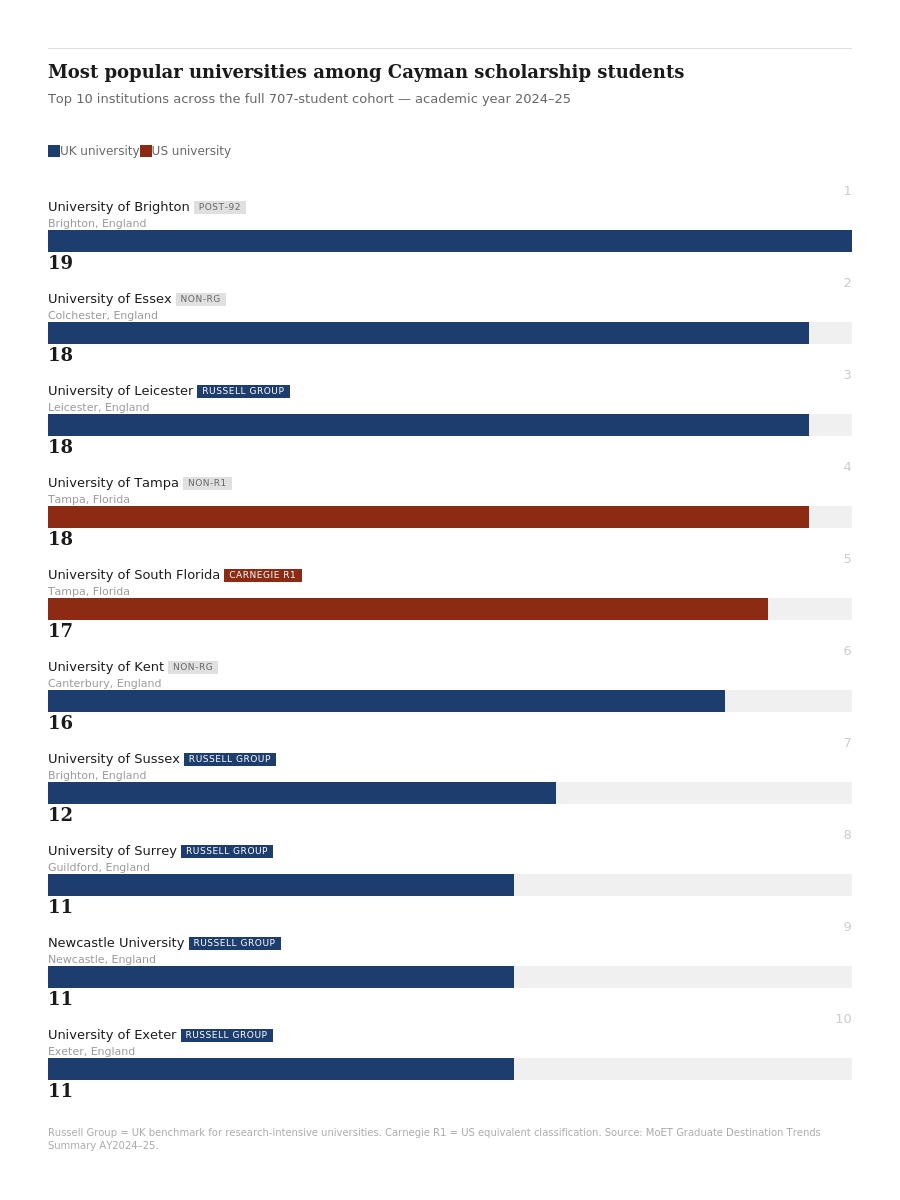
The UK is the dominant destination for Caymanian studying overseas, accounting for just over half of the total.
The US takes 221 students, or 31.3%, while Canada takes 81, or 11.5%.
Undergraduate scholarships are capped at $30,000 per year. Postgraduate awards run to $35,000.
Academic suspensions are triggered when a student falls below the minimum grade point average requirement of 2.75 (considered a B-minus in the US system) or a 2:1 in the UK system. There were 31 suspensions in 2025, up from 14 in 2024.
A system built on Survey Monkey
The Ministry of Education and Training does not have strong data about how many scholarship recipients return to Cayman after graduation, which fields they enter, or whether they find work in their chosen profession.
“What I’ve inherited in terms of data is a mess,” Anglin said. “We are using a product that is sold by Survey Monkey.”
Survey Monkey is an online survey platform.
Government has moved through reforms to the Business Staffing Plan regime and through tighter regulation of work permits to ensure qualified Caymanians get first opportunity in the job market.
But closer links between students in training and prospective employers are needed.
Anglin says he aims to develop a system that connects businesses with a database of information about scholars. Right now, he said, an employer could bring someone in on a work permit without any knowledge that a Caymanian was about to graduate in the same field.
‘Nobody’s job is to make sure you get a job’
Woody Foster, chairman of Literacy is for Everyone and former head of the Cayman Islands Education Council, said the link needs to be clearer.
He argues there has long been a disconnect between the scholarship programme and the job market.
“Nobody’s job is to make sure that you get a job,” he said. “There’s no cohesion in terms of let’s follow this child through and get them to a job.”
Foster suggests this process should start in high school, with more specific careers guidance, and that students should be followed all the way through the further-education process and helped with job placements and internships.
He said Cayman has, too often, shied away from complexity when it comes to workforce development. Giving away more than $30 million in scholarships sounds like a great policy to create an educated workforce, but more work is needed to get the best from those dollars.
Foster cautions that it is not simply about training people for Cayman’s key industries and he is supportive of students going away to learn for a variety of reasons.
“Spending the money on scholarships to send them away to give them an opportunity to learn and grow and think and meet people, I think is money well spent,” he said.
And, he argues, there is value in some of the subjects that may not seem like a good fit for Cayman’s economy.
“Look at Frank E Flowers. When he went off to study film, there was no market for it in Cayman, but how do you even quantify the value his career has had for Cayman?” he asks.
He also questions the necessity of requiring students to return to work in Cayman as part of the scholarship contract. Foster believes many would benefit from getting work experience in their fields in the US or UK, for example, and will likely return home later as professionals who can command higher salaries.
What are Cayman students studying?
There is some correlation between scholarship data and the economy. Of the 707 students currently on overseas scholarships, nearly one in three is studying business, management or finance.
However, very few are studying accounting, for example, either as a first degree or postgraduate study.
While Cayman produces a proportionately high number of accountants compared with similar-sized communities, recruiters have told the Compass there are, at most, 10 qualified local candidates for every 100 jobs that come up.
Anglin, who is himself a qualified accountant and also finance minister, said, “We have 754 persons registered with CIIPA (Cayman Islands Institute of Professional Accountants) right now on a work permit. That’s a staggering number.”
Despite Cayman’s growth as a financial centre, that dynamic has not shifted in four decades.
“There was a gap when I got my scholarship, and, 36 years later, there’s still a gap, and the gap is wider than it’s ever been.”
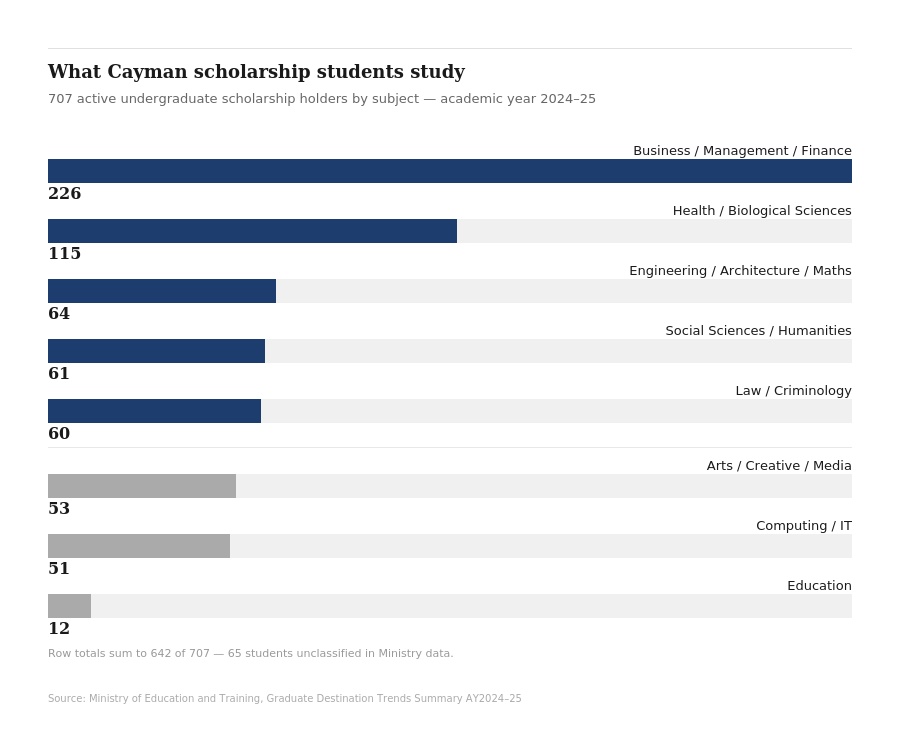
Law accounts for 60 of the 707 scholarship students, though many firms fund training through their own scholarship programmes linked to internships and career pathways.
Anglin says these types of scholarships, linked to specific companies, are often supplementary to what government offers, and represent a best-case scenario for students.
“The best position to be in is to be tied to an employer from the time you’re in university,” Anglin said.
“I was guaranteed a job. Pricewaterhouse paid my university. What do you think [PwC is] going to do at the end of it?”
He said he is in early discussions with the Big Four accounting firms and with CIIPA about a formal partnership to promote the accounting profession.
Where the money goes
The UK’s dominance as a scholarship destination is partly explained by a financial advantage the programme has never formally exploited.
Caymanian students attending British universities pay home-rate tuition fees, currently capped at £9,250 per year, just over CI$10,000. A full three-year degree at a Russell Group institution – the UK’s informal benchmark for top academic and research universities – costs roughly $30,000 in tuition. In the United States, private university fees can run to that figure and much more annually.

The scholarship award does not distinguish between them. A student receives up to $30,000 per year, regardless of where and what they study.
Where tuition fees are lower, the funds can go towards food, travel and accommodation. In practice, the average award for students in the UK runs to around $26,000, which is typically enough to cover everything.
That leaves Cayman graduates at an enormous financial advantage compared to their peers in the UK, who typically graduate with an average debt of £55,000, around CI$60,000.
However, there is no formal policy directing students towards the UK to capture the fee advantage, and the grant amounts are currently standardised regardless of tuition costs.
 Christina Bodden, a partner at Maples and co-founder of 100 Women in Finance, as well as a member of the Education Council, tries to direct students and parents towards UK universities, specifically because of the home-fees benefit.
“The equivalent education in the US would probably cost three or four times as much just for tuition fees,” she said.
Some students opt for the proximity of the United States, despite the added cost.
More than one in three American placements are concentrated in Florida. The University of Tampa and the University of South Florida dominate.
Price and quality differentials among schools are much harder to track in the US system, however.
“We are going to have to look at what US schools we are going to continue to fund because I can tell you, sitting here, I am not happy with some of the institutions that I see,” said Anglin.
“This is no fault of the students. If you don’t set any guardrails and you simply say apply for any degree you want to do and apply for any school once it’s regionally accredited, then that’s what people will do. So, we do need to up our game.”
The programme has no minimum institutional standard. A student may attend any regionally accredited university and, if they meet the academic threshold, receive a scholarship.
When Anglin was a scholar himself, he says institutions were required to be rated ‘highly competitive or above’ by the Barron’s or Peterson’s college guides to qualify for Cayman government support. He is considering reintroducing that type of barometer.
“Scholarships, by their nature, are supposed to be a scholarly endeavour,” Anglin said. “It’s hard for me to justify when I Google some schools and I see they’re less competitive.”
From game programming to jazz
From game programming to jazz, the subjects pursued by Caymanian students run the gamut of what universities have to offer.
Fifty-three students in the current cohort are studying arts, creative subjects or media. Among the courses funded, according to data released under a Freedom of Information request, are degrees in painting, theatre, film production, jazz and culinary arts at institutions, including the Royal College of Art and the Culinary Institute of America.
There is no suggestion that funding support should be limited for those types of studies. The foundational principle of the scholarship programme is that any Caymanian who earns the grades will get supported through university.
Nonetheless, Anglin would like to see more clearly outlined national workforce priorities funded more generously, while leaving the broader entitlement in place.
A Scholarship Advisory Committee has been established to define those priorities. Accounting, healthcare and law have been named explicitly.
‘Could do better’
Simon Cawdery, an economist and Compass columnist, said Cayman would benefit from a means-tested scholarship programme and a philosophy that puts the trades on an equal footing with academic qualifications.
“Why not treat the trades equivalent to universities and pay scholarships for plumbing courses, watchmaking courses, electrician courses and so on? There are real, well-paying jobs with business opportunities in those sectors.”
Government has increased the amount it spends on trade and vocational scholarships, but it remains a tiny fraction of the overall spend.
Cawdery also suggests a cost-benefit analysis that could determine the value of scholarship spending versus “more focused intervention in early-stage education, so we get more people up to a higher level of base education standards”.
Another senior business leader, who asked not to be named to allow them to speak freely, said there appeared to be a lot of waste in the scholarship system, with all families getting the same support regardless of need.
“The data raise very serious questions about fairness and value for money. In my opinion, the system needs a complete overhaul,” the person said.
“Means-testing would allow them to shift funding from families that don’t need help to families that do.”
They also suggested students on scholarships could be asked to seek sponsorship from businesses that could offer financial or other support and an indication that the degree programme was in demand.
The most generous system in the world
There is no remit to cut spending on what Anglin believes is one of Cayman’s most valuable programmes.
“We’ve had one of the most liberal and generous national scholarship programmes on the planet,” he said. “I went to university in 1991, and from then, it proceeded that any child who had the requisite grades got a scholarship.
“There was no cap. There’s never been a cap. There’s no country in the world that has that system.”
Despite that commitment, he acknowledges that other areas of the education system are competing for funding.
Currently, a comparatively small amount of money is spent on training young people in trades – $89,550, less than one-third of 1% of overseas scholarship spending, went to local vocational training grants in 2025.
Anglin says he wants to expand TVET funding as part of his reforms.
The redevelopment of the Cayman Islands Further Education Centre as a genuine technical and vocational training centre is also a priority for Anglin this term.
Maples partner Bodden agrees that the funding available in Cayman for university and postgraduate studies presents an enormous opportunity for students.
The firm has awarded more than US$8 million in scholarships since 1994, and many of its current senior staff, including Bodden, came through the firm’s scholarship and training programme.
Last year, Maples disbursed approximately US$600,000.
Those who study law are effectively hired from the moment they receive funding – returning every summer for internships and on a clear path to qualifying as lawyers at Maples on graduation.
“When you combine the public sector offering of scholarships with what is available in the private sector, you really just simply need to have the motivation to want to study,” Bodden said.
The firm typically hires its legal scholars directly into associate roles on qualification.
Links to the job market
Anglin argues that public scholarship money must work harder for the economy, and students must come home to real jobs and meaningful careers. He says spending has to become more targeted to ensure a Caymanian workforce for the future.
“We know AI, technology, healthcare are huge growth areas,” he said. “Accounting is not going to go from 754 work permits within CIIPA to zero. That’s just a hole that needs to be filled. So, therefore, that always has to be promoted.
“I think it’s important for the government to send a very clear signal about what’s key to economic development.”
Related Videos