


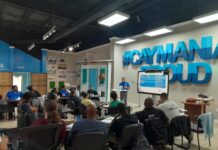
Minister for Caymanian Employment and Immigration Michael Myles implored a conference room of HR professionals to hire and elevate more Caymanians.
Speaking at the ‘Work Reimagined’ conference held on 29 May by the Cayman Islands Society for HR Professionals, Myles warned that he would take a hard stance against companies that don’t hire Caymanian interns. Noting that the government internship programme will hire up to 200 interns, Myles called on private-sector companies to start offering internship programmes.
“If you don’t do that, you’re failing us. If you don’t do that, then it becomes me against you and I will go to war.” Noting that Jersey has much stricter limits for immigration – nine months for some unskilled workers – Myles threatened that Cayman could do the same. “We’ll get to that, if that’s what it comes down to. Do we want to? No.”
But Myles was keen to emphasise that his approach was pro-business. “Our goal is to ensure that Cayman remains a place of competitive nature [but] we have to shift the conversation back to who’s in the queue, which Caymanians are in the queue?”
Speaking in the morning session of the conference, which was held at Hotel Indigo Grand Cayman, Myles pointed out that hiring more Caymanians would bring wider benefits for the business community. He noted that social spending, such as welfare payments and healthcare, for unemployed Caymanians costs approximately $200 million per year and that most of the revenue to pay for that spending is raised through fees on the business community.
Myles also pointed out that more than 1,500 Caymanians are currently receiving some form of scholarship or grant to study at a cost of approximately $40 million per year – an investment that the country only recoups if they return to work in Cayman.
Promote Caymanians
While Myles was keen to highlight the importance of internships in giving young Caymanians their first start in business, he also stressed that companies also have to do more with older Caymanian workers. “We need to ensure that Caymanians are not just getting in on the ground level, but you are also pushing the elevator, so they can move up.”
Myles said many Caymanians feel that their progression to the higher echelons of companies was often blocked. “It’s unfair because you have broken the glass ceiling. Why are you making a glass ceiling for our people?”
But in an approach that was described by fellow panellist, Chief Officer of Caymanian Employment and Immigration Wesley Howell, as “carrot and stick”, Myles said there would be plenty of help for firms willing to upskill Caymanians. He said that grants worth up to $15,000 are available for training Caymanians domestically, with up to $25,000 available to send Caymanians to international courses.
In another example of the “carrot and stick” approach, Howell said the government would be introducing an accreditation scheme that would highlight those companies that were “knocking it out of the park” when it comes to hiring and training Caymanians. At the other end of the scale, firms performing badly would be placed on a “risk register”.
Related Videos












The Control of Housing and Work (Jersey) Law 2012 ties work and housing rights to four residential statuses (Entitled, Entitled for Work, Licensed, Registered). Businesses get a licence capping how many “Licensed” (essential, <10-year) and "Registered" (<5-year) employees they may hold. There is no quota and no financial penalty for non-local hiring as such; control is via licence caps.
The "9-month" reference is to seasonal/short-term unskilled work, not the professional workforce.
As to Myles's assertion that more than 1,500 Caymanians receive scholarships and grants at a cost of approximately $40 million per year, what actual quality control is done on that? Are they studying useful subjects at credible institutions? If not, why do you expect that we can employ them? Further, Myles's assertion that these are "investments" isn't true: they are electoral bribes. And finally, Cayman isn't a country, it's a BOT, and by demanding that Caymanians return to Cayman, combined with the affirmative action regime, it cripples their long-term credibility and employability by tainting them as diversity hires. You should be ENCOURAGING young Caymanians to spread their wings, earn their place in international firms in international cities, and then come back when THEY want to, with thta experience.
Myles cannot blackmail businesses into hiring people. It hasn't worked. It doesn't work. It will never work.
What would be really helpful: WORC providing fully structured programs for internships and career days. Many employers do not have know how/experience with internship programs. Help employers by providing guidance. The $40million spent on scholarships, what programs are the individuals taking and what careers do they want? Does an internship at a construction site, janitorial company, restaurant help someone who wants to pursue a legal career? While all experience teaches us something, the individual must also see it and want it. How can we get business and WORC developing programs that address the need. I feel all the speeches are way too vague and general.
I’ve had more time to consider this. I remain of the view that “Myles” and “the truth” have a vast chasm between them.
The accreditation carrot is the one defensible idea here. The rest is the typically intellectually empty rhetoric one has sadly come to expect from Myles:
– As I noted above, the Jersey comparison is factually wrong. Jersey’s nine-month limit applies to seasonal and unskilled workers – hospitality, agriculture, construction. Financial-services professionals sit in Jersey’s “Licensed” and “Entitled for Work” categories, which carry no such cap. Importing that logic into Cayman’s professional finance workforce would be materially more severe than anything Jersey does. Myles’s comparison doesn’t hold.
– The unemployment data doesn’t support “war” rhetoric; or indeed any criticism. Caymanian unemployment is 4.1% per the ESO’s Fall 2025 Labour Force Survey – better than the US, better than the OECD average. Effectively full employment. The problem, to the extent it exists, is in senior representation – but this is almost exclusively the result of this being a tiny island, with poor educational performance, and few locals having international experience.
– The Auditor General’s verdict stands unrebutted. CIG spent CI$144 million on Caymanian employment programmes over 2019–2023. The OAG found no measurable impact on the unemployment rate. Doubling down on the same approach with added coercion isn’t a strategy. Myles is throwing good money after bad.
– Mandatory internships produce compliance theatre, not careers. German longitudinal data shows mandatory schemes have no significant effect on long-term employment. Singapore’s equivalent enforcement experience produced sham advertisements. Voluntary programmes with conversion pathways and retention metrics work; bombast and blackmail don’t.
– Forced placement harms Caymanians on merit. Coate and Loury’s famous analysis* of preference regimes shows that when clients know a quota exists, they can’t distinguish merit appointments from compliance appointments. Every Caymanian professional in the sector carries that discount. Myles is tainting all of his own people with the stench of affirmative action preferences.
Myles should (1) require Caymanians to attend STEM courses at demanding universities only; and (2) enable international secondments for such graduates, so they can get 3-5 years working experience in first world countries before returning to Cayman. That’s what expats have. That’s what clients demand. That’s what cripples Caymanian careers.
* Coate, S. and Loury, G.C. (1993) ‘Will Affirmative-Action Policies Eliminate Negative Stereotypes?’, Journal of Political Economy, 101(5), pp. 1220–1240.
Myles again is far off the mark. As others have noted. How many of these scholarship individuals are studying relevant subjects that are in, in demand career fields in the Cayman Islands. He is certainly not pro business and non of the current government is. They have crippled Caymanians and expats alike. His anti business rhetoric pushes out businesses and makes the hurdle so high to start business in Cayman. I’m not sure if he knows how the private sector thrives but it’s by hiring the best employees, not DEI hiring and handouts. The employment environment in Cayman needs to be know for the best and brightest minds to command top dollar but Myles wants to make it into jobs for everyone, whether they are skilled or not. There’s tons of construction, tourism, restaurant jobs and such. Not everyone can make 100k a year. Why would private company hand that to someone who has no experience and can’t show up on time. To get experience you need a high caliper education from a decent school. Bright minds are in Cayman. To compete with bright minds, you need to have the education, work ethic ,credentials and qualifications to back it up. Does Myles seriously want businesses to spend their money to train Billy Bob and Joe Schmo off the street with a high school diploma? A high school diploma is nothing in today’s competitive work environment. We haven’t even seen AI take full effect and grab jobs. Government fees are so high to do business in Cayman that businesses are offshoring jobs to the U.S., Europe and India. Thanks to Myles and his buddies in the government.