
The government’s two-tier vehicle and driver’s licensing fee regime will take effect on 1 Sept., with expatriate residents paying up to eight times more than Caymanians for driving licences.
Cabinet approved the implementing regulations on 1 July and they were published in this week’s gazette.
The Traffic (Amendment) Regulations introduce separate Department of Vehicle and Drivers’ Licensing fees for Caymanians and non-Caymanians, with expats facing substantially higher charges for driver’s licences, learner’s permits, driving tests and some vehicle licensing transactions.
Under the new regulations, the cost of a three-year driver’s licence for a non-Caymanian will increase from $75 to $600, an eight-fold difference, while the cost of taking a driving test will be $200 for expats and $50 for Caymanians. Five-year licences will cost non-Caymanians $1,000, while the Caymanian fee will be $125, and a 10-year licence will jump to $2,000, compared with $250 for Caymanians.
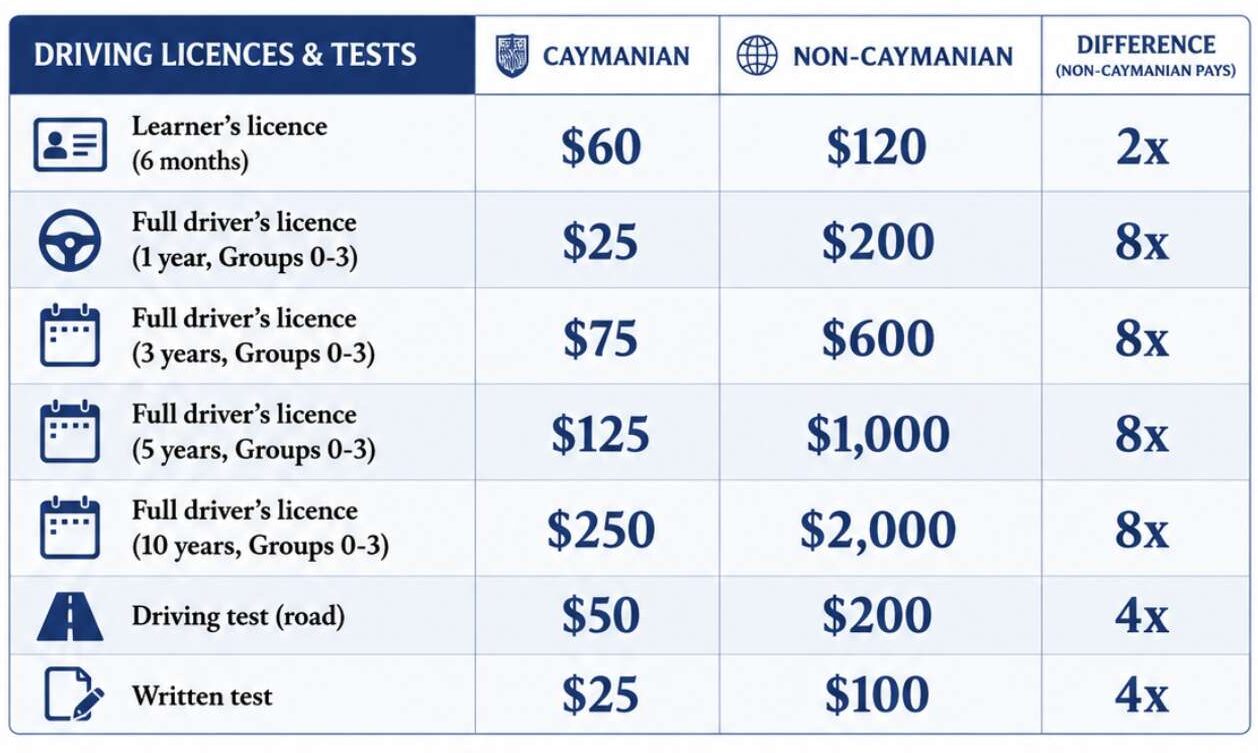
The regulations also provide that non-Caymanian spouses and civil partners of Caymanians will qualify for the Caymanian fee structure.
The publication ends months of uncertainty after Premier André Ebanks revealed earlier this year that government had paused implementation because of technical difficulties identifying who qualified for the lower Caymanian rates.
Speaking to the Compass in February, Ebanks said the main challenge was that there was no straightforward mechanism for all Caymanians to verify their status, making it difficult for the DVDL to identify those eligible for the preferential rates.
At the time, Ebanks said the new ‘My eID‘ national identity card could provide the solution. Rolled out in Grand Cayman in February and the Sister Islands in May, the card gives Caymanians a secure way to verify their identity and status, addressing the longstanding challenge of proving Caymanian status.
The delay raised questions over one of the National Coalition for Caymanians government’s key revenue measures. The 2026-27 budget relies on about $209 million in new and increased fees over two years, with the DVDL changes expected to contribute to that total.
The regulations published this week indicate those implementation issues have been resolved, although government has not publicly explained how Caymanian status will be verified when the new fees take effect.
According to the Ministry of Social Development, 1,229 My eID cards had been issued as of June. As the programme was open only to Caymanians up to 1 July, that equates to about 3% of the eligible population based on the latest available figures, indicating a substantial increase in uptake would be needed if My eID is to become the primary means of verifying eligibility for the lower fees.
Increased fees to bring in $9.6M in government revenue
The measures were introduced as part of the 2026-2027 budget, with Finance Minister Rolston Anglin arguing the fee increases would minimise the burden on Caymanians while generating an additional $9.6 million in revenue in both 2026 and 2027.
A Compass report published in November 2025 found Cayman’s proposed non-Caymanian driver’s licence fees would likely be the highest in the world.
The analysis compared licence renewal costs across jurisdictions including the UK, Canada, Bermuda, the British Virgin Islands, Jamaica and the United States, finding none imposed separate fee structures for citizens and non-citizens.
The analysis also highlighted the potential impact on overseas workers, many of whom already live close to the poverty line. Even at the new minimum wage of $8.75 an hour, a three-year driver’s licence for a non-Caymanian will cost the equivalent of nearly two weeks’ gross pay for the island’s lowest-paid workers.
During Finance Committee proceedings last year, Attorney General Samuel Bulgin said there was a “presumption of legality” surrounding the two-tier fee structure unless a court ruled otherwise, adding that government had broad authority to provide preferential treatment for Caymanians without breaching constitutional anti-discrimination provisions.
International law does not generally prohibit governments from charging different fees to citizens and non-citizens. Under the International Covenant on Civil and Political Rights, the UN Human Rights Committee has said such distinctions are not discriminatory if they are based on “reasonable and objective” criteria and pursue a legitimate purpose.
Related Videos